Volkswagen VIN Number Check

Enter any Volkswagen VIN to decode it and see open NHTSA recalls for free. Then check the TDI emissions fix, Takata air bag and do-not-drive campaigns below for your model year.

1VW 1V2 3VW 3VV WVW WVG

Free decode with open NHTSA recalls. 17 characters, no I, O or Q.

About Volkswagen VINs

How Volkswagen VINs are built

Volkswagen vehicles assembled in Chattanooga, Tennessee carry a 1VW or 1V2 prefix. Models imported from Germany or Mexico begin with WVW or 3VW. The Jetta is the most commonly traded used Volkswagen in the US. A free VIN decode on any Volkswagen shows its factory specs, assembly plant and engine, plus any open NHTSA recalls.

The first three characters show where a Volkswagen was built. 1VW (cars such as the Passat) and 1V2 (the Atlas, Atlas Cross Sport and U.S.-built ID.4) mean Chattanooga, Tennessee. 3VW cars (Jetta, Golf, Beetle) and 3VV SUVs (the second-generation Tiguan and the Taos) come from Puebla, Mexico. Cars imported from Volkswagen AG start with WVW (Golf R, CC, Arteon and older GTIs) and SUVs with WVG: a first-generation Tiguan from Wolfsburg, a Touareg from Bratislava in Slovakia, a 2021 ID.4 from Zwickau. The prefix doesn't name the model, so let the full 17-character decode confirm model, engine, year and plant.

Volkswagen vehicles manufactured for the US market carry VIN prefixes of 1VW, 1V2, 3VW, 3VV, WVW, WVG. The VIN number encodes the country of manufacture (Germany), production plant, vehicle line, body style, engine type, model year, and a unique production sequence number.

HQWolfsburg, Germany
Founded1937
Group CEOOliver Blume (since 2022)
US assemblyChattanooga, TN
US sales 2024379,178
US sales 2025329,813

Sources: HQ: Volkswagen Group · Founded: Volkswagen chronicle · CEO: Volkswagen Group press release · US plant and sales: Volkswagen of America, Jan 2026

NHTSA campaign data

Which model years each recall covers

Drag the year line to your car’s model year. Bars it crosses are the campaigns to confirm on the VIN.

2014
Do Not Drive Park outside (fire risk) Safety recall Emissions fix / warranty
18 campaigns cross 2014
20082012201620202024
SAFETY RECALL · 16V-078 · 18V-148
Takata driver air bag inflator can rupture in a crash (excessive internal pressure)
2007–2014 Passat, 2009–2014 CC, 2010–2014 Golf. Passat years are 2007–2010 and 2012–2014 (sedan, plus the 2007–2010 wagon). Also 2010–2014 Eos; NHTSA's vehicle list for 16V-078 also includes the 2010–2014 Jetta SportWagen. 18V-148 fits an alternative inflator and partially supersedes 16V-078. Filed under NHTSA's Takata inflator investigation (EA15-001).
What to askConfirm no air bag campaign is open on the VIN. A repair under 16V-078 alone may not be the final fix.

Coverage depends on build dates and equipment (engine, transmission, drivetrain). A listed year doesn't mean every car from that year is included; the VIN lookup decides. "Takata" marks campaigns NHTSA files under its Takata inflator investigation (EA15-001) or whose recall text names Takata. "Do not drive" and "Park outside" mean NHTSA's recall record carries that advisory.

Volkswagen Recalls: How to Check a Specific VIN

  1. Enter the full 17-character VIN in the NHTSA recall lookup. It shows open safety recalls, including the do-not-drive and park-outside campaigns above.
  2. Then use Volkswagen's own recall lookup, which also covers service actions and campaigns that are not safety recalls.
  3. On a 2009–2016 TDI, enter the VIN in Volkswagen's emissions modification lookup. Emissions fixes are EPA and CARB settlement campaigns, not NHTSA safety recalls, so NHTSA's lookup won't show them.
  4. If a do-not-drive recall is open, don't drive the car until it is repaired; if a park-outside recall is open, don't park it indoors. Recall repairs are free at Volkswagen dealers.
Full list: every safety recall in this timeline
Selected Volkswagen recalls worth confirming on a used-car VIN (NHTSA campaign data)
CampaignIssueModels & years
16V-078 · 18V-148Takata driver air bag inflator can rupture in a crash (excessive internal pressure)2007–2014 Passat, 2009–2014 CC, 2010–2014 Golf. Passat years are 2007–2010 and 2012–2014 (sedan, plus the 2007–2010 wagon). Also 2010–2014 Eos; NHTSA's vehicle list for 16V-078 also includes the 2010–2014 Jetta SportWagen. 18V-148 fits an alternative inflator and partially supersedes 16V-078. Filed under NHTSA's Takata inflator investigation (EA15-001).
19V-862Driver inflator fitted under an earlier Takata recall may explode (propellant degradation)2012–2015 Passat, 2011–2014 Golf. Diesel (TDI) cars only, thought to have been repaired before under one of the Takata air bag recalls. Long-term heat and humidity can degrade the propellant. Also the 2011–2013 Audi A3 diesel.
16V-079 · 18V-247Takata driver air bag inflator can explode in a crash (2006–2007 Passat)2006–2007 Passat. Sedan and wagon. 16V-079 covered the 2006 Passat; 18V-247 (2006–2007) fits an alternative inflator and partially supersedes it. Filed under NHTSA's Takata inflator investigation (EA15-001). These Passats are also listed in 24V-834.
19V-014Takata driver air bag inflator can explode in a crash2015 Passat, 2015–2017 CC. Also 2015–2016 Eos. Filed under NHTSA's Takata inflator investigation (EA15-001).
20V-785 · 22V-945Takata driver air bag inflator may explode (propellant degradation)2012–2016 Beetle. 20V-785 covers 2012–2014 Beetle and Beetle Convertible, 22V-945 covers 2015–2016. Long-term heat and humidity can degrade the propellant. Both are filed under NHTSA's Takata inflator investigation (EA15-001).
24V-834Driver air bag inflator may explode (propellant degradation)2017–2019 Beetle, 2012–2014 Passat. Also 2017–2019 Beetle Convertible, 2017 Passat Wagon and 2006–2007 Passat sedan. Dealers replace the driver front air bag module. Owner letters were mailed December 4, 2024.
15V-483Debris can tear the air bag clock spring; driver front air bag may not deploy2011–2014 Jetta, 2011–2014 Golf, 2011–2014 GTI, 2011–2014 Tiguan, 2010–2014 Passat, 2010–2014 CC. Also 2010–2013 Eos and 2012–2014 Jetta SportWagen. The clock spring is the flat cable that keeps the air bag connected while the steering wheel turns.
09V-333DSG temperature-sensor wiring can make the transmission shift abruptly to neutral2009–2010 Jetta, 2009–2010 GTI. Cars built September 2008–August 2009 with the DSG gearbox; also the 2009 Eos. Poorly crimped connector wires can make the sensor falsely detect high gearbox oil temperature. The fix reprograms the transmission control module.
19V-866Jetta Hybrid: cracks in the DSG mechatronic unit can cause a sudden loss of drive power2013–2015 Jetta. Only the Jetta Hybrid with the DQ200 7-speed DSG. Hairline cracks in the mechatronic unit cause an internal oil leak and low oil pressure, so the clutch may not engage.
16V-913ABS control unit may fail during ABS or stability-control activation2009–2010 Jetta, 2009 GTI, 2010 Golf. Also 2009 Jetta SportWagen, Eos and Rabbit.
19V-615Key can be removed when the shifter is not in Park; rollaway risk2011–2018 Jetta, 2012–2019 Beetle, 2015–2019 Golf, 2015–2019 GTI. Only cars with an automatic transmission, manual handbrake and keyless entry. Golf years are 2015–2016 and 2018–2019; also 2017–2019 Golf SportWagen and 2012–2019 Beetle Convertible. Silicate build-up on the shift-lever micro switch is the cause; dealers add a switch and circuit board.
18V-904 · 19V-188Rear coil springs may fracture and damage a rear tire2015–2019 Golf, 2019 Jetta, 2018–2019 Tiguan, 2018–2019 Atlas. 18V-904: 2018–2019 Atlas, 2015 Golf SportWagen and 2019 Jetta. 19V-188: 2015–2019 Golf, 2017–2019 Golf SportWagen, 2018–2019 Tiguan and 2019 Jetta.
18V-369Do Not Drive Brake caliper pistons may lack coating; reduced braking2018 Atlas, 2018 Passat, 2018 Golf, 2018 GTI, 2018 Beetle. Also 2018 Golf SportWagen and Beetle Convertible. NHTSA's record carries a do-not-drive advisory.
18V-324Do Not Drive Front lower ball-joint nut may be loose; steering can be affected2018 Tiguan. Tiguan and Tiguan LWB. NHTSA's record advises owners not to drive the car until it is repaired.
19V-879Do Not Drive Front wheel bearings may be improperly machined2019 Jetta, 2019 GTI. Jetta GLI and Golf GTI, plus the 2019 Golf Alltrack. NHTSA's record carries a do-not-drive advisory.
20V-712Do Not Drive Steering knuckle may have been damaged in production; loss of steering2021 Atlas, 2020–2021 Atlas Cross Sport. NHTSA's record advises owners not to drive the car until it is inspected. A second knuckle recall, 21V-026, covers the same vehicles.
21V-026Front steering knuckle may fracture at the strut mounting2021 Atlas, 2020–2021 Atlas Cross Sport. Same vehicles as 20V-712; dealers inspect and replace one or both knuckles as needed.
25V-835Do Not Drive Incorrect wheel bolts may have been installed; a wheel can detach2026 Atlas, 2026 Atlas Cross Sport, 2026 ID.4. NHTSA's record carries a do-not-drive advisory.
17V-766 · 18V-284 · 19V-614Fuel tank may leak fuel2018–2019 Atlas. 17V-766 and 18V-284: 2018 Atlas fuel tanks (thin walls or a manufacturing error). 19V-614: 2019 Atlas, fuel-tank suction jet welded in the wrong position; fuel can leak and the engine may stall.
22V-753 · 23V-593Engine connecting-rod bearings may be damaged; engine failure2022–2024 Atlas, 2022–2024 Atlas Cross Sport. 22V-753 covers 2022–2023, 23V-593 covers 2024. Dealers inspect the engine and replace it if necessary.
22V-152Door wiring-harness contacts can corrode and delay the front side air bag2019–2023 Atlas, 2020–2023 Atlas Cross Sport. Dealers secure or replace front door harnesses that show a fault code.
23V-215 · 24V-464Passenger occupant detection fault can switch off the front passenger air bag2018–2024 Atlas, 2020–2024 Atlas Cross Sport. 23V-215: 2018–2021 Atlas and 2020 Atlas Cross Sport. 24V-464: 2021–2024 Atlas and 2020–2024 Atlas Cross Sport; dealers replace the sensor mat and wiring harness.
25V-081Transmission may have been manufactured incorrectly; loss of drive power2025 Atlas, 2025 Atlas Cross Sport.
26V-590Steering-rack mounting bolt may corrode and break2018 Tiguan, 2018–2019 Atlas. Filed September 2026; owner letters are expected to be mailed November 10, 2026. Dealers replace the right-side bolt.
20V-724Front seat-belt webbing may tear in a crash2018 Tiguan. Tiguan LWB.
25V-854Passenger occupant detection fault can switch off the front passenger air bag2025 Tiguan. Until repaired, NHTSA's record says no one should sit in the front passenger seat. Dealers repair the seat wiring harness.
25V-526Rear-axle tie-rod bolt may be loose; loss of control2025 Tiguan.
14V-441Winter fuel can form bubbles in the fuel system and stall the engine2009–2014 Tiguan. First-generation Tiguan built July 2007 to June 2014.
18V-102Tiguan Limited: driver air bag may not be the US-market part2017–2018 Tiguan. Tiguan Limited, the first-generation Tiguan sold alongside the new model. The vehicles fail FMVSS 208 (occupant crash protection).
16V-170Brake pedal pivot pin may lack its securing clip; pedal can dislodge2011–2016 Touareg.
17V-151Fuel filter flange may crack and leak fuel2007–2010 Touareg.
22V-956Park outside 12-volt charging cable can chafe on the steering column and short; fire risk2023 ID.4. Rear-wheel-drive cars. NHTSA's record tells owners to park outside and away from structures until repaired.
25V-836 · 26V-028Park outside High-voltage battery cell modules may have misaligned electrodes; fire risk2023–2024 ID.4. Until repaired, owners are told to park outside right after charging, not to charge indoors overnight, to avoid DC fast (Level 3) charging and to limit charging to 80%. Dealers replace battery cell modules as necessary.
26V-030High-voltage battery may overheat; fire risk2023–2025 ID.4. Dealers update the battery software and replace the battery as necessary. Owner letters were mailed March 18, 2026.
22V-162Incorrect soldering inside the high-voltage battery may cause an unreliable connection2021 ID.4. Dealers replace the battery cell modules.
23V-312 · 24V-651Door handles can let water reach the circuit board; doors may open unexpectedly2021–2024 ID.4. 23V-312 covered 2021–2022; 24V-651 expands it to 2021–2024 and adds a software update.
22V-830Electric-motor seal may let coolant into the high-voltage system2023 ID.4. Dealers inspect and replace the electric motor if necessary.
25V-125On-board charger may stop charging the 12-volt battery; loss of drive power2024 ID.4. Also 2024–2025 Audi Q4 e-tron.
20V-135 · 21V-695Electronic brake booster input rod may be installed incorrectly or come loose2019–2021 Arteon. 20V-135 covers the 2019 Arteon, 21V-695 the 2021 Arteon.

Diesel emissions · TDI

TDI diesels: buyback, emissions modification and what to check

In September 2015 the EPA issued a notice of violation to Volkswagen. About 590,000 model year 2009–2016 diesel cars and SUVs sold in the US had defeat-device software and emitted NOx at up to 40 times the standard. The settlements gave owners a buyback or an approved emissions modification, so every used TDI from those years has one of a few histories.

For the 2.0L TDI, the consent decree (effective October 25, 2016) offered owners a buyback, an early lease termination or a free emissions modification once EPA and CARB approved one for their car. Volkswagen could resell bought-back cars only after the approved modification, with labels and disclosure to the buyer.

Modified cars are labeled. The consent decree requires a label permanently affixed to every modified vehicle. VW's disclosure for the 2015 cars describes two labels under the hood: an emissions modification completion label and an updated Vehicle Emissions Compliance Information (VECI) label. The 2015 fix also came with an Extended Emissions Warranty: 11 years or 162,000 miles from the in-service date, or 5 years or 60,000 miles from the modification, whichever is greater.

The 3.0L V6 TDI (2009–2016 Touareg, plus Audi and Porsche models) had its own settlement in December 2016. These fixes are EPA and CARB campaigns, not NHTSA safety recalls, so check them in Volkswagen's emissions modification lookup rather than the NHTSA recall lookup.

  1. Sep 18, 2015
    EPA notice of violation

    The EPA and CARB told Volkswagen that its 2.0L TDI cars had a defeat device that cut emission controls in normal driving.

  2. Jun 28, 2016
    2.0L settlement announced

    Buyback, lease termination or emissions modification for 2009–2015 2.0L TDI cars. The consent decree took effect October 25, 2016.

  3. Dec 20, 2016
    3.0L settlement

    A separate settlement for 3.0L TDI vehicles, including the 2009–2016 Touareg.

  4. Jan 6, 2017
    First approved fix

    EPA and CARB approved the emissions modification for model year 2015 2.0L cars.

  5. Jan 11, 2017
    Guilty plea

    Volkswagen agreed to plead guilty, with a $2.8 billion criminal penalty and $1.5 billion in civil penalties.

  6. May–Jul 2017
    Older 2.0L cars approved

    May 19: 2012–2014 Passat with automatic transmission. July 27: 2009–2014 Jetta, Golf and Beetle (and the Audi A3).

  7. Oct 2017 – Jul 2018
    3.0L SUVs and second-phase fixes

    October 20, 2017: first fix for 3.0L SUVs. April 18, 2018: second phase for 2015 2.0L cars. May 18 and July 13, 2018: further 3.0L SUV fixes.

US diesel models with defeat devices, as listed by the EPA
EngineModelModel years
2.0L TDIJetta2009–2015
2.0L TDIJetta SportWagen2009–2014
2.0L TDIGolf2010–2015
2.0L TDIGolf SportWagen2015
2.0L TDIBeetle and Beetle Convertible2013–2015
2.0L TDIPassat2012–2015
2.0L TDIAudi A32010–2015
3.0L TDITouareg2009–2016
3.0L TDIAudi Q72009–2016
3.0L TDIPorsche Cayenne2013–2016
3.0L TDIAudi A6 Quattro, A7 Quattro, A8, A8L, Q52014–2016

Sources: EPA: Volkswagen violations · Consent decree, Appendix A · Appendix B (labels) · VW 2015 2.0L TDI disclosure

Engine and gearbox history

Timing chains, DSG gearboxes and Atlas engine bearings

Beyond the diesels, three mechanical stories come up again and again on used Volkswagens: the timing-chain tensioner warranty extension on 2008–2014 models, DSG gearbox recalls, and the 2022–2024 Atlas connecting-rod bearing recalls.

After a class settlement, Volkswagen extended its warranty on a failed timing chain or timing-chain tensioner to 10 years or 100,000 miles from the original in-service date. Engine damage caused by the failure was covered on a sliding scale, from 100% (5 years or less and under 60,000 miles) down to 25% (7–10 years and 85,001–100,000 miles), and owners had to show reasonable adherence to the oil-change schedule.

On almost every covered car, 10 years from the in-service date has now passed, so the extension no longer helps a buyer. What matters is the paper trail: a timing-chain or tensioner replacement record and regular oil changes.

Vehicles in the timing-chain warranty extension (VW bulletin VWP-18-07, Oct 2018)
ModelModel yearsEngine codes
Beetle and Beetle Convertible2012–2014CPLA
Jetta sedan2008–2010CBFA
Jetta sedan2012–2014CPLA
Jetta SportWagen2009CBFA
GTI2008–2012CBFA, CCTA
CC2009–2012CBFA
Eos2009–2012CCTA
Passat sedan and wagon2008–2010CCTA
Tiguan2009–2013CCTA

09V-333 · DSG shift to neutral

09V-333: 2009–2010 Jetta and GTI and 2009 Eos with DSG, built September 2008–August 2009. A badly crimped temperature-sensor connector can make the gearbox shift abruptly to neutral.

19V-866 · Jetta Hybrid DSG

19V-866: 2013–2015 Jetta Hybrid with the DQ200 7-speed DSG. Cracks in the mechatronic unit can cause an oil leak and a sudden loss of drive power.

22V-753 / 23V-593 · Atlas bearings

22V-753 (2022–2023) and 23V-593 (2024) Atlas and Atlas Cross Sport: connecting-rod bearings may be damaged. Dealers inspect the engine and replace it if necessary.

Sources: VW warranty bulletin VWP-18-07 (on NHTSA) · VW dealer FAQ (on NHTSA) · NHTSA recall records

Volkswagen models

Volkswagen Models

Open a model for its VIN check, generations, recalls and owner complaints.

About Volkswagen

🎙️ Listen to this article

The People's Car Had Dark Origins

Volkswagen, the German automotive giant known for iconic vehicles like the Beetle and the Golf, has a history that begins with rather peculiar origins. The company was initially commissioned by Adolf Hitler in 1937, aiming to produce a "people's car" that would be affordable for the average German family. The design was put in the hands of Ferdinand Porsche, leading to the creation of the Volkswagen Beetle. Despite its beginnings under a regime responsible for immense atrocities, the Beetle would go on to become one of the most beloved cars in history.

The Beetle Becomes a Cultural Symbol

After World War II, the Beetle transitioned from a vision for mass mobility in Germany to an international success story. By the late 1950s and into the 1960s, the Beetle had made its mark in the United States, capturing the imagination of a growing counter-culture. It was simple, reliable, and had an unmistakable silhouette, which led to its adoption as a symbol by those who were disenchanted with more traditional American cars.

The "Think Small" advertising campaign launched by Doyle Dane Bernbach in 1959 played a pivotal role in transforming the Beetle into an icon. With clever, self-deprecating humor, the campaign challenged the status quo of automotive advertising and captivated the American public. The Beetle became the car that was endearing enough to be both practical and a bit rebellious at the same time.

As the years went on, Volkswagen introduced various iterations of the Beetle, but it was the original model that left an indelible mark on American culture. Despite newer models, vintage Beetles remain a nostalgic reminder of a more laid-back era, cherished by car enthusiasts and collectors alike.

While the Beetle continued to thrive, Volkswagen was looking to build on its success with a new model that could take the reigns. Enter the Volkswagen Golf, known as the Rabbit when it debuted in the United States in 1975. The Golf took the reliability and economy of the Beetle and packaged it in a modern design, quickly becoming a global success.

The Golf's sporty sibling, the GTI, emerged in 1976 as the progenitor of the "hot hatch" segment, offering thrilling performance in a practical hatchback form. The GTI became a legend in its own right, attracting drivers who wanted a car that was both everyday-functional and exciting to drive.

Meanwhile, the Volkswagen Jetta, though perceived as somewhat mundane in Europe, became hugely popular in the American market. With its sedan form, the Jetta appealed to buyers looking for a reliable commuter car, eventually becoming one of Volkswagen's best-selling models in the United States.

Dieselgate: A Self-Inflicted Crisis

The Dieselgate scandal of 2015 marked a significant turning point for Volkswagen. The carmaker was found to have installed software in diesel vehicles to cheat emissions tests, leading to a major backlash and loss of consumer trust. The scandal affected millions of cars worldwide and forced Volkswagen to confront the consequences of its actions head-on.

The financial fallout from Dieselgate was massive, with Volkswagen paying tens of billions in fines, legal settlements, and buybacks. The damage to its reputation was equally significant, prompting the company to undergo a comprehensive reassessment of its strategies and priorities.

In an effort to rebuild trust and pivot away from diesel technology, Volkswagen embarked on an ambitious electric vehicle initiative. The introduction of the ID.4, an all-electric SUV, represented the company's commitment to producing environmentally friendly vehicles. The ID.4 is part of a broader "ID." family of electric models, marking Volkswagen's aggressive push into the electric vehicle market.

Rebuilding Trust with Electric Vehicles

Volkswagen's pivot to electric vehicles is not just a strategic move, but a necessity in the face of evolving consumer demands and regulatory pressures to reduce carbon emissions. The ID. family includes a range of electric cars designed to appeal to various segments of the market, from compact city cars to larger family vehicles.

With its sights set on becoming a leader in electric mobility, Volkswagen has invested heavily in production facilities, technology development, and infrastructure support for electric vehicles. The company's goal is to electrify its entire lineup and make a significant impact on global carbon reduction efforts.

As Volkswagen navigates this new chapter in its history, it remains one of the largest automakers in the world by volume. The company's ability to adapt and innovate has been crucial to its resilience, allowing it to overcome past missteps and forge a path toward a more sustainable future.

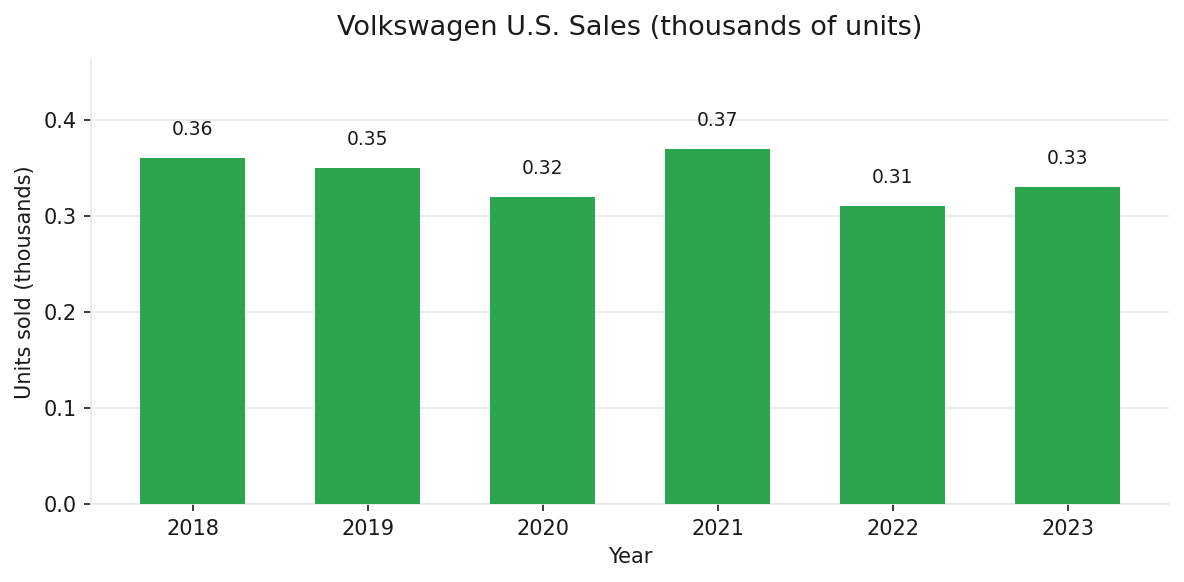
Volkswagen U.S. annual vehicle sales 2018-2023
Volkswagen U.S. annual sales
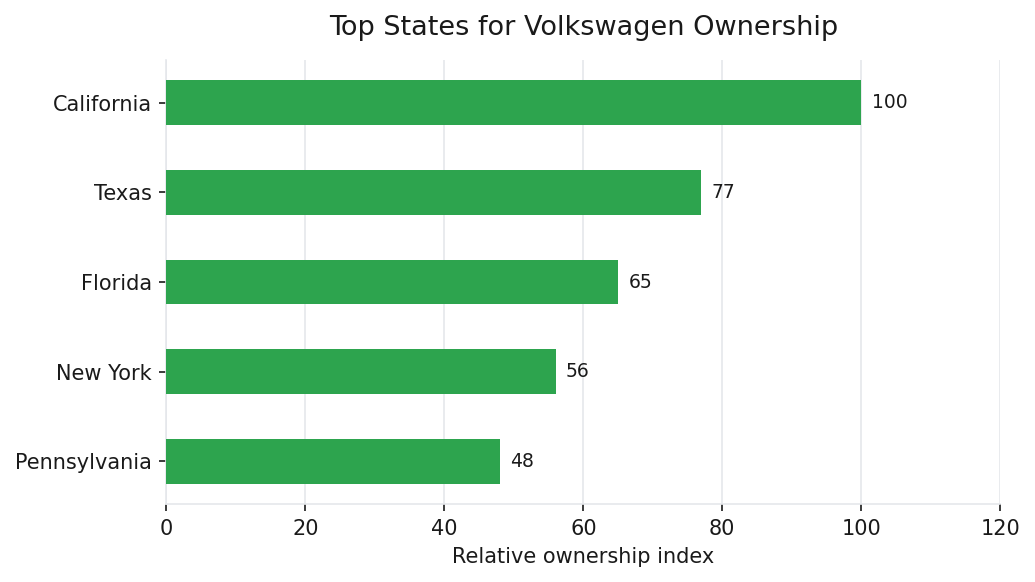
Top U.S. states for Volkswagen vehicle ownership
Top states for Volkswagen ownership

Used-car checklist

What to Verify on a Used Volkswagen

Six checks specific to used Volkswagens.

TDI: modified or bought back

On a 2009–2015 2.0L TDI or a 2009–2016 Touareg TDI, look under the hood for the emissions modification labels, run the VIN in VW's emissions modification lookup and ask for the dealer record. See the TDI section.

Takata air bag inflators

Many 2006–2019 Passat, Beetle, Golf, CC and Eos are in driver-inflator recalls (16V-078, 18V-148, 19V-014, 20V-785, 22V-945, 24V-834). On a 2012–2015 Passat TDI or 2011–2014 Golf TDI, 19V-862 replaces an inflator fitted under an earlier Takata recall. All must show as closed.

Do-not-drive recalls

18V-324 (2018 Tiguan), 18V-369 (2018 Atlas, Passat, Golf, GTI, Beetle), 19V-879 (2019 GLI and GTI), 20V-712 (2021 Atlas, 2020–2021 Atlas Cross Sport) and 25V-835 (2026 Atlas, Atlas Cross Sport and ID.4) carry a do-not-drive advisory. Confirm them before a test drive.

Atlas engine and air bag sensors

2022–2024 Atlas and Atlas Cross Sport: connecting-rod bearing recalls 22V-753 and 23V-593 (engine inspection or replacement). 2018–2024: passenger occupant detection recalls 23V-215 and 24V-464. Ask for the dealer records.

ID.4 battery and doors

2023–2024 ID.4: battery cell recalls 25V-836 and 26V-028 with a park-outside advisory. 2023–2025: 26V-030 (battery overheating). 2021–2024: door-handle recall 24V-651. Ask for proof of any battery work.

Timing chain and DSG records

On a 2008–2014 car in the timing-chain extension (Jetta, GTI, CC, Eos, Passat, Tiguan, Beetle), ask for timing-chain or tensioner records and the oil-change history; the extension itself has run out on nearly all of them. On a 2009–2010 Jetta or GTI with DSG, confirm 09V-333.

World Manufacturer Identifier

Volkswagen VIN prefixes (WMI)

Prefix registrations and example decodes come from NHTSA's vPIC database. The prefix tells you the maker and plant region; check that the decoded model and year match the car.

1VW
Volkswagen Group of America · Passenger car

Chattanooga-built cars. A 2013 Passat TDI and a 2016 Passat decode to Chattanooga, Tennessee.

1V2
Volkswagen Group of America · MPV

Chattanooga-built SUVs: a 2019 Atlas, a 2020 Atlas Cross Sport and a 2023 ID.4 decode here.

3VW
Volkswagen de México · Passenger car

Puebla-built cars. 2010, 2014 and 2019 Jetta, 2016 Golf and 2016 Beetle decode to Puebla.

3VV
Volkswagen de México · MPV

Puebla-built SUVs. A 2019 Tiguan and a 2022 Taos decode to Puebla.

WVW
Volkswagen AG · Passenger car

Imported cars: a 2019 Golf R and a 2010 GTI decode to Wolfsburg, a 2019 Arteon and a 2012 CC to Emden.

WVG
Volkswagen AG · MPV

Imported SUVs: a 2016 Tiguan decodes to Wolfsburg, a 2015 Touareg to Bratislava (Slovakia) and a 2021 ID.4 to Zwickau.

2V4
Routan minivan · built by Chrysler (FCA Canada)

The Volkswagen Routan was built in Windsor, Ontario. A 2010 Routan decodes there.

Worked example

Worked example: reading a Volkswagen VIN

Example VIN (demo only, not a real vehicle): 3VWLL7AJ1EM000000

3VWLL7AJ1EM000000
3VW
1–3 · WMI
Volkswagen de México passenger car.
LL7AJ
4–8 · Vehicle descriptor (VDS)
Volkswagen's codes for model, body, engine and restraints. This pattern decodes as a Jetta SEL TDI sedan with the 2.0L (1.968L) four-cylinder diesel.
1
9 · Check digit
Calculated from the other 16 characters using the federal formula. If one character is mistyped or altered, the check digit usually stops matching.
E
10 · Model year
E = 2014 (federal year-code table)
M
11 · Assembly plant
Decodes to Puebla, Mexico.
000000
12–17 · Serial number
Production sequence. A zeroed demo serial is used here on purpose.
Buyer check: a 2014 Jetta TDI is one of the 2.0L diesels on the EPA list (Jetta 2009–2015), so look for the emissions modification labels under the hood and run the VIN in VW's emissions modification lookup. In NHTSA's lookup, confirm clock-spring recall 15V-483 (2011–2014 Jetta) and, on cars with an automatic, manual handbrake and keyless entry, key-removal recall 19V-615. The year and plant you decode should match the title, the windshield VIN plate and the door-jamb label.

Buyer notes by model

Top Volkswagen Models: What to Check

Open a model for the checks that matter most.

Volkswagen Jetta

2009–2015 Jetta TDIs (and 2009–2014 Jetta SportWagen TDIs) are in the diesel settlement, so check the emissions modification labels and VW's lookup. 2009–2010 Jettas with DSG need 09V-333, and 2009–2010 Jettas are in ABS recall 16V-913. 2011–2014 cars are in clock-spring recall 15V-483, and 2011–2018 automatics with a manual handbrake and keyless entry in key-removal recall 19V-615. 2013–2015 Jetta Hybrid needs DSG recall 19V-866; a 2019 GLI needs 19V-879 (do not drive). Jetta sedans from 2008–2010 and 2012–2014 are in the timing-chain extension.

Volkswagen Passat

2006–2007 cars: Takata recalls 16V-079/18V-247 and 24V-834. 2007–2010 and 2012–2014: 16V-078 and 18V-148; 2012–2014 also 24V-834, and 2015 19V-014. 2012–2015 Passat TDI is in the diesel settlement and in 19V-862 (inflator replaced again). 2008–2010 Passats are in the timing-chain extension. The 2012–2022 Passat was built in Chattanooga (1VW).

Volkswagen Tiguan

Decode the generation first: a first-generation Tiguan from Wolfsburg starts with WVG, the second generation from Puebla with 3VV. 2009–2013 Tiguans are in the timing-chain extension, 2009–2014 cars in stall recall 14V-441, and 2011–2014 in clock-spring recall 15V-483. 2017–2018 Tiguan Limited needs 18V-102. The 2018 Tiguan has do-not-drive recall 18V-324, seat-belt recall 20V-724 (LWB), coil springs 19V-188 and new steering-rack bolt recall 26V-590. 2025 cars: 25V-526 and 25V-854.

Volkswagen Golf and GTI

2010–2015 Golf TDIs (and the 2015 Golf SportWagen TDI) are in the diesel settlement; 2011–2014 Golf TDIs are also in 19V-862. 2010–2014 Golfs need Takata recalls 16V-078/18V-148, and 2011–2014 Golf and GTI clock-spring recall 15V-483. 2009–2010 GTIs with DSG need 09V-333, and 2008–2012 GTIs are in the timing-chain extension. 2015–2019 cars: rear coil springs 19V-188 and, on automatics with a manual handbrake and keyless entry, key-removal recall 19V-615. 2018 Golf and GTI have do-not-drive brake recall 18V-369, 2019 GTI 19V-879.

Volkswagen Atlas and Atlas Cross Sport

Built in Chattanooga (1V2). 2018–2019 Atlas: fuel-tank recalls 17V-766, 18V-284 and 19V-614, plus steering-rack bolt 26V-590. 2021 Atlas and 2020–2021 Atlas Cross Sport: steering-knuckle recalls 20V-712 (do not drive) and 21V-026. Passenger occupant detection: 23V-215 and 24V-464. Side air bag harness: 22V-152. 2022–2024: connecting-rod bearings 22V-753/23V-593. 2025: transmission 25V-081; 2026: wheel bolts 25V-835 (do not drive).

Volkswagen ID.4

A 2021 ID.4 decodes to Zwickau, Germany (WVG), a 2023 car to Chattanooga (1V2). 2023–2024: battery cell recalls 25V-836 and 26V-028 with a park-outside advisory, and 2023 RWD cars 22V-956. 2023–2025: battery overheating 26V-030. 2021: battery soldering 22V-162. 2021–2024: door handles 24V-651. 2024: on-board charger 25V-125. Ask for records of any battery work.

Volkswagen Beetle

2013–2015 Beetle and Beetle Convertible TDIs are in the diesel settlement. 2012–2019 Beetles are covered by driver air bag inflator recalls: 20V-785 (2012–2014), 22V-945 (2015–2016) or 24V-834 (2017–2019). 2012–2019 automatics with a manual handbrake and keyless entry are in 19V-615, and 2012–2014 Beetles are in the timing-chain extension. 2018 cars need do-not-drive brake recall 18V-369.

Volkswagen Touareg and Arteon

2009–2016 Touareg TDIs (3.0L V6) are in the 3.0L diesel settlement, so ask for the emissions modification record. 2011–2016 Touaregs need brake-pedal recall 16V-170, and 2007–2010 fuel-filter recall 17V-151. Touaregs decode to Bratislava (WVG). The Arteon (WVW, Emden) has brake-booster recalls 20V-135 (2019) and 21V-695 (2021).

FAQ

Common questions about Volkswagen VINs

What VIN prefix do Volkswagen vehicles use?

Volkswagen vehicles manufactured in Germany carry VINs beginning with WVW or WV1 for passenger cars and commercial variants. Jetta and Golf models assembled in Puebla, Mexico use a 3VW prefix. The Volkswagen Atlas assembled in Chattanooga, Tennessee carries a 1V2 prefix, identifying US manufacture. The Atlas Cross Sport built in Chattanooga uses the same 1V2 prefix, while the Tiguan is built in Puebla, Mexico. Volkswagen ID.4 electric vehicles assembled in Chattanooga also use a 1V2 prefix. Knowing the origin prefix helps verify whether the VIN matches the seller's claimed assembly location.

What does a free Volkswagen VIN check on VinNumber.net show?

The free decoder reads the VIN in NHTSA's vPIC database and returns the model, model year, body, engine, drive type and assembly plant. Volkswagen VINs in vPIC start with prefixes such as 1VW, 1V2, 3VW, 3VV and WVW. The same lookup lists NHTSA safety recalls for that make, model and model year. Each of our 10 Volkswagen model pages adds what NHTSA and the EPA have published: owner complaints, technical service bulletins, defect investigations, fuel economy and, where NHTSA has tested the car, NCAP crash ratings. It is not a vehicle history report: it doesn't show accidents, title brands, odometer readings or theft records.

Where is the VIN on a Volkswagen?

Volkswagen places the VIN on a plate at the driver side base of the windshield. A corresponding sticker is on the driver side door jamb. On Jetta and Golf models, the VIN is also stamped on the firewall in the engine bay. Atlas and Tiguan SUVs have the VIN stamped on the front subframe. Beetle models have an additional VIN location on the spare tire area or trunk floor.

Which Volkswagen models have the most documented recalls?

In NHTSA's recall data the Atlas and Jetta have the most Volkswagen campaigns, followed by the Tiguan and Passat; the Jetta and Passat reflect long production runs, while the Atlas has accumulated many campaigns since its 2018 launch. TDI diesel models across multiple nameplates received recall campaigns and settlement modifications tied to the emissions compliance settlement. The Golf GTI has received recall campaigns covering brake components, including the 2018 brake caliper recall and the 2009 ABS control unit recall. The second-generation Tiguan has recalls for the front ball-joint nut, rear coil springs and seat belts.

Are Volkswagen TDI diesel models safe to buy used after the emissions scandal?

Check any 2009-2015 2.0L or 2009-2016 3.0L Volkswagen TDI carefully before purchase. Many were bought back by Volkswagen, fitted with modified software to bring them into emissions compliance and then resold. The modification can affect performance and fuel economy compared to original specifications. The buybacks and emissions modifications were EPA and CARB settlement actions, not NHTSA safety recalls, so NHTSA's recall lookup won't show them. Look under the hood for the emissions modification labels, run the VIN in Volkswagen's emissions modification lookup at vw.com and ask the seller for the buyback and modification paperwork.

How can I tell if a used Volkswagen TDI received the emissions fix?

Look under the hood: modified cars carry an emissions modification completion label and an updated Vehicle Emissions Compliance Information (VECI) label. Then enter the VIN in Volkswagen's emissions modification lookup at vw.com and ask for the dealer invoice. This applies to 2009–2015 2.0L TDI models (Jetta, Jetta SportWagen, Golf, Golf SportWagen, Beetle, Passat) and the 2009–2016 Touareg 3.0L TDI. These are EPA and CARB settlement fixes, not NHTSA safety recalls, so NHTSA's recall lookup won't show them.

Which Volkswagen models have Takata air bag recalls?

NHTSA files these Volkswagen driver air bag inflator campaigns under its Takata investigation: 16V-078 and 18V-148 (2007–2010 and 2012–2014 Passat, 2009–2014 CC, 2010–2014 Golf and Eos), 16V-079 and 18V-247 (2006–2007 Passat), 19V-014 (2015 Passat, 2015–2017 CC, 2015–2016 Eos), 20V-785 (2012–2014 Beetle) and 22V-945 (2015–2016 Beetle). 19V-862 covers 2012–2015 Passat and 2011–2014 Golf diesels previously repaired under a Takata recall. 24V-834 adds 2017–2019 Beetle, 2012–2014 Passat and 2006–2007 Passat for propellant degradation. Check the VIN in NHTSA's lookup.

Which Volkswagen recalls say do not drive or park outside?

NHTSA lists a do-not-drive advisory on 18V-324 (2018 Tiguan ball-joint nut), 18V-369 (2018 Atlas, Passat, Golf, GTI and Beetle brake calipers), 19V-879 (2019 Jetta GLI, GTI and Golf Alltrack wheel bearings), 20V-712 (2021 Atlas and 2020–2021 Atlas Cross Sport steering knuckles) and 25V-835 (2026 Atlas, Atlas Cross Sport and ID.4 wheel bolts). Park-outside advisories apply to ID.4 recalls 22V-956 (2023 rear-wheel drive) and 25V-836 and 26V-028 (2023–2024 battery cells). Don't drive or garage the car until the repair is done.

Is the Volkswagen timing chain warranty extension still valid?

Almost never. After a class settlement, Volkswagen extended coverage for a failed timing chain or tensioner to 10 years or 100,000 miles from the original in-service date on 2008–2014 models, including 2008–2012 GTI, 2008–2010 and 2012–2014 Jetta sedan, 2009–2012 CC and Eos, 2008–2010 Passat, 2009–2013 Tiguan and 2012–2014 Beetle. Ten years have now passed for nearly all of these cars. Ask the seller for timing-chain or tensioner repair records and the oil-change history instead.