
The most recent large scale depreciation study, covering over 800000 five year old vehicles sold between March 2024 and February 2025, put the industry average at 45.6 percent, up from 38.8 percent in 2023 and still settling back toward the 49.6 percent that was normal before the pandemic compressed used inventory and pushed prices up across every segment. The market has been normalizing for two years now, and the spread between the best and worst performing vehicle types has gotten wider as it does. Sports cars and trucks are holding up. Electric vehicles are falling off a cliff. The Porsche 911 came in at 19.5 percent import vs domestic resale value plays a key role in five year depreciation, the lowest in the study, and the 718 Cayman was close behind at 21.8 percent. The Toyota Tacoma lost 26 percent. The Chevrolet Corvette 27.2 percent. The Chevrolet Camaro is 28 percent, and it is out of production now. The Toyota Tundra came in at 29.1, the Honda Civic at 31, and the Toyota 4Runner at 31.3. Updated model level data running through early 2026 shows some of those numbers tightening further, with the Tacoma tracking closer to 20 percent on a five year basis against an all vehicles average that has come down to about 41.5 percent as used supply continues to stabilize.
The bottom of the table is just as concentrated as the top. The Jaguar I-PACE lost 72.2 percent over five years, worst in the entire study, and Jaguar pulling out of active production during that period didn't help. A 2019 I-PACE that listed above 80000 dollars new was worth around 21000 by early 2025. The BMW 7 Series gave up 67.1 percent. The Maserati Ghibli and the BMW 5 Series both came in at 64.7. Luxury sedans as a category have been losing ground to luxury SUVs for over a decade, and the premium new buyers pay for the brand new experience doesn't carry into the used market, where a three year old example with complex electronics and no warranty coverage left is a very different purchase. A 2020 BMW 7 Series that stickered around 85000 dollars was down over 65000 in value by the time it hit the used market. That kind of depreciation creates a buying opportunity for anyone who can absorb the maintenance, but it also creates a fraud opportunity for anyone willing to wash a salvage title or hide accident history to close the gap between the damaged price and the clean title price. A vehicle history report on a high depreciation luxury vehicle is the minimum, because the spread between clean and damaged values at that dollar level is exactly where title washing and undisclosed damage pay off.
Electric vehicles as a segment lost 58.8 percent over five years, the worst of any category and well above the roughly 40 percent that trucks and hybrids gave up over the same period. The Tesla Model 3 and the Hyundai Kona Electric were the only two EVs that beat the segment average. The Tesla Model S and the Nissan Leaf were among the worst performers in the entire study across all categories. A three year old EV with a 220 mile range is now competing against new models doing 300 or more miles on a charge, and the used buyer is pricing in battery health uncertainty on top of that. Federal credits on new EV purchases push the effective price of a new vehicle down close to what a two or three year old example sells for on the used market, and that compression has been brutal for used EV values. Hybrids went the other direction. They lost 40.7 percent on average, the best of any segment, and Toyota's lineup accounted for most of the top performers. The Camry, the RAV4 hybrid, and the Corolla hybrid all sit at the low depreciation end of their segments, and Toyota and Lexus are ranked as the top two brands for five year cost to own in the most recent data.
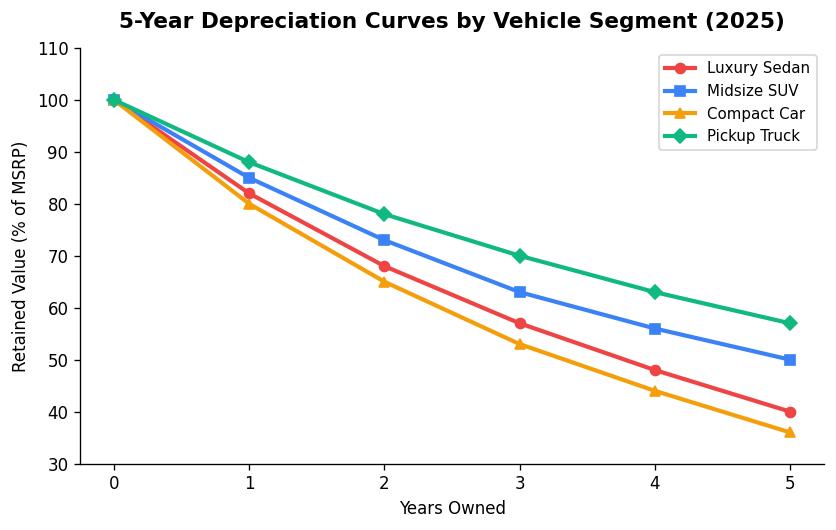
Full size pickups sit in the 40 to 50 percent range over five years, with the F-150, the Silverado, and the RAM 1500 all beating the industry average by a comfortable margin. Trucks are work vehicles for a large share of their buyer base, and the replacement cycle runs on operational need more than preference, and demand across economic cycles stays more stable than it does for luxury or lifestyle segments. The Jeep Wrangler holds roughly 60 to 65 percent of its value after five years and has been at or near the top of the retained value rankings for decades, though the 4Runner pushed past it for the number one spot in the midsize SUV segment in the most recent data, at 31.3 percent depreciation versus the Wrangler in the mid 30s. The 4Runner got its first full redesign in over a decade for 2025, and the older generation's residual values held even through the transition, which says something about how the reliability reputation carries value independent of the model year cycle.
None of the depreciation math applies correctly if the vehicle history is wrong. A single reported accident takes 10 to 25 percent off the clean history value, depending on severity. A rebuilt title takes 30 to 40 percent off a clean title, comparable regardless of how the repair looks. Those discounts are permanent and follow the vehicle through every resale, and they are the reason title washing is worth the effort for the people running those operations. A salvage title lookup and a VIN check before purchase confirms whether the depreciation curve the seller is pricing off of is actually the right one for the vehicle being sold, because a vehicle carrying hidden damage or a washed title already took that hit. The seller is just not disclosing it.