The first character of every VIN encodes the country where the vehicle was assembled, and in 2026, that character matters more to the transaction economics than it has in years because of tariffs on imported vehicles and parts that went into effect in 2025 and have stayed in place. A vehicle assembled in the United States carries a 1, 4, or 5 in that first position. A 2 means Canada. A 3 means Mexico. J is Japan, K is South Korea, and W is Germany. The VIN decoder will return the assembly plant, but it won't tell you where the engineering was done, where the parts were sourced, or where the brand is headquartered, and those are often three or four different answers on the same vehicle. Toyota builds its best selling sedans in Kentucky. Honda assembles the Odyssey in Alabama. BMW builds the X series SUVs in South Carolina. A number of domestic brand models have been assembled in Mexico and Canada for years. The import versus domestic labels that carry cultural weight in the American market don't map cleanly onto where vehicles are actually built, and they map even less cleanly onto what drives the price differences in the used market.
What drives the price difference is the long term reliability record and the repair cost expectations that go with it. Toyota and Lexus ranked first and second for five year cost to own in the most recent industry data, and Toyota took the number one spot for predicted new car reliability in the 2026 Consumer Reports rankings, with Lexus right behind it. Honda came in fourth. The Toyota Corolla and Camry hold about 62 to 64 percent of their value after five years, the Tacoma does better than that, and the Honda Civic and Accord sit at 60 to 61 percent. The annual maintenance cost runs about 441 dollars for a Toyota and 428 for a Honda, both well under the industry average of roughly 650. Those numbers show up directly in the used market pricing because buyers factor in what it is going to cost them to own the vehicle over the next several years, and the brands with the lowest expected repair bills command the highest resale premiums. A five year old midsize SUV from Toyota with 65000 miles on it will sell for 8000 to 12000 dollars more than a mechanically comparable domestic competitor at similar mileage in most markets, and the gap is not about where the vehicle was assembled. It is about what the buyer expects to spend at the shop.
German luxury brands sit on the other end of that equation. BMW, Mercedes, and Audi build vehicles with engineering quality and driving dynamics that have no precise equivalent from Japanese or American manufacturers, and the new car premiums reflect that. The used car premiums do not. Average annual repair cost on a BMW runs about 968 dollars against the 441 for a Toyota, and that spread compounds over a multi year ownership period. Proprietary diagnostic tools, brand specific oil and fluid specifications, and electronic systems that require dealer level equipment for routine service all push the maintenance cost up beyond what most used car buyers want to absorb once the warranty has expired. A three to four year old German sedan that stickered above 80000 new can lose 60 to 67 percent of its value in five years, and the used buyer picking it up at a third of the original price is getting a lot of vehicle for the money if they have budgeted for the ongoing cost. The problem in the used market is that the spread between clean title value and damaged or salvage value on a high depreciation luxury vehicle is wide enough to make buried collision history on German imports worth the effort. A vehicle history report and a salvage title lookup on any European luxury vehicle in that depreciation range is not optional.
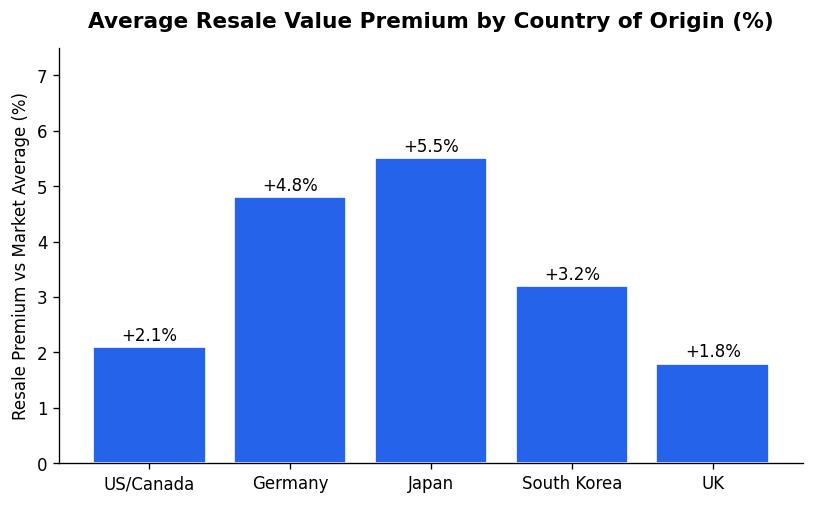
Korean manufacturers have moved significantly in the last decade. Hyundai and Kia scored 50 and 51, respectively, in the 2026 Consumer Reports reliability rankings, competitive with several Japanese competitors and well above where they sat ten years ago. Subaru actually took the top spot at 68 points. The used market has partially adjusted to the Korean quality improvement, but not all the way, and newer Hyundai and Kia models from roughly 2017 forward often represent better value per dollar than their reputation from a decade ago would suggest. The exception is the 2011 through 2021 model year security vulnerability that drove theft rates up on certain platforms, which suppressed used values and raised insurance costs on those specific vehicles in the affected markets. A VIN check on any vehicle in that range should include a stolen vehicle check as a default step because the theft exposure on those years is a known quantity in the insurance data.
Parts availability separates the brands that hold value from the ones that don't once vehicles get past the 100000 mile mark. A high volume Japanese sedan at 150000 miles has an enormous parts supply through independent channels, aftermarket suppliers, and salvage inventory at competitive pricing. A European vehicle at the same mileage from a brand without a deep American service network pulls from a narrower supply base at higher unit cost with less competition among suppliers, and that difference shows up fast when a non trivial repair comes in outside warranty coverage. The tariff environment in 2026 is making parts sourcing even more complicated for imported platforms because duties on components affect not just the new car price but the long term repair cost that feeds back into the used market valuation. None of the country of origin data tells you what happened to the specific vehicle being sold. The assembly plant in the VIN says where it was built. The NMVTIS record says what happened to it after that. The two, together with a full vehicle history report, get closer to what the vehicle is actually worth than the brand reputation alone.