Over 2.3 million electric vehicles are hitting their three to five year mark in 2026, and best time to buy a used EV returns alone are projected to exceed 300000 units this year. That is a lot of used EV inventory entering the market at a moment when the one thing that determines what a used EV is actually worth, the battery's state of health, is not captured anywhere in the title chain, the NMVTIS record, or the standard vehicle history report. The NMVTIS file carries title brands, ownership transfers, salvage designations, and odometer readings. It says nothing about whether the pack is at 92 percent of its original capacity or 68 percent. A VIN check will flag a salvage title or a total loss event. It will not tell you that the vehicle spent four years on DC fast chargers in Phoenix and lost a quarter of its rated range. The battery management system inside the vehicle has the number. The paperwork does not.
NHTSA has over a hundred battery related safety campaigns on file covering EVs from the 2013 model year forward, and the average recall completion rate across all manufacturers sits around 48 percent as of the most recent NHTSA reporting. EVs have been disproportionately affected by recalls relative to their share of the road, 8.6 percent of all recall activity between 2018 and 2022, against about 2.5 percent of vehicles in operation. The largest battery campaigns covered fire risk from manufacturing defects in specific cell lots, tens of thousands of vehicles across consecutive model years of a single platform, and a meaningful number of those vehicles had not received replacement modules by the time they moved into private party resale. That recall history sits in NHTSA's database. It does not appear in the NMVTIS record automatically, and it is not in most vehicle history reports unless the recall lookup runs by VIN separately. A stolen vehicle check won't surface it either. The gap between what the recall database knows and what the title chain reflects means vehicles with open battery safety campaigns are moving through the used market with clean looking histories.
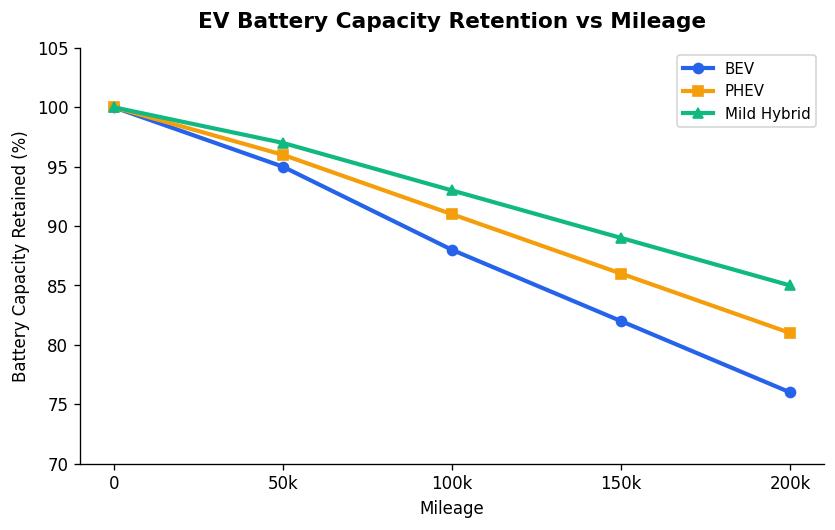
Lithium ion cells lose capacity from heat exposure over their lifetime, not just from mileage. Two vehicles with identical odometer readings can have state of health numbers 20 points apart, depending on where they were driven and how they were charged. The air cooled platforms that launched in the early 2010s showed degradation above 20 percent within five years in southwestern markets. Packs with liquid cooling from the same era in moderate climates typically held 85 to 90 percent at comparable mileage. An Idaho National Laboratory study found that vehicles charged exclusively on DC fast chargers degraded 12 percent faster than those using Level 2 home charging, and the state of health gap between a rideshare vehicle fast charging in a hot climate and a commuter on home charging in the Pacific Northwest can run 15 to 25 percentage points at the same calendar age. Geography and charging behavior predict degradation better than mileage on most platforms, and neither of those variables shows up in a listing. Service records sometimes carry charging session data if the vehicle stayed with an authorized shop through its early years, but that record usually disappears after the first or second ownership transfer.
California's Advanced Clean Cars II regulation was supposed to require battery health monitors in the infotainment system starting with the 2026 model year, along with warranty standards for battery capacity. Some manufacturers went ahead and built the monitors into their 2026 vehicles anyway, but the regulation was nullified when Congress pulled California's EPA waivers in 2025. There is no federal requirement for a battery health readout on any production EV, and pulling the state of health number on many newer models requires dealer specific diagnostic software that independent shops and private buyers don't have access to. Some platforms still report it through a standard OBD port, and some manufacturers run a battery health test through their own service mode, but the process is not standardized and is not part of any pre purchase inspection unless the buyer specifically requests it. Lenders on higher dollar EV transactions have started asking for state of health documentation before approving financing, and a few state DMV programs are looking at battery capacity checks for used EV certification, but most of the secondary market has not caught up. Dealers listing used EVs rarely pull a BMS reading before pricing. Private sellers almost never do.
Range figures in used EV listings almost always reflect the original EPA rating for the model, not the current effective range of the specific vehicle being sold. On a five or six year old vehicle from a warm climate with high mileage and unknown charging history, the gap between the listed range and what the vehicle actually does at a full charge can run past 40 percent. The federal battery warranty minimum is eight years or 100000 miles, and capacity guarantees vary by manufacturer but generally cover the pack down to about 70 percent of rated capacity. A vehicle outside that warranty window or below the threshold is carrying a replacement cost of 8000 to 22000 dollars, depending on the platform, and that cost is invisible in the listing price unless someone pulled the number from the BMS before the vehicle went up for sale. At salvage and wholesale auctions, the situation is worse. The lot description covers visible damage and title brand. The battery reading never comes up. The BMS number is the only data point that closes the gap between what the listing says the vehicle can do and what it actually does, and it does not transfer with the title.