Roughly 50 million vehicles on American roads are carrying at least one unrepaired safety recall, about one in every five, according to NHTSA and National Safety Council estimates. Every used car buying checklist should include a recall check — over 30 million vehicles were recalled in 2025 alone across nearly 1000 separate campaigns, and over a million more were added in just the first month of 2026. The average completion rate across all manufacturers sits around 48 percent, and most component categories fall in the 60 to 70 percent range when measured at the five quarter mark after the recall is issued. Takata airbag inflators, the largest recall in automotive history covering 67 million vehicles across more than 20 manufacturers, are at 46 percent completion. At least 5 million vehicles with unrepaired Takata inflators were still on the road as of February 2026, and over 630000 vehicles nationally were under active Do Not Drive orders, not all of them Takata related. The inflators can rupture during deployment and send metal fragments into the cabin. Twenty seven people have died from it in the United States, and over 400 have been injured. The recall has been open for over a decade.
The recall data sits in NHTSA's system, and it is searchable by VIN at nhtsa.gov/recalls, but it does not appear in the NMVTIS record, and it is not part of most vehicle history reports unless the recall lookup gets run separately. A VIN check that pulls the NMVTIS record covers title brands, ownership chain, salvage designations, and odometer history. It does not cover recalls. Whether the vehicle has an open recall on its brakes, its fuel system, or its airbag is a separate query against a separate database, and it has to be done by VIN. There is no federal law stopping a private seller from selling a vehicle with an open recall, and most states don't require independent dealers to complete them before selling either. Franchised dealerships are generally expected to address recalls before delivery but the rules and the enforcement vary. Vehicles move through private sale after private sale with open recalls on safety critical systems, and nothing in the title chain flags it.
Open recalls range from software updates a dealer can push in a few minutes to fuel system leaks and airbag defects that can kill the occupant. NHTSA publishes the recall description in plain language and categorizes the risk, and the difference between something that can wait and something that carries a Do Not Drive designation is not always obvious from the campaign number alone. The used market doesn't sort them. A vehicle with an open recall on its fuel rail that could cause a fire under the hood is listed and sold at the same price as an identical vehicle with no open recalls, because nobody pulled the number before it went up for sale.
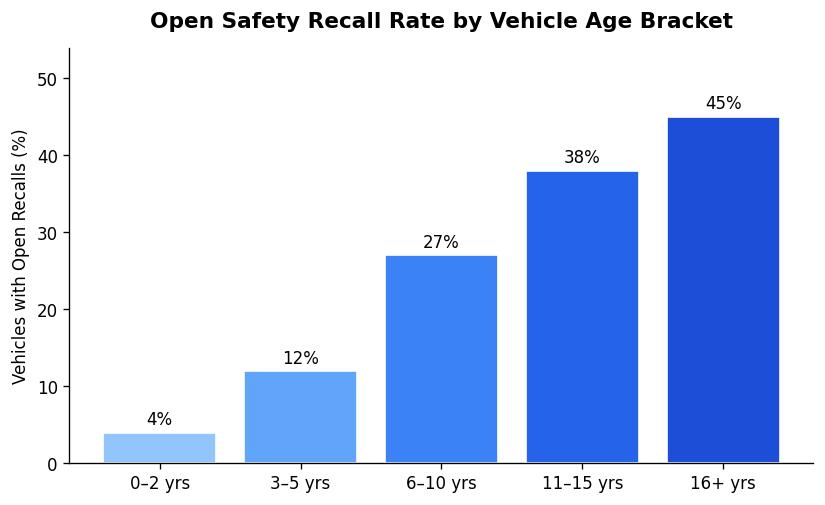
Completion rates drop as vehicles age, and the vehicles moving through the used market are older than the ones still at the original dealership. Newer vehicles have completion rates around 87 percent because they are still going back to franchised dealers for warranty work and routine service. As vehicles age past the warranty period, change owners, and start going to independent shops instead of the dealer, the completion rate falls off. The recall notification goes to the registered owner by first class mail, and if the registration address is outdated or the vehicle has changed hands without the new owner registering it in their name, the notification never arrives. The Takata recall completion data broken down by ZIP code showed a direct correlation with income. The 100 ZIP codes with the highest completion rates within the most affected areas had a median income of around 81000 dollars. The 100 with the lowest completion rates had a median income of around 46000 dollars. The recall system depends on owners bringing vehicles to a franchised dealer for a free repair, and people who are less likely to visit a franchised dealer for any reason are less likely to get the recall done.
Older, lower priced vehicles are more likely to carry open recalls and more likely to change hands through private sales and independent lots where nobody is running the NHTSA lookup before the deal closes. A vehicle with a clean title and a clean NMVTIS record, and a clean vehicle history report, can still have an open recall on something that creates a real safety risk, and the buyer won't know about it unless they check the recall database separately. The repair is free at any franchised dealer, no matter who owns the vehicle, but the recall has to be found first, and right now, the used market does not do that on its own.