
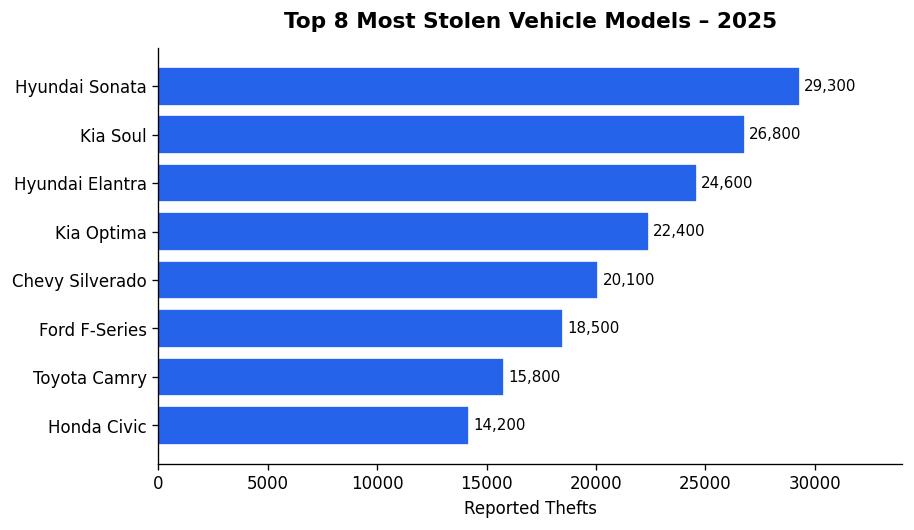
The NICB released its full year 2025 theft data on March 18, and the headline number was 659880 reported thefts nationally, the lowest in decades and 23 percent below 2024. That follows a 17 percent drop in 2024 from the 2023 peak of over a million. The pandemic era theft surge appears to be done. What has not changed much is which vehicles are getting taken. The Hyundai Elantra was the most stolen model in the country for the third year running, with 21732 thefts in 2025. The Honda Accord came in second at 17797. Hyundai and Kia vehicles together accounted for 14 percent of all thefts in 2025, down from 16 percent in 2024 and 21 percent in 2023, and the IIHS reported that theft claims dropped 46 percent on Hyundai and Kia vehicles that received the manufacturer's software update. The update adds a simulated immobilizer function to the 2011 through 2021 model years that shipped without one, the same vehicles that became targets after social media videos demonstrated how to start them with a broken steering column cover and a USB cable. The numbers are coming down. They are not coming down fast enough for the vehicles that still haven't been updated, and the NICB's data shows those models still sitting at the top of the list three years after the fix became available.
The first half of 2025 numbers broke the list out further. The Hyundai Sonata was second at 9154 thefts, the Honda Accord at 8531, the Chevrolet Silverado 1500 at 8006, the Kia Optima at 6011, the Ford F-150 at 4996, the Toyota Camry at 4986, and the Honda CR-V at 4889. The vehicles on that list fall into two categories, and the categories represent different problems. The Hyundai and Kia models are there because of a specific security gap that the manufacturers have been patching since 2022. The Silverado and the F-150 are there because full size pickups have been theft targets for decades, older model years lack modern immobilizer systems, and the parts are interchangeable enough across years that a stripped truck generates 15000 to 25000 dollars in components for a chop shop operation. The Honda Accord and Civic, particularly the 1998 through 2004 models, have no electronic immobilizer at all, and their parts fit across model years without any vehicle specific coding, which keeps them on the list even as their market values decline because the parts value hasn't declined with them. The Camry is on the list mostly because there are so many of them on the road. The CR-V for the same reason.
California reported 136988 thefts in 2025, more than 20 percent of the national total by itself. The San Francisco, Oakland, and Fremont metro area led the country at 477.51 thefts per 100000 residents, and Bakersfield was right behind it at 477.27. Washington D.C., ran at about 373 per 100000, nearly four times the national average, even after an 18 percent decline. Washington State saw the biggest drop of any state at 39 percent, Colorado and Puerto Rico followed at 35 and 34 percent. The crime is concentrated in large metro areas, and the top ten metro areas by volume accounted for more than a third of all thefts nationally, and that concentration matters for the used market because it is the same areas where stolen vehicles enter the resale pipeline through VIN cloning fraud and title fraud. A stolen vehicle check and a VIN check on any private sale purchase in a high theft metro area is the minimum, and a vehicle history report that shows the full ownership chain and title history through the NMVTIS record is what catches the vehicles that made it through the cloning process with a clean number from a donor vehicle in another state.
The stolen vehicle problem and the used market fraud problem feed each other. A vehicle that gets stolen and stripped for parts never enters the title system again. A vehicle that gets stolen, cloned, and resold enters the title system under someone else's VIN and stays there until a duplicate registration flag or a law enforcement query catches it, which can take months or years. The 85 percent recovery rate that the NICB reports includes vehicles found within days, often damaged or partially stripped, and vehicles recovered much later through title investigations and VIN checks that uncovered the cloning. The salvage title lookup on a vehicle being sold privately won't flag a cloned VIN because the VIN being checked is clean. The physical verification, dashboard plate rivets, door jamb label, engine bay stamps, ECU readout through the OBD port, is what catches cloning when the database can't, and the vehicles at the top of the NICB's theft list are the same ones most likely to show up in a cloning operation because they are the vehicles with the highest demand in the used market.