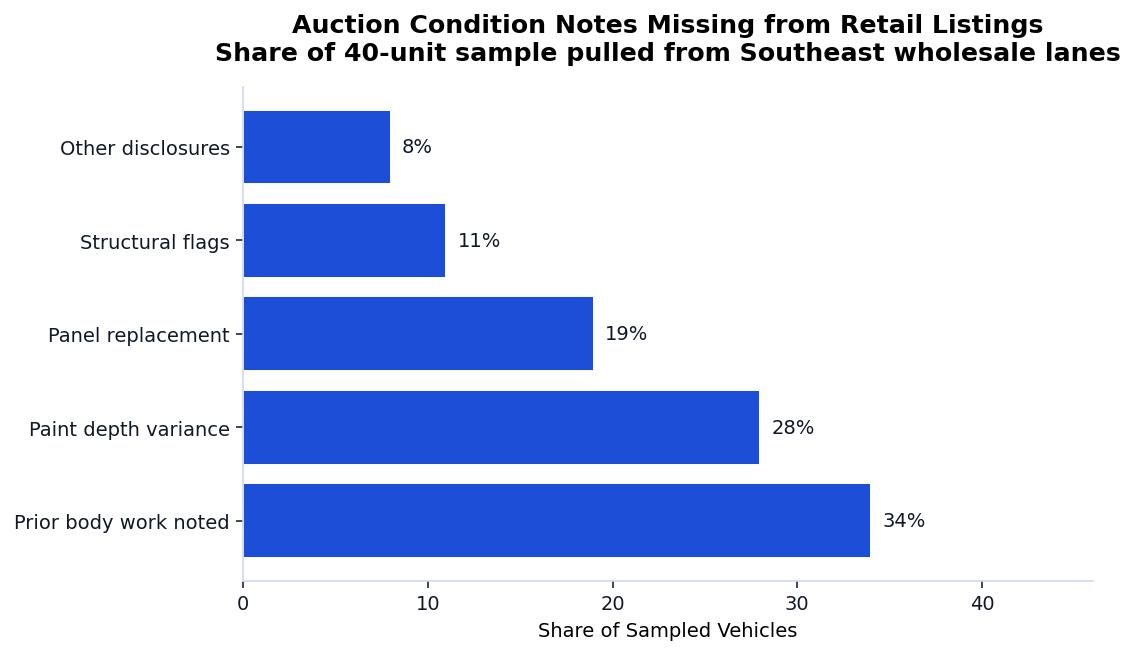
NAAA member auctions sold more than 8 million vehicles in 2025, up 3 percent year over year, with in-lane sales at 7.2 million units and total consideration topping 100 billion dollars for the first time. Somewhere between a quarter and a third of that metal reached a retail lot within sixty days of the wholesale hammer, and the conversion rate held at 58.5 percent on 12.3 million units that crossed the block. A compact crossover that rolled through a Southeast facility last spring carried a 2.8 condition grade with annotations for a replaced right fender, overspray on the A-pillar, and paint-meter readings around 14 mils on a panel that left the factory between four and six. Three weeks later, the same VIN hit a North Carolina listing as excellent condition, no accidents, no disclosures. The auction condition report—which the retail listing never referenced and which the buying dealer may never have read closely—documented everything with photos and measurements the retail customer never sees. I pulled roughly forty auction history packets last fall on late-model crossovers that exited fleet and lease channels in the Southeast, and about a third of those reports carried notes on prior body work or paint-depth inconsistencies that never appeared in the retail description when I ran the same VINs through listing aggregators.
Gary Medford, who spent eleven years chasing auto fraud for NICB before moving into dealership compliance consulting, told me the auction condition report is the closest thing to a contemporaneous physical inspection most of these vehicles ever get. By the time the unit hits retail, it has been detailed, reconditioned, maybe patched cosmetically, and the report lives in a wholesale database nobody on the consumer side can reach. Most states do not compel the purchasing dealer to hand those disclosures to the next buyer. Ohio mandates prior-damage disclosure when repair costs exceed six percent of MSRP; North Carolina runs a different threshold entirely. A dealer who buys through simulcast, never sees the vehicle in person, pulls a clean NMVTIS record, and treats that as the operative disclosure document stands on defensible ground in a lot of jurisdictions even when the wholesale report shows issues that would change how the next buyer evaluates the car. Medford was blunt: the wholesale disclosure apparatus is actually good and getting better, but retail has not caught up with the volume sourced through digital lanes where the dealer never lays hands on the car.
The NAAA arbitration policy that took effect 1 June 2025 forces wholesale sellers to announce any single defect north of $800 in repair cost and gives buyers up to seven calendar days to arbitrate timed online deals. The Auction Standards Committee even added an EV and hybrid battery position statement in August 2024 plus tighter accountability language for ambiguous announcements. That framework protects the transaction between consignor and dealer; the retail customer sits completely outside it. Commercial consignors drove most of the 2025 volume growth—fleet, lease return, rental decommission—and inspectors on those cars regularly log resprayed bumper covers, refinished quarter panels, and paint-depth readings that no retail listing will mention. A sedan that graded 3.0 with cosmetic repair notes will arrive at an independent lot looking pristine, the listing will highlight the clean NMVTIS record, and nothing from the wholesale record that actually described the metal will surface. The vehicle history report will confirm the NMVTIS status; the auction history report, if anyone runs it, shows the condition grade and damage annotations. Most buyers do not even know that dataset exists.
The digital sourcing shift compressed the gap further. A decade ago the buyer walked the lanes and used the condition report to confirm what they already saw. Simulcast and timed online sales made it normal for a dealer in one state to buy from a facility three states away, never touching the vehicle. In those transactions the condition report replaces personal inspection entirely, and inspection rigor varies enough across facilities and sale days that some reports are meticulous while others leave material issues undocumented at the wholesale level—and invisible downstream. The FTC Used Car Rule requires a Buyers Guide for warranty disclosure but says nothing about revealing acquisition history or auction data embedded in the VIN trail, and state consumer frameworks define prior-damage thresholds so differently that a dealer may or may not be obligated to disclose auction annotations depending solely on venue. None of that changes the core reality: the most detailed physical assessment happened at the auction, and it sits in a database the retail deal never references.