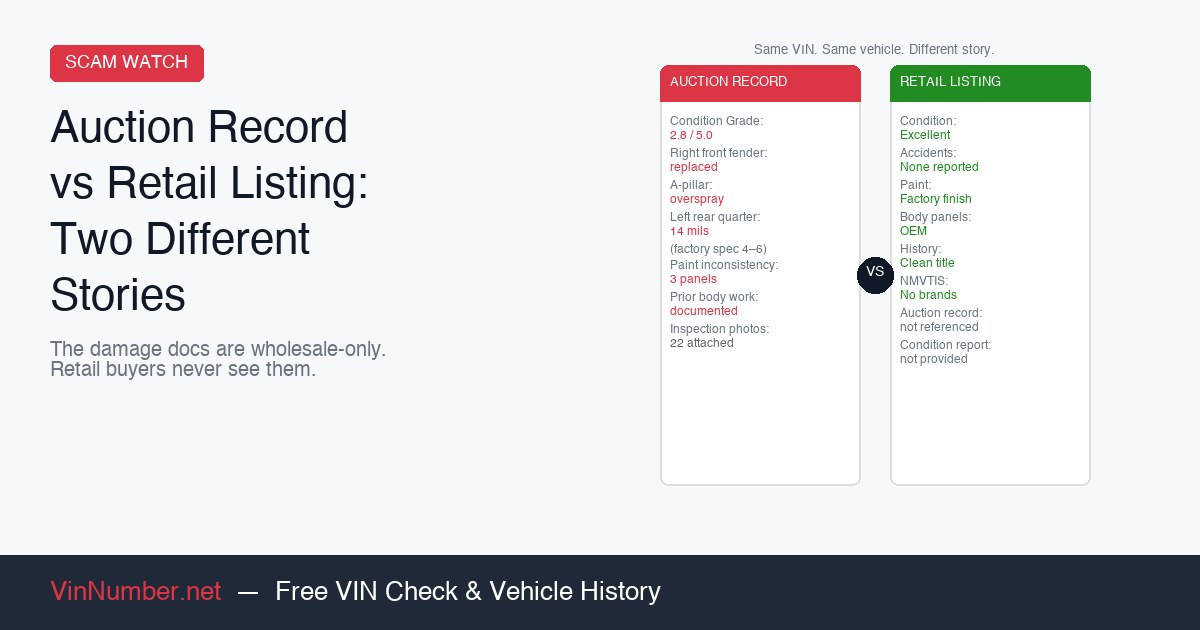
NAAA member auctions sold more than 8 million vehicles in 2025, up 3 percent from the prior year, with inlane volume at 7.2 million units and a gross transaction value that exceeded 100 billion dollars for the first time, and somewhere between a quarter and a third of that volume, depending on whose sourcing estimates you trust, ended up on retail lots within sixty days of the wholesale sale. Buyers who want to understand the salvage auction buying guide dynamics will notice the conversion rate held at 58.5 percent against 12.3 million vehicles that entered the lanes. A compact crossover that moved through a Southeast facility last spring carried a 2.8 condition grade with annotations for a replaced right front fender, overspray on the A-pillar, and paint meter readings on the left rear quarter at roughly 14 mils against a factory spec of 4 to 6. Three weeks later the same VIN was listed at a dealership in North Carolina as being in excellent condition with no accidents reported. The NMVTIS record was clean. The auction condition report, which the retail listing did not reference and which the purchasing dealer may never have reviewed in detail, told a materially different story about the physical state of that vehicle, and it told it with photos and measurements that the retail buyer had no way to access. I pulled a batch of roughly forty auction history reports last fall on vehicles that had moved through wholesale in the Southeast over the prior six months, mostly compact and midsize crossovers between two and five years old that had come out of fleet disposal and lease return channels, and the condition reports on about a third of them carried annotations for prior body work or paint depth inconsistencies across multiple panels that did not appear anywhere in the corresponding retail listings when I ran the same VINs through listing aggregators.
Gary Medford, who investigated auto fraud for NICB in the mid-Atlantic region for eleven years before moving into dealership compliance consulting, told me last year that the auction condition report is the closest thing to a contemporaneous physical inspection most of these vehicles will ever get. By the time the vehicle reaches retail it has been through reconditioning and detail, maybe minor cosmetic repair, and the condition report is sitting in a wholesale database that nobody in the retail transaction knows about or has access to. Most states do not require the purchasing dealer to pass auction documentation through to the next buyer. Ohio mandates disclosure of prior damage when repair costs exceed six percent of MSRP. North Carolina applies a different standard. A dealer who buys through simulcast without physically inspecting the vehicle, pulls a clean NMVTIS record, and treats that as the operative disclosure document rather than the auction condition report occupies defensible ground under many state frameworks even when the wholesale record contains annotations that would change how the next buyer evaluated the vehicle. Medford was blunt about it. The disclosure apparatus at the wholesale level is actually good and getting better, he said, but the retail side has not caught up with how much inventory is now sourced through digital channels where the dealer never touches the vehicle before it arrives on the lot.
The NAAA arbitration policy that took effect June 1 2025 requires wholesale sellers to disclose defects singularly exceeding 800 dollars in repair or replacement cost and provides arbitration windows ranging from sale day for certain inlane categories up to a minimum of seven calendar days for online transactions, and the Auction Standards Committee added an EV and hybrid battery position statement in August 2024 along with revised seller accountability provisions for ambiguous or restrictive announcements. That framework governs the wholesale transaction and within that space it works. Dealers who buy through NAAA member facilities and exercise their arbitration rights within the window have recourse when condition does not match disclosure. The problem is downstream. Commercial sales drove much of the 2025 volume increase at auction, with fleet disposal, lease return, and rental decommission units feeding the lanes in growing numbers, and those vehicles tend to present well cosmetically because fleet operators maintain appearance standards but may carry underlying mechanical wear or prior repair history that the auction inspector captures in the condition report and the fleet seller discloses under NAAA policy but that evaporates once the purchasing dealer takes possession and repackages the vehicle for retail. A five-year-old sedan out of a rental fleet that went through wholesale with a condition grade of 3.0 and annotations for resprayed bumper covers and a repaired rear body panel will arrive at the independent lot with the same VIN, the same clean title, the same odometer reading, and none of the physical condition data that the auction facility documented at the point of sale. The vehicle history report will confirm the NMVTIS record is clean. The auction history report, if anyone runs one, will show the wholesale transaction and the condition grade and the damage annotations. Most retail buyers do not know that record exists.
The digital shift in wholesale sourcing has compressed the gap even further. A decade ago, the dealer’s buyer was at the auction walking the vehicles, and whatever the condition report said was cross-checked against what the buyer could see and feel in person. Simulcast purchasing and timed online sales have made it possible for a dealer in one state to acquire inventory from a facility three states away without anyone from the dealership ever laying hands on the vehicle, and in those transactions the condition report is not a supplement to personal inspection but a replacement for it, and the variation in inspection thoroughness across facilities and across sale days means that some of the condition reports are detailed and accurate and some of them are cursory enough that material condition items go undocumented at the wholesale level and therefore have no chance of surfacing at the retail level. The FTC’s Used Car Rule requires dealers to post a Buyers Guide disclosing warranty status but does not mandate disclosure of wholesale acquisition history or auction condition data, and state-level consumer protection frameworks address prior damage disclosure with enough variation across jurisdictions that a dealer who acquires a vehicle with documented prior body work on the auction condition report may or may not have a legal obligation to disclose that information to the retail buyer depending entirely on where the retail transaction takes place and how the state defines the threshold. None of which changes the fundamental market dynamic, which is that the most detailed physical assessment the vehicle received happened at the auction and the data from that assessment sits in a database that the retail transaction does not reference.