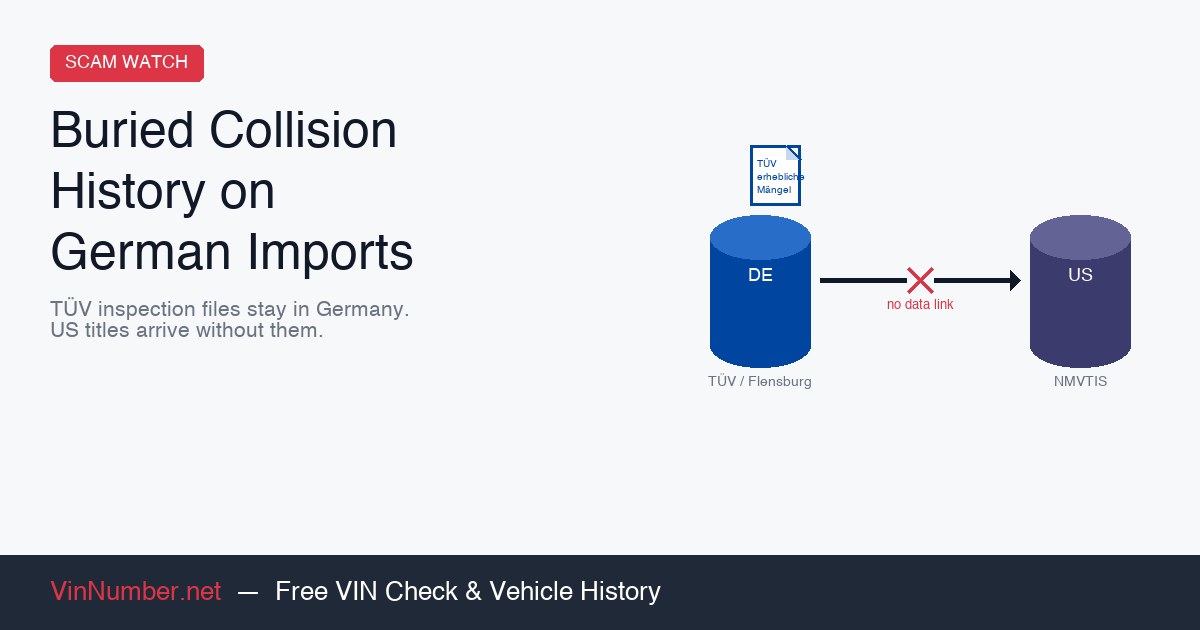
About 1000 officers from ten countries wrapped up Operation Nimmersatt in April, and what the European Public Prosecutor’s Office found was 16500 wrecked American cars that had been run through Lithuanian body shops and pushed back into EU markets after somebody stripped the salvage brands off the titles. EPPO put the total at 144 million euros in laundered vehicles and 31 million in VAT fraud. The documentation gap that made the whole thing work also runs in the other direction, and that part did not get much attention. German lease returns carrying collision repairs in their TUV inspection files have been clearing US customs and getting titled clean because the Kraftfahrt Bundesamt in Flensburg has no data link to NMVTIS, and nobody at the ports is checking.
TUV and DEKRA run the strictest periodic vehicle inspections anywhere in Europe, checking structural integrity and brakes and suspension, and underbody corrosion every 24 months on anything past three years old, and all of that goes into federal records in Flensburg. When a car picks up erhebliche Mangel on the structural line, it cannot go back on German roads until a shop fixes it and the vehicle passes reinspection. That history stays attached as long as the car stays in the country. The moment it ships out of Bremerhaven or Antwerp, the records sit in a TUV archive somewhere in Hessen or Bavaria, and there is no way to pull them from the US side without paying a European data broker.
Last summer an inspector who does prepurchase work in the Mid Atlantic ran a paint meter over an executive sedan and the B pillar readings came back off. He paid for a European data pull, and the Hessen file had a serious structural deficiency notation from eight months before export. The car had been repaired by then and had passed a followup HU and shipped within weeks, and when it hit wholesale auction in Pennsylvania the damage history was locked in a German database that US buyers cannot access. That inspector works three or four days a week out of a shop between Virginia and northern New Jersey. Since that first sedan he has pulled files on fifteen to twenty more imports and found structural repairs that never made it onto the US titles. German service books, valid TUV stickers, cars that looked clean until the European data came back.
The Zentralverband Deutsches Kraftfahrzeuggewerbe puts German lease volume at around 2.5 million vehicles a year. Export absorbs a good share of that because the math favors shipping over reconditioning for German retail. Factory service schedules, dealer grading before wholesale, TUV inspections every two years, there is more paper on these cars than American wholesale vehicles ever see. That is why importers have treated them as safe inventory for years. The problem is nobody pulls the inspection files, so the Hauptuntersuchung history stays in Germany while the registration document crosses the Atlantic with the car.
Running a VIN check in the US gets you NHTSA recalls, domestic title brands, insurance loss records from North American carriers. The Flensburg database and the TUV archives and the DEKRA records have no pipeline into NMVTIS. CBP clears incoming vehicles based on whatever paperwork shows up in the shipping container, state DMVs title them off the same documents, and the European inspection history drops out entirely. One broker in Baltimore has been handling around 200 imports a year for fifteen years. She told me she has never seen a German exporter include inspection files in a shipment. She has never seen CBP try to pull German records on an incoming car. She does not think the port systems are set up to do it.
German sedans with low kilometers and clean US titles move at 8 to 12 percent over comparable vehicles, a premium tracked in import vs domestic resale value data, with disclosed damage at wholesale auction. On a 35000 dollar car that comes out to three or four thousand. European data aggregators will sell inspection files, but pulling them costs money and takes time, and creates problems once you have the information, because at that point, state consumer protection law starts asking what you did with it. Several importers have told me off the record that they would rather not know. None of them wanted to say how often they skip the pull.
Bremerhaven, Antwerp, and Rotterdam move containers both ways across the Atlantic. Nimmersatt traced salvage American wrecks flowing east through shell companies that washed the titles. Nobody has traced damaged German lease returns flowing west. NHTSA has been citing 450000 vehicles a year sold with rolled odometers for longer than most people in this business have been working, and a 2024 estimate from one of the big data aggregators put 2.14 million clocked cars on US roads, with average buyer overpayment of around 4000 dollars. Accident history suppression across borders is a separate problem that nobody at the federal level has tried to size. Volume is probably lower than odometer fraud, but the losses per buyer are not.
A midsize wagon that came through inspection late last year had dealer service stamps at 15000 kilometer intervals and a valid TUV sticker through 2026. The European data pull came back with two claims totaling 14000 euros, front collision and hail. Neither showed up in NMVTIS or on the US title. That wagon was sitting on a lot in northern Virginia, priced at 28000 dollars, listed as single owner European delivery, clean title. Whether the dealer knew about the German claims or was working off the same blind data as everyone else is not something the inspector could tell me. Virginia had a bill this year that would have made importers produce foreign inspection records before retail sale. It lasted three weeks in committee before it got pulled.