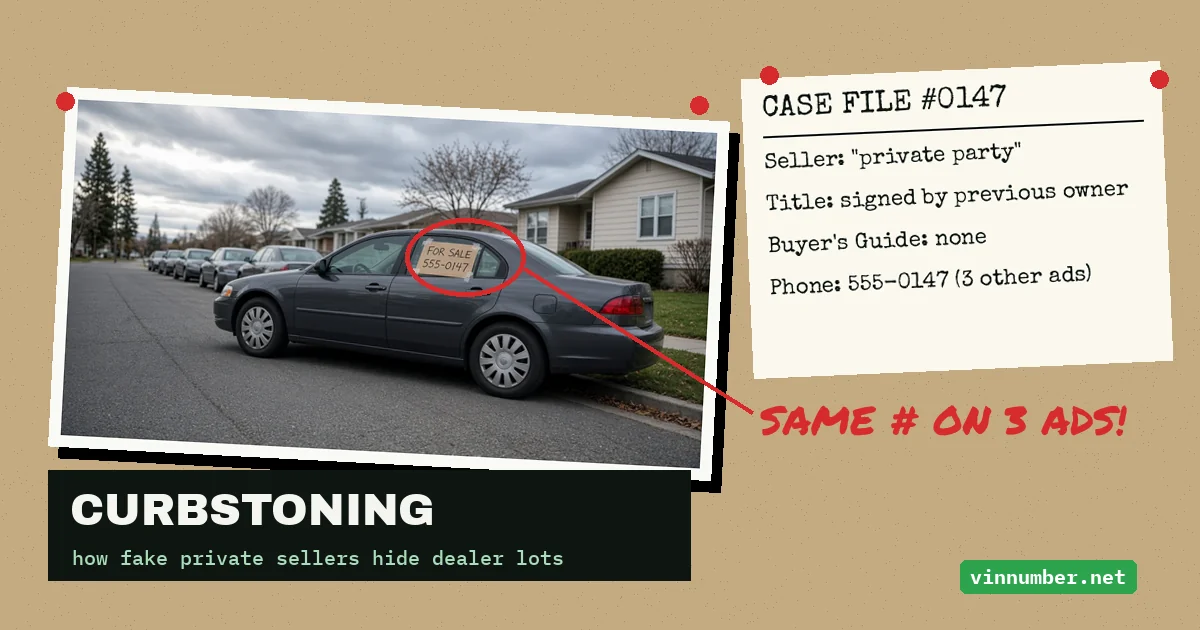
What curbstoning is, why it puts buyers at risk, how to recognize a curbstoner before handing over money, and what protections you lose when you buy from one.
Definition
Curbstoning is the practice of selling used vehicles without a dealer license while posing as a private seller. The term comes from the old practice of parking cars along curbs with "For Sale" signs, effectively running a car lot without a lot, a license, or any of the disclosure requirements that apply to licensed dealers.
Key Takeaways
- Curbstoning is illegal in every state. Dealer licensing requirements vary by state: some set annual sales thresholds, while others focus on the nature of the selling activity, such as buying vehicles in order to resell them.
- The FTC's Used Car Rule requires covered used car dealers, with certain exemptions, to display a Buyer's Guide on vehicles they offer for sale. The Guide discloses warranty status and advises the buyer to request a pre purchase inspection. Curbstoners may fail to provide a Buyer's Guide, even when their sales activity makes them subject to the rule. [1]
- Vehicles sold by curbstoners may have undisclosed problems, including previous accident, salvage or flood damage, odometer rollback, mechanical defects, and outstanding liens. The private party format helps hide them, because private sellers generally face fewer disclosure requirements than licensed dealers, even though federal odometer law and some state disclosure rules still apply.
- Title jumping, where someone buys a vehicle and resells it without properly transferring the title into their own name, is a warning sign of curbstoning because it conceals the reseller's involvement in the transaction. It is itself illegal in most states.
- A vehicle history report, a title check, and a few questions about ownership can help buyers spot potential signs of curbstoning before they commit to the purchase.
Every state requires some form of dealer license for anyone who sells used vehicles as a business. Where the line falls varies. Some states set annual sales thresholds, while others focus on the nature of the selling activity. In California, individuals buying and selling vehicles as a business may need a dealer license regardless of how many vehicles they sell; the DMV separates dealers from people selling vehicles they acquired and used for personal purposes. [3] Florida generally presumes someone is operating as a dealer if they buy, sell, or offer three or more vehicles within a 12 month period, under Florida Statutes §320.27. [8] Texas generally allows individuals to sell up to four vehicles of the same type per calendar year without a dealer license, provided those vehicles are owned and registered in their name, under Texas Transportation Code chapter 503. [9] These rules exist because licensed dealers are subject to consumer protection rules that private sellers are not, and curbstoning is the practice of selling like a dealer while pretending to be a private seller to avoid those rules.
The vehicles that flow through curbstoning operations can include ones that licensed dealers would not put on their lots. Salvage auction purchases with cosmetic repairs and no disclosure. Flood vehicles from hurricane zones, cleaned and dried. Vehicles with rolled back odometers. Cars with outstanding liens that the buyer will discover at the DMV. The curbstoner's business model depends on the buyer not knowing any of this, and the private party sale format is what makes that possible.
What a licensed dealer is required to do that a curbstoner is not
The difference between buying from a licensed dealer and buying from a curbstoner is the set of protections that disappear. Understanding what those protections are makes the risk concrete.
- Buyer's Guide disclosure. The FTC's Used Car Rule, codified at 16 CFR Part 455, requires covered used car dealers to display a Buyer's Guide on vehicles they offer for sale, with certain exemptions. [10] Coverage depends on sales activity: the rule generally reaches anyone who sells or offers a used vehicle after selling or offering five or more in the previous 12 months, and it does not apply in Maine and Wisconsin, which have comparable state disclosure rules. [1] The Guide discloses whether the vehicle is sold with a warranty or "as is," lists the major systems of the vehicle and potential defects, and advises the buyer to ask for a pre purchase inspection. Because coverage turns on sales activity rather than a state license, an unlicensed seller is not automatically outside the rule. Curbstoners may still fail to provide a Buyer's Guide, even when their sales activity makes them subject to it.
- Lemon law protections. Many state used car lemon laws focus on dealer sales, leaving private party buyers with fewer protections. New York's used car lemon law, for example, covers qualifying dealer sales and excludes private sales. [13] However, some states provide additional rights for private sales, including Massachusetts. [12] A vehicle purchased through what appears to be a private party sale can lose the dealer sale protections it would otherwise carry.
- Title and disclosure obligations. Licensed dealers must follow federal and state disclosure requirements covering warranties, title history, and certain vehicle defects. California, for example, requires disclosure of salvage history and other title brands. [17] Private sellers generally face fewer requirements, although their obligations vary by state: federal odometer disclosure applies to covered private transactions, [11] and Massachusetts requires private sellers to disclose known defects that affect safety or substantially impair the vehicle's use. [12] A curbstoner uses the private party format to sidestep the stricter dealer obligations.
- Recourse and accountability. Licensed dealers generally operate from approved business locations, may be required to carry surety bonds, and hold a license that can be revoked. Curbstoners often lack these safeguards. A curbstoner may have nothing more than a phone number that is disconnected the day after the sale, which makes it harder for buyers to resolve disputes or recover their money if the vehicle turns out to have undisclosed problems.
How curbstoners source and sell vehicles
Curbstoning operations tend to follow a recognizable pattern. Curbstoners may acquire vehicles through auctions, private sales, and other resale channels before offering them to unsuspecting buyers. Three patterns come up repeatedly.
Salvage and insurance auctions. Curbstoners acquire vehicles at salvage auctions, either by holding a dealer license in one state while selling without one in another, or by using a relationship with a licensed dealer who bids on their behalf. The vehicles purchased at these auctions can be total losses, flood damaged, or carrying mechanical problems that made them unsuitable for a dealer's retail lot. The curbstoner performs minimum cosmetic repairs and lists the vehicle at or near private party retail pricing. [4]
Private purchases at below market prices. Curbstoners buy vehicles from individuals who need to sell quickly, often responding to listings where the seller signals urgency. The purchase price is well below market, and the vehicle is relisted at full private party value.
Title jumping. Title jumping, also called floating the title, is a warning sign of curbstoning. It occurs when someone buys a vehicle and resells it without properly transferring the title into their own name. Instead, the curbstoner holds the previous owner's signed title and passes it directly to the next buyer as if the previous owner were the seller. By skipping the required title transfer, a curbstoner may avoid taxes or fees that would otherwise apply to their purchase, depending on the state and the type of transaction. It also avoids creating a DMV record of their involvement and keeps their name off the title chain entirely. Title jumping is illegal in most states. [4]
Example: A curbstoner in Texas buys a 2018 Chevrolet Equinox from a private seller for $8,500. The vehicle has a clean title. The curbstoner never transfers the title into their own name, holds the signed title, and lists the SUV on an online marketplace for $14,500, posing as a private owner selling because of a move. The listing uses a burner phone number. The buyer who purchases the vehicle at $14,500 receives the title signed by the original owner, not the curbstoner, and has no record that an intermediary was ever involved.
How to spot a curbstoner
Seven warning signs are worth investigating before you buy. None of them proves on its own that someone is operating as an unlicensed dealer, so look for several clues together rather than relying on any single one. [18] None of them requires special tools or expertise.
- The seller's phone number appears on multiple listings. Copy the phone number from the listing and paste it into a search engine. If the same number shows up on ads for several different vehicles, the person on the other end is not a private owner selling one car. They are running a volume operation.
- The seller says "which car?" when you call. Someone selling their own vehicle knows which car you are calling about. A person juggling multiple listings needs you to identify which one.
- The name on the title does not match the seller's ID. If the seller's name doesn't match the title, ask for documentation proving they're authorized to sell the vehicle, such as a power of attorney. [16] Without it, a title signed by someone else, explained away as selling on behalf of a friend or a relative who is out of town, could involve title jumping.
- The seller insists on meeting at a neutral location. An owner selling from their home or workplace has no reason to avoid showing where they live. Parking lot meetups, gas station handoffs, and other public space arrangements can suggest there is no fixed address behind the operation.
- No maintenance records are available. Someone who owned and drove the vehicle for years typically has service receipts, oil change records, or at least some documentation. A seller who acquired the vehicle days or weeks ago has none of that.
- The seller pressures you to decide quickly. High pressure tactics, including claims of other interested buyers, limited time pricing, or refusal to allow a pre purchase inspection are designed to close the sale before the buyer can discover problems. [5]
- The price is notably below market for the vehicle's year and condition. Salvage or flood damaged vehicles sold at private party prices already carry substantial margins for the seller. A price that looks unusually good may reflect a vehicle whose actual value is far lower than the listing suggests.
On online marketplaces, three additional patterns stand out. An account created in the last few weeks with no prior selling history deserves extra scrutiny, especially if the same account posts multiple vehicle listings in a short window. Photos taken in the same location across different listings, same driveway, same apartment complex parking lot, suggest one seller cycling through inventory rather than multiple private owners. Dealer style phrasing also gives it away. Phrases like "clean title in hand," "just detailed," and "priced to sell this weekend" read like someone who writes these ads routinely, not a private owner selling one car.
Example: A seller on an online marketplace lists a 2017 Ford F-150 and a 2019 Nissan Altima from the same account within two weeks. Both listings use photos taken in the same apartment complex parking lot. The account was created three weeks ago and has no other activity. A buyer who notices the pattern searches the seller's phone number and finds a third listing on a different platform for a 2016 Honda CR-V.
Example: Someone finds a 2020 Toyota Camry listed online for $16,000, roughly $2,500 below comparable listings. On the phone, the seller asks, "Which car?" When asked about the title, it turns out the name on the document is different from the seller's. The explanation is that the car belongs to a cousin. The buyer declines and reports the listing.
Questions that expose a curbstoner
The spotting indicators above are observational. These five questions, asked directly on the phone or in person, force the seller to either answer honestly or start improvising.
- "How long have you owned this vehicle?" A private owner gives a specific answer, two years, since last March, bought it from my brother in law in 2021. Someone who acquired the vehicle days ago at a salvage auction hesitates or gives a vague response.
- "Is the title in your name?" The answer you want is yes. Anything else, selling for a friend, the title is still in my ex's name, we have not gotten around to transferring it, calls for documentation proving the seller is authorized to sell. Without it, the deal could involve title jumping.
- "Can I see the title before we meet?" No legitimate reason exists to refuse this. Stalling, changing the subject, or offering to "just bring it to the meeting" can mean the title is signed by someone else.
- "Where is the vehicle parked right now?" An owner selling from home gives an address. Someone rotating vehicles through temporary locations will suggest meeting somewhere neutral instead.
- "Do you have service records for the vehicle?" Oil changes, tire rotations, warranty repair receipts. Years of ownership leaves a paper trail. A seller who bought the vehicle at auction last month has nothing to show you.
Example: A buyer calls about a listed SUV and asks how long the seller has owned it. The seller says "a while." The buyer asks if the title is in the seller's name. The seller says the title situation is "a little complicated" but promises it will be sorted out at the sale. The buyer ends the call.
What to do if you suspect curbstoning
If you believe a seller is operating as a curbstoner, you can report them to your state's DMV enforcement division or your state attorney general's consumer protection office. Most states accept reports online. In California, the DMV runs an investigations unit for unlicensed dealer complaints. Their investigators have been known to pose as buyers to build cases against repeat offenders. [6] Other states route these reports through their motor vehicle dealer licensing boards.
A useful report includes the seller's phone number, the listing URL or a screenshot of the ad, the VIN of the vehicle if you have it, and any text messages or call records with the seller. The more specific the report, the faster an investigator can act on it. [5]
If you have already purchased a vehicle from a suspected curbstoner, pull a vehicle history report immediately using the VIN. Reports from NMVTIS-approved providers provide available title records, odometer readings, title brands, and salvage history. Some reports may also include historical theft information, but you should not rely on them as a comprehensive stolen vehicle check. [14] VinNumber's free decoder covers only factory specs and NHTSA recalls. If the report reveals undisclosed problems, document everything, including the listing, the bill of sale, text messages with the seller, and photos of the vehicle, and contact your state's consumer protection office.
5 Curbstoning Mistakes Buyers Make
1. Assuming a private party sale is safer because there is no dealer markup
A licensed dealer's markup pays for the protections that come with the transaction, including the Buyer's Guide, disclosure requirements, and the bond many states require behind a dealer's license. A private party sale from a legitimate owner can be a perfectly good transaction, but a curbstoner mimicking a private sale strips away every protection while keeping the price.
2. Not checking the title before paying
The title is the single document that reveals title jumping. If the name on the title is not the seller's name, the seller is not the titled owner and needs documentation proving they are authorized to sell the vehicle. Without it, the transaction could involve title jumping. The explanation, whatever it is, should be verified independently before any money changes hands.
3. Skipping the vehicle history report because the seller provided one
The report the seller hands you may have been generated weeks or months before the vehicle's most recent problems were recorded. Pull your own report on the day of the transaction to ensure the data is current.
4. Not searching the seller's phone number online
This takes 30 seconds and catches volume sellers immediately. A phone number that appears across multiple vehicle listings on different platforms is one of the strongest warning signs a single check can turn up, though it is still worth confirming with the other clues above.
5. Buying without a pre purchase inspection because the seller discouraged it
Discouraging or outright refusing a pre purchase inspection is one of the clearest warning signs in any used car transaction. No owner with nothing to hide objects to a buyer paying for an independent mechanical inspection.
Frequently asked questions
Is curbstoning illegal?
Yes. Selling vehicles for profit without a dealer license is illegal in every state. How states define dealer activity varies, but operating a volume sales business without the required license violates state motor vehicle dealer licensing laws. Penalties range widely. In California, unlicensed dealing is a misdemeanor carrying up to six months in jail and a $1,000 fine, and police can impound vehicles offered for sale by unlicensed sellers. [6] In Nevada, a Las Vegas man charged with 56 counts related to unlicensed vehicle sales and forgery pleaded guilty to one felony forgery charge in 2018. As part of his plea agreement, he agreed to probation and restitution. [7] Other states treat repeat offenses as felonies, and vehicles used in the operation can be seized. [2]
How many cars can I sell without a dealer license?
It depends on the state. Dealer licensing requirements vary: some states set annual sales thresholds, while others focus on the nature of the selling activity. In California, individuals buying and selling vehicles as a business may need a dealer license regardless of how many vehicles they sell. [3] Florida generally presumes someone is operating as a dealer if they buy, sell, or offer three or more vehicles within a 12 month period. [8] Texas generally allows individuals to sell up to four vehicles of the same type per calendar year without a dealer license, provided those vehicles are owned and registered in their name. [9] Selling like a dealer without the required license is curbstoning regardless of whether the seller intended to operate as a dealer.
What is title jumping?
Title jumping occurs when someone buys a vehicle and resells it without properly transferring the title into their own name. The original owner's title is passed directly to the next buyer, making it appear that the curbstoner was never part of the transaction. Title jumping is illegal in nearly every state and is a warning sign of a curbstoning operation. By skipping the required title transfer, the reseller may avoid taxes or fees that would otherwise apply to their purchase, and the ownership chain in the DMV's records is broken. [4]
Can I get my money back if I bought from a curbstoner?
Recovering money from a curbstoner can be difficult, particularly if the seller disappears after the sale. Curbstoners often operate without a fixed business address and may use a prepaid phone number. Buyers may still have legal options under state law, including potential fraud claims and small claims court for qualifying disputes, [13] and federal law allows civil actions for intentional odometer fraud. [15] Obtaining a judgment doesn't guarantee you'll recover your money, though. Prevention, through the checks described in this guide, is more effective than pursuing recovery after the fact.
Does a vehicle history report protect me from curbstoning?
A vehicle history report can help uncover salvage or flood damage, title problems, and odometer discrepancies that may point to odometer rollback. [14] However, it may miss unreported issues and cannot tell you whether the seller is a curbstoner. That identification comes from the behavioral indicators described above. Searching the phone number, looking at whose name is on the title, and paying attention to how the seller reacts when you ask for an inspection are what separate a private owner from someone running a volume operation.
The Bottom Line
Curbstoning puts the buyer on the wrong side of every protection that exists in the used car market. The Buyer's Guide is usually missing. Dealer focused lemon law protections may not apply. The seller has no bond and no license to revoke. The vehicle may carry undisclosed damage, rolled back mileage, or an outstanding lien. The defense against it is straightforward. Check the title for the seller's name. Search the seller's phone number for multiple listings. Run a vehicle history report from an NMVTIS-approved provider to catch title brands, odometer discrepancies, and salvage records, knowing it can miss unreported problems. And if anything about the transaction feels like it is moving too fast or avoiding too many questions, walk away.
Article sources
- FTC. "Dealer's Guide to the Used Car Rule." https://www.ftc.gov/business-guidance/resources/dealers-guide-used-car-rule
- Auto Law Firm. "What Is Curbstoning in Used Car Sales?" https://www.autolawfirm.com/california-auto-dealer-laws-faq/what-is-curbstoning-in-the-context-of-used-car-sales/
- California DMV. "Vehicle Industry Registration Procedures Manual: Dealer." https://www.dmv.ca.gov/portal/handbook/vehicle-industry-registration-procedures-manual-2/general-information-licensees/dealer/
- Wisconsin DMV. "Unlicensed Car Dealers." https://wisconsindot.gov/Pages/dmv/cons-protect/buy-sell-veh/unlicensedcardealers.aspx
- BBB. "BBB Tip: Avoiding Illegal Car Sales Known as Curbstoning." https://www.bbb.org/article/news-releases/24541-bbb-tip-avoiding-illegal-car-sales-known-as-curbstoning
- San Diego City Attorney. "Beware Unlicensed Car Dealers Posing as Private Sellers." https://www.sandiego.gov/sites/default/files/legacy/cityattorney/pdf/2012/curbstoning120300.pdf
- News 3 Las Vegas. "Man not licensed to sell cars pleads guilty to felony charge." https://news3lv.com/news/local/man-not-licensed-to-sell-cars-pleads-guilty-to-felony-charge
- Florida Legislature. "The 2026 Florida Statutes, Section 320.27: Motor vehicle dealers." https://www.flsenate.gov/Laws/Statutes/2026/320.27
- Texas Legislature. "Transportation Code, Chapter 503: Dealer's and Manufacturer's Vehicle License Plates." https://tcss.legis.texas.gov/resources/TN/htm/TN.503.htm
- eCFR. "16 CFR Part 455: Used Motor Vehicle Trade Regulation Rule." https://www.ecfr.gov/current/title-16/chapter-I/subchapter-D/part-455
- NHTSA. "Consumer Alert: Changes to Odometer Disclosure Requirements." https://www.nhtsa.gov/press-releases/consumer-alert-changes-odometer-disclosure-requirements
- Mass.gov. "Private party car sales." https://www.mass.gov/guides/private-party-car-sales
- New York State Attorney General. "Used Car Lemon Law." https://ag.ny.gov/publications/used-car-lemon-law
- U.S. Department of Justice, NMVTIS. "Frequently Asked Questions." https://vehiclehistory.bja.ojp.gov/faq/list
- U.S. Code. "49 U.S.C. 32710: Civil actions by private persons." https://www.govinfo.gov/content/pkg/USCODE-2024-title49/html/USCODE-2024-title49-subtitleVI-partC-chap327-sec32710.htm
- California DMV. "Signature by Power of Attorney (POA)." https://www.dmv.ca.gov/portal/handbook/vehicle-industry-registration-procedures-manual-2/general-registration-information/signature-by-power-of-attorney-poa/
- California DMV. "Branded Titles." https://www.dmv.ca.gov/portal/vehicle-registration/titles/branded-titles/
- Minnesota Attorney General. "Curbstoning." https://www.ag.state.mn.us/consumer/publications/Curbstoning.asp