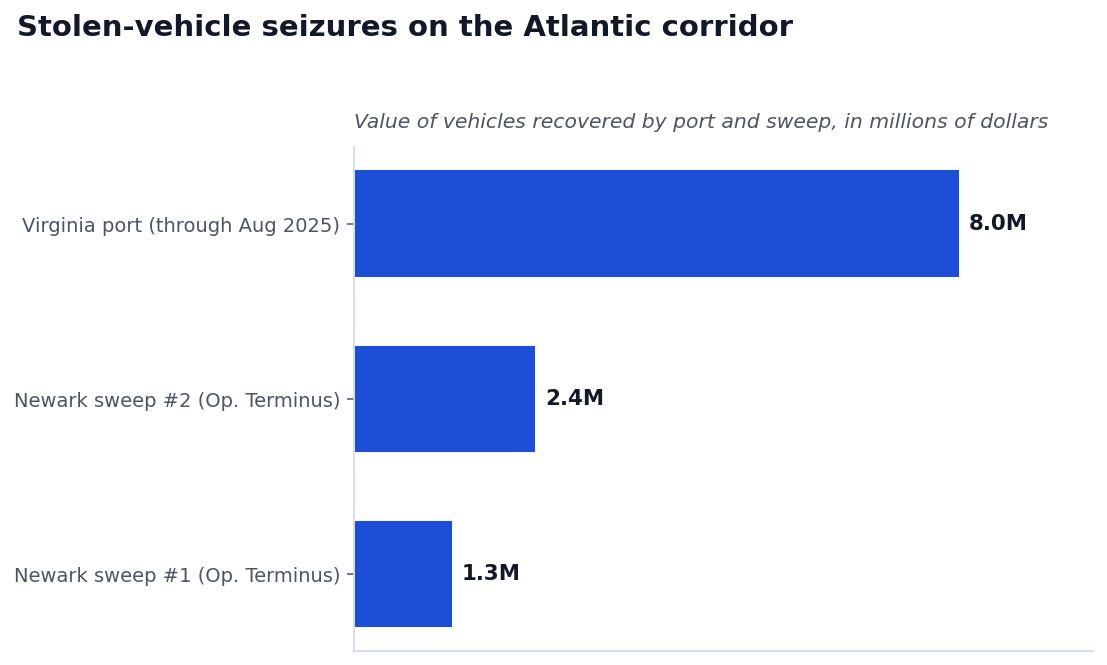
CBP pulled somewhere north of 1100 stolen vehicles out of shipping containers at Atlantic and Gulf coast seaports during fiscal year 2025, nearly all headed for West Africa. Investigators at those ports think that number captures a fraction of what actually moves through, because the pipeline does not just run outbound. Vehicles get fed into the export documentation chain, all the right paperwork gets filed, and then the vehicle never actually leaves.
Definition: A shipper's export declaration is a customs filing declaring intent to export a vehicle. It generates an outbound record against the VIN the moment the container clears the port gate — before the vessel actually loads.
Key Takeaways
- CBP pulled 1100+ stolen vehicles from Atlantic and Gulf coast containers in FY2025, but investigators say phantom exports — declarations filed for vehicles that never board a vessel — likely move a comparable volume with no comparable enforcement.
- The Automated Export System, NMVTIS, and NCIC do not share data in real time. An export declaration lands on the VIN before any theft entry does, and vehicle-history products reading events chronologically bury the stolen flag behind it.
- Freight forwarders behind the fraudulent declarations dissolve within 60–90 days, before compliance audits catch the gap between filed manifest and vessel departure.
- Seventeen states still do not fully participate in NMVTIS, so vehicles enter the domestic titling system without a query against the national database.
- Vehicle theft dropped 17% in 2024 and 23% in H1 2025, but investigators think the drop masks a shift toward targeted late-model SUVs and pickups pushed through export and title-laundering circuits.
The pipeline that turns a stolen VIN into a clean title
None of this is conceptually new, but the scale has shifted. A vehicle gets stolen in the tristate area or mid Atlantic corridor, and within days, it's loaded into a container with export paperwork filed under a shell freight forwarding entity. That container clears the port gate, which is the moment it generates an outbound export record against the VIN. Somewhere between the gate and the vessel, the vehicle gets pulled and moved to a secondary location. Run a VIN check six months later, and the NMVTIS[1] record shows an export event, nothing more.
Whether the theft record has even been posted by then depends on how quickly the owner reported it to law enforcement and how long it took that department to get the entry into NCIC[2], a gap that in some jurisdictions stretches to weeks. I spoke with an investigator on the Maryland Auto Theft Task Force who'd pulled records on units where the outbound export notation predated the theft entry in NCIC by days, sometimes by more than a week, and that sequencing gap is what buries the stolen flag behind the export record in any vehicle history product reading events chronologically.
Months later, the vehicle resurfaces carrying fabricated purchase documentation, sometimes through a curbstoner working in a state that doesn't require title brands to transfer across jurisdictions, sometimes through a complicit dealer who runs a title application on the VIN with a forged bill of sale attributed to some fictitious foreign buyer who supposedly returned the vehicle after the export deal collapsed. Arizona and Texas both stamp export only designations onto titles under specific conditions, and both have documented cases where those stamps were either scraped off the paper title physically or, more commonly now, just ignored during electronic title processing in states that never bother to cross-reference the originating brand database.
Why the paperwork poisons everything downstream
Three systems that ought to share data in real time simply don't. NMVTIS gets title and brand data from state DMVs and participating salvage yards, but has zero direct feed from CBP[3]'s export documentation system. The Automated Export System, where all those shipper's export declarations get filed, doesn't push any vehicle-level data back into NMVTIS or NCIC in real time. Meanwhile, the vehicle history products that dealers actually use are pulled from NMVTIS, insurance loss records, auction histories, and state DMV feeds. Not one of those sources can tell you whether a vehicle declared for export actually got on a boat.
The people running these circuits on the East Coast have clearly figured out how much room that gives them. Baltimore's field office has started pulling containers where the declared contents include a vehicle, but the weight doesn't line up with what a loaded vehicle plus household goods should actually weigh, though it's a rough screen at best, and it relies on manual review at a port that moves thousands of export containers every week.
Robert Kinney, a CBP supervisory officer at Baltimore who's been doing vehicle export enforcement for over a decade, put it bluntly, the hard part isn't catching the vehicles that are actually in the containers heading overseas, it's identifying the ones that generated all the export paperwork and then never showed up at the terminal. It's the declaration filing that poisons everything downstream. Nobody, as of this writing, is systematically matching filed declarations against confirmed vessel departures on a per VIN basis.
NICB[4] has been raising this geographic issue in internal bulletins, and frankly, it's not subtle. The Newark-to-Savannah corridor moves more containerized vehicle exports than anywhere else in the country, and the same stretch also produces a disproportionate share of theft recoveries where the title history just doesn't track. Sandra Reyes, a supervisory special agent with HSI[5] who's been working port diversion cases since 2021, told me she keeps seeing the same pattern play out: a freight forwarding entity files shipper's export declarations for vehicles that never board a vessel, generates enough of a paper trail to make the export look real, and then the entity dissolves, usually within sixty to ninety days.
I went through the paperwork on one case where a full size SUV taken from a rental fleet in northern New Jersey popped up on an export declaration filed through a forwarder registered near Elizabeth, showed as exported in every major vehicle history product within two weeks, and then resurfaced seven months later with a clean Georgia title, 4200 more miles on the odometer, and absolutely no record of having left the continental United States.
What the domestic end looks like
If the port side is hard to police, the domestic end is worse. Seventeen states still aren't fully participating in NMVTIS, so a vehicle that enters the titling system in one of those states may never trigger a query against the national database when the title gets issued. Even in states that do participate, when the only record in the system is an export notation planted by a fraudulent declaration, what the title clerk sees is a vehicle that left the country and came back, and that's routine enough that nobody looks twice.
The FBI's VIN Examination Program[6] can confirm whether a plate's been tampered with or whether the confidential VIN locations match the primary plate, but that's a forensic step that only kicks in after a vehicle is flagged, not something that happens at the DMV counter during routine title transfer. A DMV fraud examiner in Virginia, who asked that I use only her title and not her name, told me her office turned up at least fourteen vehicles over a six month stretch that had clean Virginia titles but also had export declarations sitting on file with CBP that nobody ever reconciled against actual vessel departures; in every single case the freight forwarder on the declaration had dissolved before her team even opened the file.
Vehicle theft nationwide dropped 17 percent in 2024, landing at roughly 850700 units, and the first half of 2025 brought another 23 percent decline to 334114 reported thefts. Those are good numbers on paper. But several investigators I've talked to think the declining totals mask a shift: fewer opportunistic grabs of older vehicles for parts, more targeted thefts of late model SUVs and pickups funneled into export and title laundering circuits where the per unit return is substantially higher, and the detection risk stays low enough to keep the whole operation profitable.
Real export vs phantom export
Not every vehicle with an export notation on its history has actually left the country. Here is the operational difference, side by side.
| What happens | Real export | Phantom export |
|---|---|---|
| Shipper's export declaration filed | Yes | Yes |
| NMVTIS shows outbound export event | Yes | Yes |
| Vehicle physically loaded onto vessel | Yes | No |
| Bill of lading matches vessel manifest | Yes | No |
| Freight forwarder still operating 90 days later | Yes | No |
| Vehicle re-enters domestic titling stream | No | Yes |
| Clean title issued in a different state | No | Yes |
| Auction or retail listing within one year | No | Yes |
Is this vehicle at risk
Recommendation
Pull NMVTIS separately from the consumer report and check for export events, brand mismatches between originating and receiving states, and any freight forwarder listed on a filed customs declaration. Cross reference the seller's title issue date against the last known service record.
Five red flags on a vehicle history report
1. Export event without matching vessel manifest
The declaration was filed and the port gate cleared, but no confirmed vessel departure is on record. Request the manifest number and check it against the CBP Automated Export System where possible.
2. Title issued in a new state within weeks of an export event
A vehicle that legitimately returned from export would carry documentation of the return leg. Missing return paperwork combined with a fresh title in a different state is a laundering signature.
3. Freight forwarder on record has dissolved
The forwarding entity behind the declaration typically dissolves inside 60 to 90 days. Any dissolved forwarder on the paperwork is grounds to treat the export event as fictitious.
4. Odometer reading inconsistent with the export window
Vehicles that never actually left often accumulate 3000 to 5000 additional miles before resurfacing on the retail market. Compare the export date's declared mileage against the current odometer.
5. Originating state does not participate in NMVTIS
Seventeen states still do not fully participate. A chain of title that runs through any of them without a query against the national database is a structural gap that laundering circuits exploit routinely.
Frequently asked questions
Does an export record on a vehicle history report mean the car actually left the country?
No. A shipper's export declaration generates an outbound event against the VIN the moment the container clears the port gate, but nothing in the vehicle history data confirms the vessel actually loaded. Phantom exports produce the same paperwork trail as real ones.
How can a buyer verify whether an export was real?
Ask the seller for the bill of lading and vessel manifest tied to the declaration. Cross reference the freight forwarder against active CBP registration. If the forwarder has dissolved or the manifest is unavailable, treat the export as unverified.
Why do the same freight forwarders keep showing up in these cases?
They do not. That is the pattern. Forwarders dissolve within sixty to ninety days after a series of fraudulent declarations, well before compliance audits catch the gap between the filed manifest and the actual vessel departure. A different shell entity opens the next week.
Which states have the biggest structural gap?
The seventeen non-participating NMVTIS states, but any state that issues titles without querying the national database on export-flagged VINs contributes to the problem. Arizona and Texas stamp export-only designations that other states routinely ignore during electronic title processing.
Are late-model SUVs really the main target?
By seizure share, yes. Baltimore's 250 CY2024 recoveries were 72 percent SUVs. The per-unit spread between a laundered clean title and a stolen or exported flag is high enough on late-model SUVs and pickups to fund the entire operation.
The bottom line
Export fraud on the Atlantic corridor is not a border problem. The border enforcement works when the vehicle is actually in the container. The problem is the paperwork side, where a customs filing lands on a VIN before any theft entry does, and where nobody systematically matches the declared exports against confirmed vessel departures. Every phantom export becomes a title-laundering seed that resurfaces months later carrying documentation clean enough to pass a routine DMV transfer.
For anyone buying a used late-model SUV or pickup, the practical takeaway is that the vehicle-history products dealers rely on cannot distinguish a real export from a phantom one. That verification has to come from outside those products. Pull NMVTIS separately, check the NCIC status through law enforcement, and cross reference any export event on the report against the freight forwarder's current status and the vessel manifest for the declared date. Anything less leaves the buyer holding a title that will pass inspection until the day it does not.
Article sources
- National Motor Vehicle Title Information System (NMVTIS). "About NMVTIS." https://www.vehiclehistory.gov/
- Federal Bureau of Investigation. "National Crime Information Center (NCIC)." https://www.fbi.gov/services/cjis/ncic
- U.S. Customs and Border Protection. "Automated Export System (AES)." https://www.cbp.gov/trade/aes
- National Insurance Crime Bureau. "Operation Terminus." https://www.nicb.org/news/news-releases/nicb-operation-terminus
- U.S. Immigration and Customs Enforcement. "Homeland Security Investigations." https://www.ice.gov/hsi
- Federal Bureau of Investigation. "VIN Examination Program." https://www.fbi.gov/investigate/violent-crime/vcac/vin-examination-program