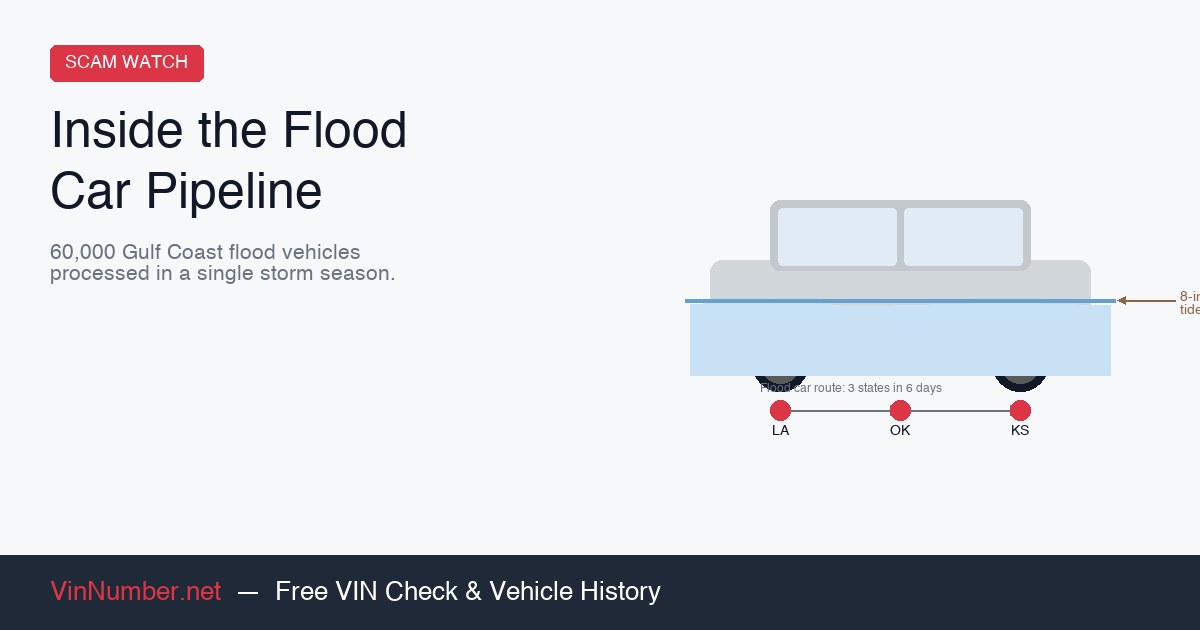
Sedgwick County processed 41 rebuilt-title applications in the first two weeks of October. That is not unusual for a busy season. What caught Angela Ruiz’s eye was that eleven of them listed Louisiana as the previous state of registration, and eight of those had been issued within thirty days of Hurricane Rosario making landfall near the Plaquemines Parish coastline. Eight is not a statistical blip.
Ruiz works out of a DMV field office in Topeka and handles VIN verification cases for western Kansas. She has a laminator on her desk that she did not request and does not use, and a whiteboard behind her that she fills with tally marks every time she pulls a vehicle history report that shows a mismatch between where a car supposedly came from and what NMVTIS has on file. The board was full by November. She erased it and started again.
The hatchback wound up in a KBI evidence bay in Wichita. Before that, it was in Plaquemines Parish. NOAA flood maps put roughly two and a half feet of standing water over that zip code in late September. The car was titled a total loss by an insurer on the third of October. By the fifteenth, it had a Louisiana salvage certificate. By the twenty second, it had a rebuild inspection stamp from a shop in Shreveport that Ruiz says she has seen on paperwork before, in connection with other cars that moved fast. Maybe that is a coincidence. She has not ruled it out.
A tow operator named Zell picked it up from a lot near Lake Charles. He does not know what happens to the cars after he drops them, and he made no particular effort to hide that when investigators called him in January. He loads, he drives, he unloads, and gets three hundred dollars a vehicle. Monroe is where he left that one, at a gravel yard run by a man whose name Zell did not volunteer and investigators had to find separately. The man buys in bulk and sells to brokers. Zell keeps no records beyond the clipboard sheets he turns in at pickup. He said the car smelled like mildew, unprompted.
The broker moved it to Oklahoma City within forty-eight hours. There was a stop at a truck wash in McAlester, where the crew charged fifty dollars and spent twenty minutes on the undercarriage. By the time the hatchback arrived at a regional auction outside Oklahoma City, the front seats were different from the ones listed in the original insurance photos, and the carpet under the rear bench had been cut and relaid. A buyer at the auction ran a VIN check on his phone during the preview and saw only the salvage notation in Louisiana and the rebuild inspection in Shreveport showing as valid. He passed. Someone else bought it for five percent under book value, which seemed like a reasonable deal at the time.
Derek Hall did not buy that car. He was at the same auction and bid on it and lost. Hall moves about forty cars a month out of a lot west of Wichita, mostly older imports, and he has been tracking these kinds of titles long enough to keep a shared spreadsheet with three dealers he knows in the area. They log VINs from vehicles they walked away from or bought and regretted, cars where the title showed rebuilt but the history underneath told a different story. The hatchback got added to that spreadsheet after a colleague from the auction called Hall with what KBI had found under the carpet. He was not shocked. He said the Gulf storm season produces a version of this every year.
Title washing on flood-damaged vehicles exploits the fact that flood brands do not travel at the same speed as the cars. Louisiana cut its branding window from thirty days down to ten after Rosario, but parishes running on generator power in October had clerks working through a backlog with no consistent internet access. NMVTIS eventually gets the notation. The trouble is that a car can cross three state lines inside a week, and a buyer in Kansas checking a rebuilt-title application has no obligation to wait for federal records to catch up. A single mechanical inspection and a notarized letter from a mechanic are enough for a rebuilt status in Kansas. The inspector does not need credentials. The letter does not require photos.
Ruiz sent a hold on the hatchback’s VIN in early December after she matched the Shreveport inspection date against the parish flood timeline. KBI got involved when the car surfaced at a Wichita lot in late November, about six weeks after Rosario. Inside the door panels, the investigators found a tide line at roughly the eight-inch mark. The body control module had corrosion on the contacts that the previous two diagnostic scans had apparently not caught or reported. The Wichita buyer said the interior lights had been flickering since the second week he owned it.
There are five investigators in the Kansas Highway Patrol’s vehicle crime unit handling title fraud cases. In a heavy storm season, they each carry between two and three hundred open files. Ruiz is not in that unit. She flags the mismatches and passes them up. Most of the time, nothing moves quickly enough to stop the car from changing hands again.
NICB put out a figure in December, somewhere north of sixty thousand flood-damaged vehicles processed through Gulf Coast salvage operations between October and the end of the year. That does not count anything dried out and sold privately before an insurer filed a total-loss notice, which is a category nobody has good numbers on. Ruiz’s whiteboard shows thirty-seven for Kansas alone. She said the number is probably higher because she only sees the ones where the title mismatch is visible enough to flag.
The owner who bought the hatchback in Wichita traded it to a used lot in Hutchinson in January after the electrical problems got worse. The lot has not been able to sell it. It is sitting in the back row under a tarp, and whoever buys it next will probably run the usual paperwork and see a clean rebuilt title out of Shreveport and not think much of it.