The Spread Between Salvage and Clean Title Value on the Same Vehicle Funds the Entire Title Washing Pipeline

The Salvage Title Spread Funds the Title Washing Pipeline
🎧 Listen to this article
\n
🎧 Listen to this article
\n \n
\n

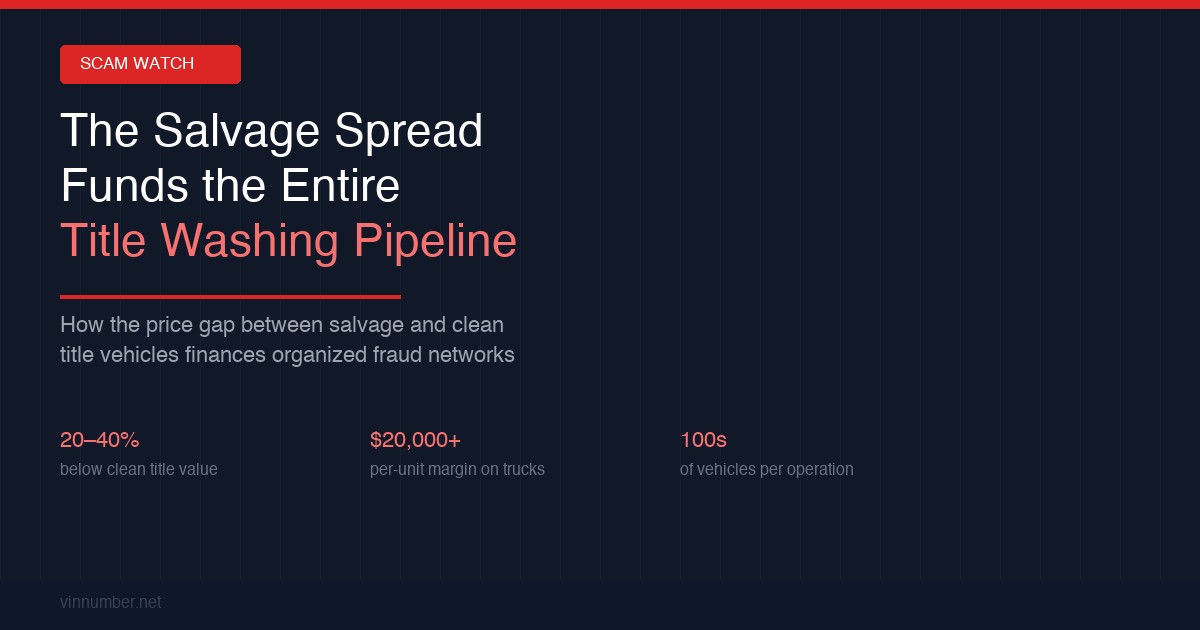
A rebuilt or salvage branded vehicle typically trades at 20 to 40 percent below clean title comparable value on the same year, make, equivalent, and mileage range, and on certain late model full-size trucks and three-row crossovers where clean title retail sits above 45000 or 50000 dollars, the dollar figure represented by that discount can land somewhere between 12000 and 20000 dollars per unit. The percentage varies with damage type and severity, with flood and fire exposure suppressing value more aggressively than collision damage that has been competently repaired, and recovered theft vehicles tend to hold better than any of the other branded categories because the mechanical condition is often intact. The spread is the number that matters for understanding why title washing operations exist, why they scale, and why enforcement actions like the Pennsylvania Attorney General's investigations over the last several years have consistently uncovered organizations running hundreds of vehicles through the pipeline rather than just a handful. A salvage title lookup on a three-year-old midsize crossover with a clean title retail value of 32000 dollars will show that the same vehicle, branded, might move at wholesale for 18000 to 22000 dollars, depending on the extent of the documented damage. Wash the title through a jurisdiction that does not carry the brand forward, or through a fraudulent reconstructed title application that bypasses the required enhanced inspection, and the vehicle reenters the retail market at or near the 32000 dollar clean title price. The gross margin on a single vehicle in that scenario runs between 10000 and 14000 dollars before accounting for repair costs, transport, filing fees, and the cost of whatever inspection paperwork had to be fabricated or purchased. On a high-value pickup or a late-model luxury SUV where the clean title comparable sits at 55000 or 60000 dollars, the per-unit margin on a successful wash can exceed 20000 dollars, and at that level the economics support multistate operations with enough overhead to employ runners, maintain relationships with compliant inspection stations, and absorb the occasional loss when a vehicle gets flagged at the receiving DMV.

A rebuilt or salvage branded vehicle typically trades at 20 to 40 percent below clean title comparable value on the same year, make, equivalent, and mileage range, and on certain late model full-size trucks and three-row crossovers where clean title retail sits above 45000 or 50000 dollars, the dollar figure represented by that discount can land somewhere between 12000 and 20000 dollars per unit. The percentage varies with damage type and severity, with flood and fire exposure suppressing value more aggressively than collision damage that has been competently repaired, and recovered theft vehicles tend to hold better than any of the other branded categories because the mechanical condition is often intact. The spread is the number that matters for understanding why title washing operations exist, why they scale, and why enforcement actions like the Pennsylvania Attorney General's investigations over the last several years have consistently uncovered organizations running hundreds of vehicles through the pipeline rather than just a handful. A salvage title lookup on a three-year-old midsize crossover with a clean title retail value of 32000 dollars will show that the same vehicle, branded, might move at wholesale for 18000 to 22000 dollars, depending on the extent of the documented damage. Wash the title through a jurisdiction that does not carry the brand forward, or through a fraudulent reconstructed title application that bypasses the required enhanced inspection, and the vehicle reenters the retail market at or near the 32000 dollar clean title price. The gross margin on a single vehicle in that scenario runs between 10000 and 14000 dollars before accounting for repair costs, transport, filing fees, and the cost of whatever inspection paperwork had to be fabricated or purchased. On a high-value pickup or a late-model luxury SUV where the clean title comparable sits at 55000 or 60000 dollars, the per-unit margin on a successful wash can exceed 20000 dollars, and at that level the economics support multistate operations with enough overhead to employ runners, maintain relationships with compliant inspection stations, and absorb the occasional loss when a vehicle gets flagged at the receiving DMV.

\n\n\n

The Pennsylvania AG's office ran three separate rounds of title washing prosecutions over a several-year period, the largest of which charged 30 individuals and 21 businesses in Lebanon, Lehigh, and Philadelphia counties for purchasing totaled vehicles, falsifying enhanced safety inspection documentation, and submitting fraudulent title applications to PennDOT. The operation was designed to bypass reconstructed title requirements in neighboring states with stricter inspection protocols, and investigators found that many of the vehicles listed as having been inspected at the charged facilities had never physically entered Pennsylvania. A related prosecution, Operation Car Wash, dismantled an organized ring led out of Brooklyn that had fraudulently obtained more than a thousand Pennsylvania license plates and used them to support a title washing and odometer fraud pipeline across multiple states, with the ringleader eventually pleading guilty to 36 third-degree felonies and forfeiting several luxury vehicles, including two exotics. Tom & Linda Platt, investigators with the Lehigh County Auto Theft Task Force who worked the Lebanon and Lehigh County cases, described the financial structure as being driven entirely by the spread. The inspection shops were charging 60 dollars per fabricated inspection, which tells you something about the volume they were processing, and the dealers moving the washed vehicles at retail were capturing the full distance between salvage acquisition cost and clean title market price on every unit that made it through the pipeline without being flagged. NMVTIS was designed in part to prevent exactly this kind of brand loss across state lines, and within its reporting framework, a salvage or junk brand applied by one state becomes a permanent part of the vehicle's federal record, but the Pennsylvania cases demonstrate that the point of failure is not always in the database. The inspectors who were supposed to verify that the vehicle had been properly reconstructed were the point of failure, and the database recorded whatever the fraudulent paperwork told it to record.

\n\n\n

The economics shift depending on the vehicle segment and the post-disaster supply environment. NICB reported that vehicle thefts across the United States declined 23 percent in 2025 to their lowest levels in several decades, which reduces the supply of stolen vehicles feeding into washing circuits, but the flood and hurricane inventory pipeline operates on a different cycle entirely and the volume of flood branded vehicles entering the salvage market after a major storm season can sustain washing operations for twelve to eighteen months after the event. The vehicle history report on those units will often show the brand if the data provider is pulling from the NMVTIS record, but a VIN check run through a provider that relies primarily on insurance loss data rather than the federal title database may miss a flood brand that was applied by a state DMV and reported to NMVTIS but never generated an insurance claim because the vehicle was uninsured at the time of the flood event. That gap between data sources creates another margin for the washing operation, because the vehicle can present as clean on one type of report and branded on another, and the purchasing dealer or retail buyer who runs only one of those reports may never see the brand at all.

\n\n

The per-unit economics of a washing circuit are simple enough that anyone who has looked at salvage auction pricing alongside retail comparable data can map the incentive structure without much difficulty, and the enforcement pattern across multiple jurisdictions over the last several years suggests that the operations tend to concentrate in states where the reconstructed title inspection requirement can be circumvented through compliant inspectors or fabricated documentation rather than in states where the inspection protocol is centralized at a state facility. The NAAA 0 to 5 condition grading scale, the NMVTIS brand history, the insurance loss records, and the state-level title chain all exist as independent layers of documentation that a sufficiently thorough salvage title lookup or VIN check can surface, and in most cases, the brand does survive the wash attempt when someone with the right access pulls the federal record. The vehicles that make it through are the ones where nobody pulls it.

\n\n\n
\n
\n

Frequently Asked Questions

\n
\n
\n How can I tell if a vehicle has been through title washing? +\n
A NMVTIS record showing a salvage or flood brand in one state followed by a clean or rebuilt title in another state within a short window is the primary indicator. A vehicle history report that pulls the federal title database will show each brand change, the state that applied it, and the dates. The gap the report won't catch is when the brand was applied but the inspection used to obtain the rebuilt designation was fraudulent — in that case the rebuilt brand looks legitimate in the database even though the inspection behind it wasn't.
\n
\n
\n What is the typical salvage title discount on a used vehicle? +\n
Salvage and rebuilt branded vehicles typically trade at 20 to 40 percent below clean title comparable value on the same year, mileage, and equipment level. Flood and fire damage suppress value more aggressively than collision damage. On high-value trucks and SUVs above 45000 dollars clean title retail, that discount can represent 12000 to 20000 dollars per unit — the economic driver behind organized title washing operations.
\n
\n
\n Does NMVTIS prevent title washing across state lines? +\n
NMVTIS records salvage and junk brands as permanent parts of a vehicle's federal record, so the brand should follow the vehicle regardless of which state retitles it. The system works when DMV clerks query it at the point of retitling and enforce the originating brand. The failure points are jurisdictions where clerks don't query consistently, where the rebuilt title inspection can be fabricated, and where the database recorded whatever the fraudulent paperwork told it to record.
\n
\n
\n What makes certain states more vulnerable to title washing? +\n
States where the reconstructed title inspection is performed by a private shop rather than a state facility, where the inspector needs no professional credentials or bonding, where the vehicle doesn't have to be physically present, and where documentation requirements don't include pre-repair photographs or parts receipts with donor VINs. Operations concentrate in these states because the probability of passing inspection without detection is higher and the per-unit economics support the overhead.
\n
\n
\n How does the flood car pipeline affect the used vehicle market? +\n
After a major storm season, flood branded vehicles can sustain washing operations for twelve to eighteen months. The pipeline exploits the fact that flood brands don't travel as fast as the vehicles — a car can cross multiple state lines within a week while the NMVTIS record catches up. Vehicles that were uninsured at the time of the flood may never generate an insurance claim, so a VIN check relying on insurance loss data rather than the federal title database may miss the brand entirely.
\n
\n
\n
\n Marcus Holt\n
\n \n
Senior Automotive Investigative Journalist
\n
Marcus Holt has spent 16 years reporting on vehicle fraud, title manipulation, and consumer protection in the used car market. He specializes in odometer tampering, salvage title schemes, VIN fraud, and the gaps in federal vehicle history reporting systems.
\n
\n
\n