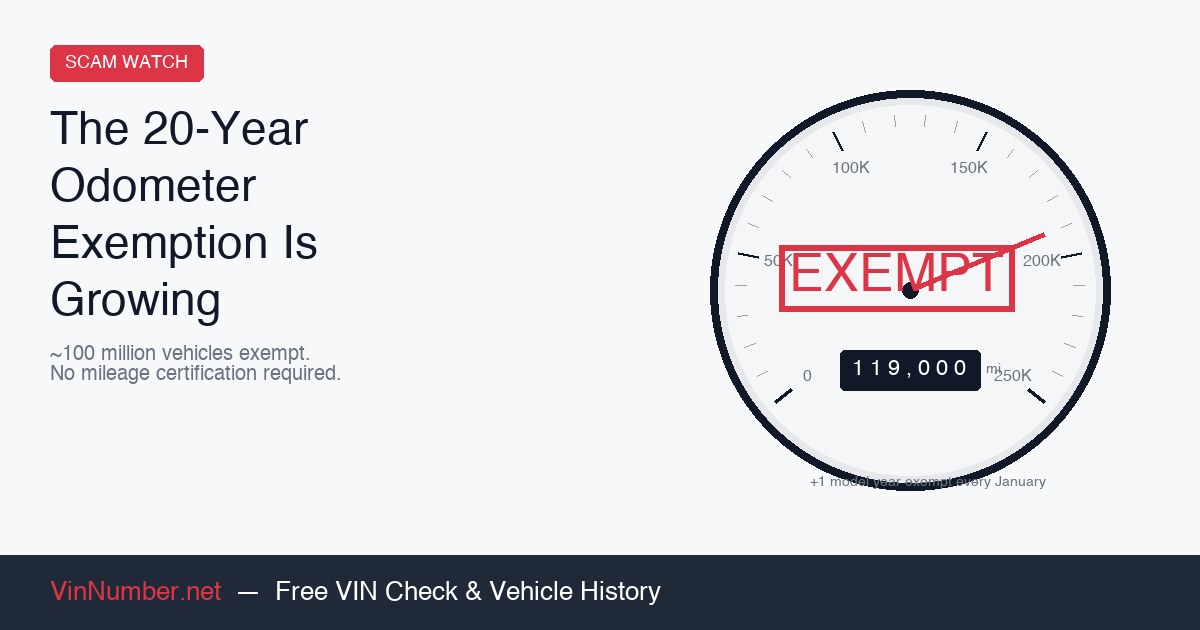
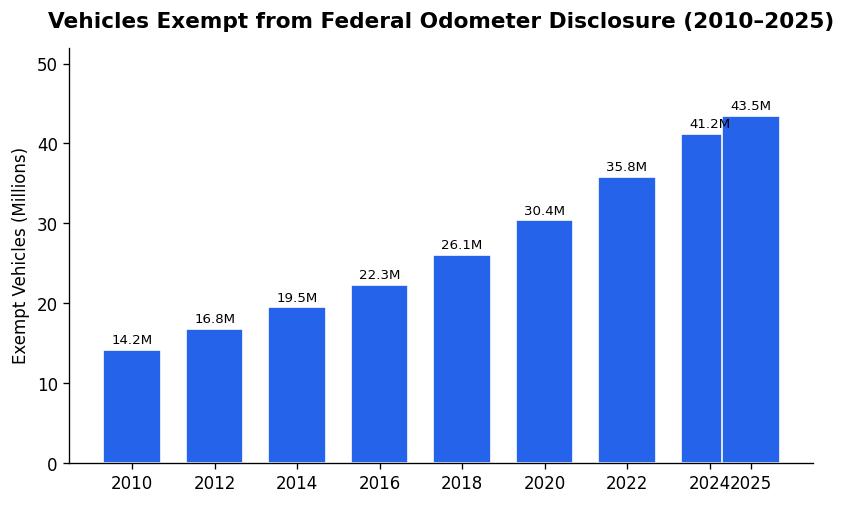
Federal odometer disclosure requirements under 49 USC 32705 don’t apply to vehicles that are 20 model years old or older, and as of the 2021 NHTSA rule change, the exemption also covers all vehicles with a model year of 2010 or earlier, regardless of age. In 2025, that means every vehicle from model year 2010 back is exempt from the federal requirement that sellers disclose the odometer reading as accurate on the title at the time of transfer, full stop. The number of exempt vehicles on American roads sits somewhere around 100 million, depending on which registration data is used, and that number grows every January when another model year ages past the 20 year threshold. A seller transferring title on an exempt vehicle writes the word “exempt” in the odometer disclosure field on the title document instead of recording the actual mileage. The mileage still shows on the dashboard. It just doesn’t have to appear on the title paperwork, and it doesn’t have to be certified as accurate by the seller under federal penalty.
The exemption exists because Congress determined that odometer readings on older vehicles become less reliable as the vehicle ages, and that requiring disclosure on vehicles with 15 or 20 years of accumulated mileage imposes a paperwork burden without corresponding consumer protection value. That rationale made more sense when the vehicle fleet was younger, and older vehicles made up a smaller share of the market. The average age of a vehicle on American roads is now over 12 years and climbing, which means the exempt population isn’t a shrinking tail of worn out vehicles anymore. NHTSA’s 2021 final rule extended the exemption from the previous 10 year window to 20 years and added the model year 2010 floor, which means that every vehicle built in 2010 or earlier is already exempt and has been since the rule took effect. The 20-year rolling window picks up where the fixed cutoff stops. In 2031, model year 2011 vehicles will age into the exemption, in 2032, model year 2012 vehicles follow, and the window continues expanding by one model year per calendar year from that point on indefinitely. The share of the US vehicle fleet covered by the exemption gets larger every year and won’t shrink unless Congress changes the statute or NHTSA reverses its own rulemaking.
The problem with the exemption is that it covers the exact segment of the used vehicle market where odometer fraud detection generates the most profit relative to the cost of committing it.
NHTSA estimates that something like 450000 vehicles are sold each year with rolled back odometers, and a disproportionate share of those are older vehicles in the 3000 to 12000 dollar price range, where a 40000 or 50000 mile reduction on the odometer adds 2000 to 4000 dollars of apparent value. Rolling back the odometer on a 2008 sedan from 178000 miles to 119000 miles takes less than an hour with an OBD programming tool that costs a few hundred dollars, and the vehicle’s resale value jumps from something like 4500 dollars to 7200 dollars based on the mileage difference alone. On an exempt vehicle, the seller doesn’t have to certify any mileage figure on the title. The title says exempt. The buyer sees a number on the dashboard and has no federally mandated disclosure document to compare it against. The odometer reading recorded at the last title event before the vehicle aged into exemption is the last verified number in the system, and everything after that is whatever the dashboard shows. A vehicle history report pulling NMVTIS data will carry the mileage readings from title events, registration renewals, inspection records, and service visits that occurred while the vehicle was still under the disclosure requirement, and those readings stop updating once the vehicle enters exempt status and title transfers no longer require mileage certification.
A VIN check on an exempt vehicle can still catch a rollback if the current odometer reading is lower than the last recorded mileage in the database. A vehicle that showed 156000 miles at its last non exempt title transfer in 2020 and now displays 112000 miles on the dashboard has an obvious discrepancy that a vehicle history report would flag. The gap in coverage comes from the direction nobody tracks. A vehicle that showed 156000 miles in 2020 and now displays 189000 miles has nothing in any database to contradict it, because 189000 is higher than the last recorded figure, and there is no way to determine from the data alone whether the actual mileage should be 219000, 243000, or some other number that accumulated during the years when title transfers stopped recording it. Wear patterns tell the story that the odometer used to tell and no longer has to. The brake pedal rubber, the driver’s seat bolster, the steering wheel grip, and the carpet wear all accumulate with use regardless of what the dashboard display reads. That physical evidence is the only verification available on a vehicle that has been exempt long enough for the database trail to go stale.
The affordable used vehicle market in the United States runs heavily on vehicles that are 12 to 20 years old, the price range where private sale buyers are spending 4000 to 10000 dollars, and don’t always pull a vehicle history report before completing the transaction. That is the same price range where the odometer exemption applies and where the financial incentive to roll back the mileage is baked into the economics of every transaction. As of 2025, the exemption covers everything through model year 2010 and everything 20 years old or older under the rolling window. The window only moves in one direction, and it adds another model year of vehicles every January.