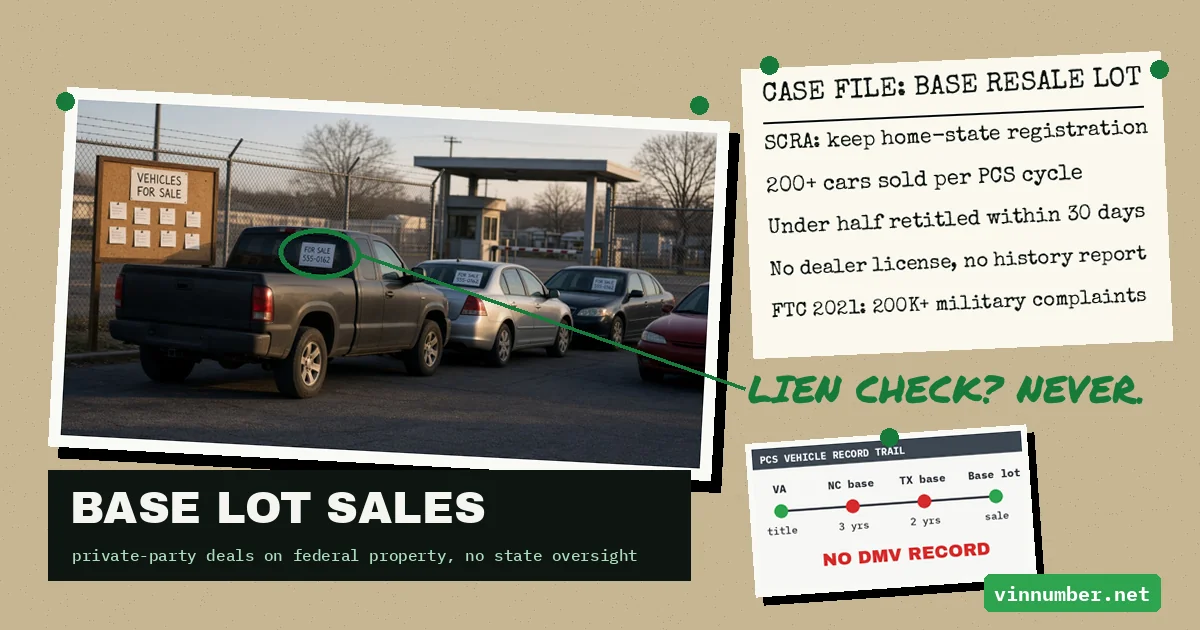
The Pentagon relocates the households of approximately 300000 service members and civilians every year at a cost of nearly three billion dollars, and roughly 80 percent of those moves are classified as discretionary under the framework the Department of Defense published in May 2025, when the services were directed to cut discretionary PCS move budgets by 50 percent by fiscal year 2030 against a fiscal 2026 baseline adjusted for inflation. Attached to every one of those relocations is a vehicle that has to go somewhere. The member shipping out either puts it on the installation resale lot, ships it at government expense, or leaves it with someone before the report date, and the member landing at the receiving installation needs a car the day they arrive. The Servicemembers Civil Relief Act lets active duty personnel hold their home state registration for the entire duration of service, regardless of where they get stationed. A vehicle titled in Virginia and driven for three years at a North Carolina base and then another two at a Texas installation can go the full five years without appearing in either duty station state's DMV records. Pull that vehicle's NMVTIS file, and it shows a title event in Virginia at purchase, then a blank stretch until the next title transfer lands wherever the next buyer files from. Whether any odometer readings actually made it into the system during those years comes down to whether the vehicle passed through documented service, a state inspection, or some other event that would have put a mileage figure into a database, and for a vehicle that spent those years bouncing between installations, there may not have been one. Five years across two installations, three or four sets of tires, brake jobs, and oil changes at shops outside the gate that probably do not feed into any data aggregator, and the ownership trail has ended up almost entirely outside the verification infrastructure the rest of the used vehicle market runs on. Rob Tisdale, who retired as an Army master sergeant after spending his last four years running the vehicle registration office at a major southeastern installation, told me the resale lot moved past 200 vehicles in a single PCS cycle routinely, fewer than half of those producing a title transfer processed inside the 30 day window the duty station state sets for private party sales.
Installation commanders set the rules on these lots, not state dealer licensing authorities, and every sale proceeds as a private party transaction with whatever disclosure requirements the duty station state puts on private sellers, which in most states is nothing enforceable. Dealer licensing does not apply, state advertising compliance is not a factor, nobody has to produce a vehicle history report, and no state motor vehicle commission or attorney general has a way to reach transactions that happen on federal property. The FTC's Consumer Sentinel database logged over 200000 complaints from military consumers across all sales channels in 2021, with reported monetary harm of over 267 million dollars, and auto related issues have sat in the top ten complaint categories for military consumers in every reporting period since the FTC started breaking out the military data. The CARS Rule went final in December 2023 with provisions aimed at dealers who prey on service members, among them prohibitions on falsely claiming military affiliation and misrepresenting whether a financed vehicle can cross state lines on PCS orders, but the rule reaches licensed dealers and nothing beyond that. Private party sales on federal installation property fall outside it entirely, in a space where the installation commander has authority over parking rules and listing durations but not over disclosure of mechanical defects, outstanding liens, title brands, or prior damage history. In all the years Tisdale managed that lot, he said he never saw a buyer pull a vehicle history report or request a lien check before completing a purchase, not a single time. Disputes that did make it to the legal assistance office, and not many did, were treated as private civil matters between two service members, no mechanism for the installation to step in on the merits, because the offices exist to handle powers of attorney and lease disputes, not to adjudicate odometer fraud or undisclosed salvage titles. The FTC complaint numbers indicate a broad problem with auto related harm to military consumers, though the data does not disaggregate on base private party sales from off base dealer transactions, and the actual exposure belonging to installation resale lots has not been quantified.
The verification gap gets wider overseas and eventually becomes close to invisible. Roughly 221600 military and DoD civilian personnel were stationed in foreign countries as of December 2025, with Japan hosting around 53000, Germany about 36000, and South Korea closer to 24000. Those personnel register privately owned vehicles through the installation provost marshal under Status of Forces Agreements with the host nations, and the SOFA plates those vehicles carry sit entirely outside the host country's civilian vehicle registration system. When one of those vehicles gets acquired from a departing member overseas and driven for two or three years under SOFA registration with the odometer accumulating kilometers, then shipped back through a Vehicle Processing Center, the service history it carries on arrival may be nothing more than receipts from an on base auto hobby shop or a host nation mechanic whose paperwork is in a language and format that no domestic vehicle history database can process. Danielle Kowalski, a title fraud examiner with an East Coast state DMV office, told me she has reviewed NMVTIS records on vehicles returning from overseas with odometer conversions from kilometers to miles that relied entirely on the service member's self reported figure at the receiving DMV. One case she documented involved a specialist at Fort Liberty who purchased a sedan from a departing service member for 14500 dollars with 48000 miles on the title, and the German language service interval records the vehicle carried from the overseas station put the actual figure closer to 74000 miles, but the DMV title clerk who processed the original conversion had no obligation and no ability to read the foreign documentation and nobody cross referenced it against the converted figure before it went onto the title. The buyer did not find out until a routine service appointment six months later turned up wear patterns inconsistent with the mileage showing on the odometer, and by then the seller had PCSed to a duty station in the Pacific and was not reachable through the installation's legal assistance office.
By age 24, roughly 20 percent of young service members carry 20000 dollars or more in auto related debt, according to FTC data cited during the CARS Rule proceeding. The PCS cycle compresses the selling window into almost nothing every year. The departing member needs the vehicle gone before the report date, and the arriving member needs transportation the day they land, and what ends up occupying the space where formal verification should sit is the trust that runs through the military community. A lien check does not happen, and a vehicle history report does not get pulled, and the base legal assistance office advises after the fact, if it advises at all. The new Personal Property Activity at Scott Air Force Base, which stood up May 1, 2026, under a direct report to the Secretary of Defense, addresses household goods logistics and the aging Defense Personal Property System software that runs them. That vehicle resale market, the one that operates alongside every PCS cycle on every installation, title chains bouncing across three or four states, SCRA protected registration gaps keeping the vehicles invisible to the titling infrastructure in the states where they are physically located and driven, none of it was part of that reform.