Dodge VIN Number Check

Enter any Dodge VIN to decode it and see open NHTSA recalls for free. Then check the Takata, Durango TIPM/ABS, Hornet PHEV and Dart shifter campaigns below for your model year.

2C3 1C4 3C4

Free decode with open NHTSA recalls. 17 characters, no I, O or Q.

About Dodge VINs

How Dodge VINs are built

Dodge Chargers and Challengers built in Brampton, Ontario, carry VIN prefix 2C3. Durangos from Jefferson North (Detroit) use 1C4 (shared WMI family with Jeep). Journeys from Toluca, Mexico, use 3C4. Older patterns include 2B3/1B3 and truck-era 1D3 (now Ram). Charger and Challenger muscle cars are among the most frequently flagged vehicles in VIN checks due to high-speed accident rates and salvage title rebounds. A free VIN decode on any Dodge shows its factory specs, assembly plant and engine, plus any open NHTSA recalls.

The first three characters identify the maker and plant region. In NHTSA's vPIC, 2C3 covers many Brampton, Ontario Chargers and Challengers. 1C4 marks Jefferson North (Detroit) Durangos (shared WMI family with Jeep). 3C4 marks Toluca, Mexico Journeys. Older patterns include 1B3/2B3 and truck-era 1D3. The 11th character and the full decode confirm the plant.

Dodge vehicles manufactured for the US market carry VIN prefixes of 2C3, 1C4, 3C4, 2B3, 1B3, 1D3. The VIN number encodes the country of manufacture (USA), production plant, vehicle line, body style, engine type, model year, and a unique production sequence number.

HQAuburn Hills, Michigan (Stellantis NA)
ParentStellantis
Muscle carsCharger · Challenger
SUVDurango
Canada plantBrampton, Ontario
Also built inDetroit · Toluca

Sources: Brand: Stellantis — Dodge · Plants/WMIs: NHTSA vPIC

NHTSA campaign data

Which model years each recall covers

Drag the year line to your car’s model year. Bars it crosses are the campaigns to confirm on the VIN.

2018
Do Not Drive Park outside (fire risk) Safety recall
2 campaigns cross 2018
200820122016202020242026
PARK OUTSIDE · 23V-623
PHEV 12V / high-voltage cables may loosen and overheat
2023–2024 Hornet. 2023–2024 Dodge Hornet plug-in hybrid (shared with Alfa Romeo Tonale). Loose 12-volt positive and/or HV connector cables can overheat. Fire risk. NHTSA's record tells owners to park outside, away from structures, until it is repaired.
What to askConfirm 23V-623 is closed on this VIN.

Coverage depends on build dates, options (AWD, PHEV, engine) and plant. A listed year doesn't mean every vehicle from that year is included; the VIN lookup decides. Pre-2010 trucks often appear under Ram today. "Takata" marks EA15-001. "Do not drive" and "Park outside" follow NHTSA's recall record.

Dodge Recalls: How to Check a Specific VIN

  1. Enter the full 17-character VIN in the NHTSA recall lookup.
  2. Then use Dodge owner resources / a Dodge dealer recall lookup.
  3. On a 2004–2015 Charger/Challenger/Durango, check every Takata campaign before a test drive.
  4. On a Hornet PHEV, confirm 23V-623 is closed before parking indoors. Recall repairs are free at Dodge dealers.
Full list: every campaign in this timeline
Selected Dodge recalls worth confirming on a used-car VIN (NHTSA campaign data)
CampaignIssueModels & years
16V-352 · 18V-021 · 19V-018Do Not Drive Takata passenger air bag inflator may rupture2006–2015 Charger, 2008–2014 Challenger, 2004–2009 Durango, 2005–2008 Magnum. NHTSA's record carries a do-not-drive advisory on these Takata passenger-inflator campaigns for older Dodge cars and SUVs (also Dakota). Filed under EA15-001. Filed under NHTSA's Takata inflator investigation (EA15-001). NHTSA's record tells owners not to drive the vehicle until it is repaired.
15V-313 · 15V-444 · 16V-947Do Not Drive Takata driver air bag inflator may rupture2006–2010 Charger, 2008–2010 Challenger, 2004–2009 Durango, 2005–2008 Magnum. Dual-stage driver frontal air bag. 15V-444 is Challenger-specific; 16V-947 covers certain 2009 Durango. Do-not-drive advisory in NHTSA's record. Filed under NHTSA's Takata inflator investigation (EA15-001). NHTSA's record tells owners not to drive the vehicle until it is repaired.
13V-103Do Not Drive Battery positive cable at the starter may short (fire risk)2013 Challenger. Small-population 2013 Challenger V6 campaign. Electrical short to ground. NHTSA's record tells owners not to drive the vehicle until it is repaired. Fire risk.
23V-623Park outside PHEV 12V / high-voltage cables may loosen and overheat2023–2024 Hornet. 2023–2024 Dodge Hornet plug-in hybrid (shared with Alfa Romeo Tonale). Loose 12-volt positive and/or HV connector cables can overheat. Fire risk. NHTSA's record tells owners to park outside, away from structures, until it is repaired.
14V-530 · 15V-115 · 19V-813Fuel pump relay in the TIPM may fail (stall / no-start)2011–2013 Durango. 2011–2013 Durango with 3.6L, 5.7L or 6.4L. 19V-813 re-recalls trucks already repaired under 14V-530/15V-115 because the relay can still fail.
14V-154 · 17V-572Brake booster may corrode / earlier shield campaign incomplete2011–2014 Durango. 2011–2014 Durango (shared with Grand Cherokee). Water intrusion can limit braking assist.
22V-426 · 24V-838ABS module may illuminate brake lights and disable ABS/ESC; may allow shift from Park without brake2018–2019 Durango. 2018–2019 Durango (and Grand Cherokee). 22V-426: start/shift from Park without brake. 24V-838: ABS/ESC disable.
24V-198Side curtain air bag inflator may rupture2018–2021 Charger. 2018–2021 Charger (and Chrysler 300). Left/right curtain inflators may rupture.
17V-432 · 17V-376Driver frontal air bag wiring may chafe and deploy unexpectedly2011–2015 Journey, 2011–2012 Grand Caravan. Steering-wheel harness chafe. Journey 2011–2015 (17V-432); Grand Caravan 2011–2012 (17V-376).
19V-293 · 25V-674Shifter cable may detach (loss of Park)2013–2016 Dart. 2013–2016 Dart with 6-speed automatic. Cable/bushing failure prevents full Park engagement (rollaway risk). 25V-674 is the 2025 expansion/reissue.
17V-435EHPS alternator may fail (loss of power steering assist)2011–2014 Charger, 2011–2014 Challenger, 2011–2014 Durango. Electro-hydraulic power steering vehicles with the affected alternator.
23V-115 · 26V-528Rear spoiler may misalign and damage during liftgate use2021–2023 Durango. 2021–2023 Durango. Spoiler not aligned with the roof.
17V-097AWD front driveshaft bolts may loosen2014–2017 Charger. 2014–2017 Charger AWD (and Chrysler 300). Loss of motive power if the front driveshaft disconnects.
15V-675ABS water intrusion may disable ABS2012–2015 Journey. 2012–2015 Journey. Water into the ABS module harness.

Durango electrical & brakes

TIPM fuel-pump relay, brake booster and ABS campaigns

Durango shares several high-consequence campaigns with the Jeep Grand Cherokee of the same years. Confirm these on any used 2011–2019 example.

TIPM fuel pump relay

14V-530, 15V-115, 19V-813: 2011–2013 Durango — stall or no-start; 19V-813 re-covers earlier repairs.

Brake booster

14V-154 and 17V-572: 2011–2014 — water/corrosion can cut brake assist.

ABS / Park

22V-426 and 24V-838: 2018–2019 — brake-light/ABS/ESC faults; may allow shift from Park without the brake.

What to do

Ask for TIPM/relay and ABS repair records. Re-check the VIN even if a prior owner said it was fixed.

Sources: NHTSA recall records · Dodge owner resources

Dodge models

Dodge Models

Open a model for its VIN check, generations, recalls and owner complaints.

About Dodge

🎙️ Listen to this article

The Brothers Who Built Detroit

Dodge has long held the title of the rebellious sibling in the Chrysler family, renowned for its raw power and bold design. This spirit traces back to its founders, Horace and John Dodge. These two brothers launched their automotive venture in 1900, initially finding success by manufacturing parts for the burgeoning Ford Motor Company. These early days laid the groundwork for their own ambitious move into car production.

In 1914, the brothers introduced their first vehicle, the Dodge Model 30-35. It quickly gained a reputation for quality and innovation, featuring all-steel bodies rather than the customary wood-framed design of the time. This decision not only improved durability and safety but also set the stage for Dodge's daring approach to car manufacturing.

During World War II, Dodge played a crucial role in the war effort, producing trucks for the military. These robust vehicles were known for their toughness, a trait that carried over into the post-war consumer models. The resilience and reliability of Dodge vehicles during these years cemented the brand's reputation as a maker of rugged, dependable cars.

Muscle Car Royalty

As American culture shifted in the 1960s, so did Dodge. The company embraced the burgeoning muscle car era with open arms, introducing iconic models like the Dodge Charger and Challenger. These vehicles quickly became legends, powered by engines like the legendary 426 Hemi. This engine was so dominant on the racetrack that it earned the nickname "The Elephant" for its sheer size and power.

The Charger and Challenger became synonymous with speed and style, capturing the imagination of a generation of car enthusiasts. Their aggressive styling and throaty V8 engines made them instant classics and secured Dodge's place among the muscle car royalty. Even today, the aura of the 1960s and 70s muscle cars lingers around the brand, inspiring new generations of drivers.

The 1990s saw Dodge continuing to push the boundaries with the launch of the Dodge Viper. This supercar came equipped with a monstrous V10 engine, offering a driving experience like no other. Its introduction solidified Dodge's commitment to high-performance vehicles and marked another chapter in its storied history.

Bankruptcy and the Hellcat Renaissance

The late 2000s were challenging years for the automotive industry, and Dodge was not immune. The financial crisis of 2008-2009 brought Chrysler to the brink of collapse, threatening the future of the Dodge brand. However, with a combination of government intervention and strategic restructuring, Chrysler emerged from bankruptcy, allowing Dodge to stage a remarkable comeback.

The revival of the Dodge Charger and Challenger in the following years marked a new era for the brand. These muscle cars embraced modern technology while paying homage to their storied past. The introduction of the Hellcat and Demon variants took things to an entirely new level, offering raw power that had to be experienced to be believed. With horsepower ranging from 707 to over 840, these models reminded everyone that Dodge was still a force to be reckoned with.

The Dodge Durango, another staple of the lineup, also saw renewed interest as a powerful SUV capable of hauling both passengers and cargo with ease. While the Durango may not scream muscle car, it shares the same DNA of performance and ingenuity that characterizes Dodge's best offerings.

The Final Chapter for V8s

As the automotive industry accelerates towards electrification, Dodge stands at a unique crossroads. The brand is among the last major manufacturers still offering V8 muscle cars to the general public, a testament to its commitment to traditional performance. However, the winds of change are undeniable, and Dodge's future line-up will inevitably incorporate electric technology.

The swan song of the V8 era comes with special editions and final releases that celebrate the history and legacy of Dodge's muscle cars. This transition marks the end of an era, but also the beginning of a new chapter. Dodge enthusiasts eagerly anticipate how the brand's rebellious spirit will manifest in an electrified future.

While the V8 muscle cars may be on their way out, they leave behind a legacy that is unmatched in automotive history. Dodge's commitment to performance and power ensures that whatever comes next will carry the same boldness and excitement that fans have come to expect.

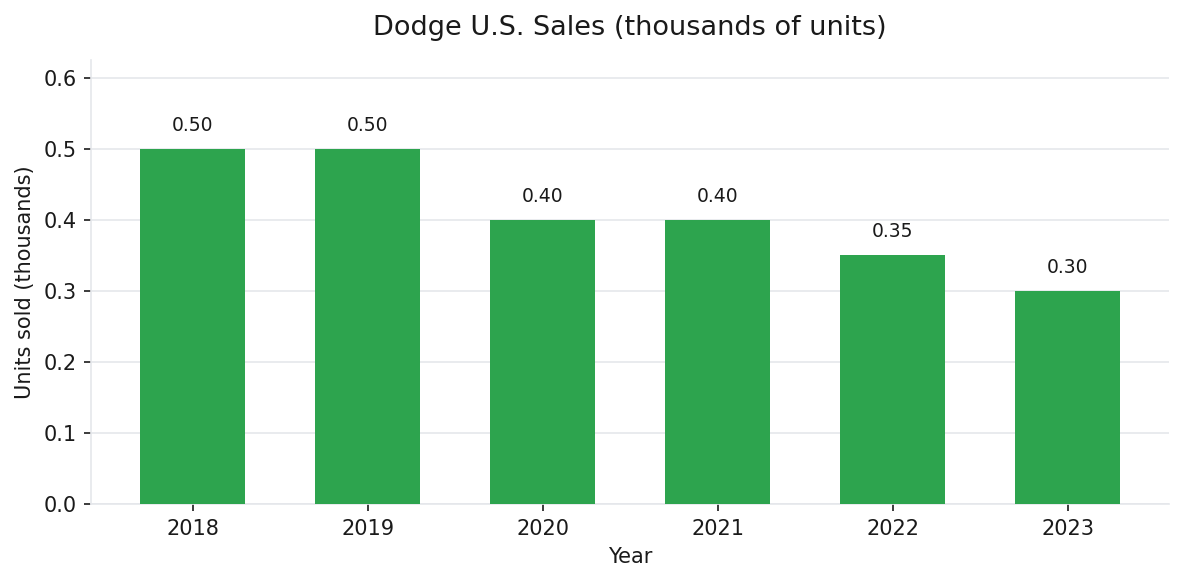
Dodge U.S. annual vehicle sales 2018-2023
Dodge U.S. annual sales
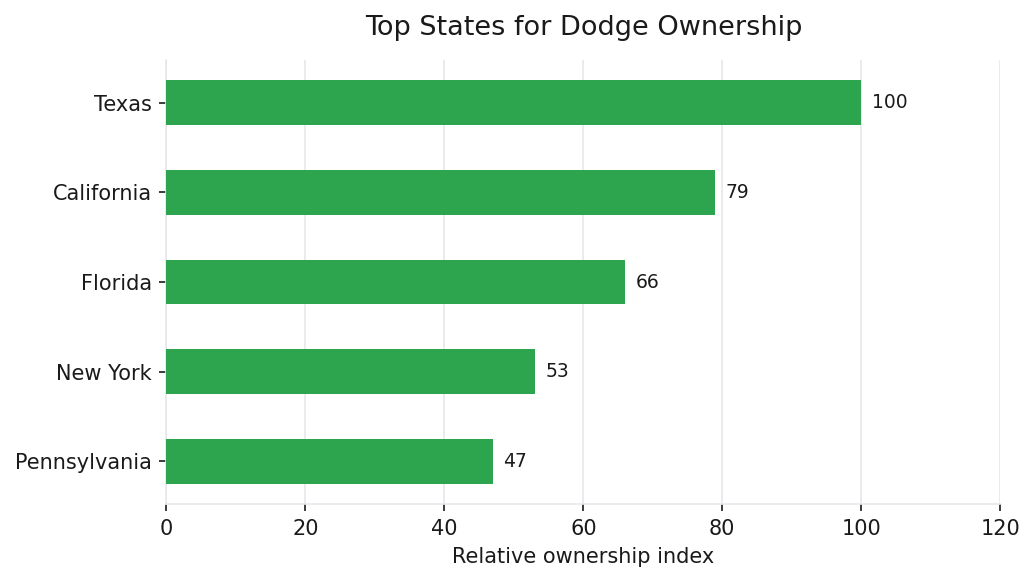
Top U.S. states for Dodge vehicle ownership
Top states for Dodge ownership

Used-car checklist

What to Verify on a Used Dodge

Six checks specific to used Dodges.

Takata (older cars/SUVs)

2004–2015: passenger 16V-352/18V-021/19V-018; driver 15V-313/15V-444/16V-947 (do not drive).

Durango TIPM / brakes / ABS

See the Durango section.

Hornet PHEV

Cable overheat 23V-623 (park outside) on 2023–2024 plug-in hybrids.

Journey / Grand Caravan air bag

Unexpected driver air bag 17V-432 (Journey) and 17V-376 (Caravan).

Dart Park function

Shifter cable 19V-293/25V-674 on 2013–2016 automatics.

Performance / fleet use

Chargers and Challengers show elevated collision rates; police-fleet Chargers need extra PPI scrutiny.

World Manufacturer Identifier

Dodge VIN prefixes (WMI)

Prefix registrations and example decodes come from NHTSA's vPIC database.

2C3
FCA Canada · Brampton

A 2016 Charger and a 2018 Challenger decode to Brampton, Ontario under 2C3.

1C4
FCA US · Jefferson North (Detroit)

A 2018 Durango decodes to Detroit under 1C4 (shared WMI family with Jeep).

3C4
Chrysler de México · Toluca

A 2018 Journey decodes to Toluca, Mexico under 3C4.

Worked example

Worked example: reading a Dodge VIN

Example VIN (demo only): 2C3CDXCTXGH000000

2C3CDXCTXGH000000
2C3
1–3 · WMI
FCA Canada passenger car, Canadian-built.
CDXCT
4–8 · VDS
Dodge codes for model, body, restraint and engine (Charger pattern).
X
9 · Check digit
Federal check digit.
G
10 · Model year
G = 2016
H
11 · Plant
Brampton plant code.
000000
12–17 · Serial
Zeroed demo serial.
Buyer check: a 2016 Charger can be covered by Takata zone campaigns, AWD driveshaft bolts 17V-097 (if AWD) and EHPS 17V-435 (earlier years); the VIN decides. Confirm Brampton matches the title.

Buyer notes by model

Top Dodge Models: What to Check

Open a model for the checks that matter most.

Dodge Charger

Takata on 2006–2015. Curtain inflator 24V-198 (2018–2021). AWD driveshaft 17V-097 (2014–2017). EHPS 17V-435 (2011–2014). Brampton 2C3.

Dodge Challenger

Takata including Challenger-specific driver 15V-444. Starter-cable DND 13V-103 (2013 V6). EHPS 17V-435.

Dodge Durango

TIPM 14V-530/15V-115/19V-813. Brake booster 14V-154/17V-572. ABS/Park 22V-426/24V-838. Spoiler 23V-115/26V-528. Detroit 1C4.

Journey · Grand Caravan · Dart · Hornet

Journey air bag 17V-432 and ABS 15V-675. Caravan air bag 17V-376. Dart shifter 19V-293/25V-674. Hornet PHEV 23V-623 (park outside).

FAQ

Common questions about Dodge VINs

What VIN prefix do Dodge vehicles use?

Dodge Chargers and Challengers built in Brampton, Ontario, use 2C3. Durango SUVs assembled in Jefferson North, Detroit, carry a 1C4 prefix shared with Jeep. Journey models built in Toluca, Mexico, use 3C4. Older cars may show 1B3 or 2B3; truck-era 1D3 prefixes are now associated with Ram.

What does a free Dodge VIN check on VinNumber.net show?

The free decoder reads the VIN in NHTSA's vPIC database and returns the model, model year, body, engine, drive type and assembly plant. Dodge VINs in vPIC start with prefixes such as 2C3, 1C4 and 3C4. The same lookup lists NHTSA safety recalls for that make, model and model year. Each of our 7 Dodge model pages adds what NHTSA and the EPA have published: owner complaints, technical service bulletins, defect investigations, fuel economy and, where NHTSA has tested the car, NCAP crash ratings. It is not a vehicle history report: it doesn't show accidents, title brands, odometer readings or theft records.

Where is the VIN located on a Dodge vehicle?

Dodge cars place the VIN on a metal plate visible through the lower driver side corner of the windshield. The same number is printed on a sticker inside the driver door jamb. Charger and Challenger models have the VIN stamped on the radiator support in the engine bay. Durango SUVs carry an additional stamp on the frame. When buying a used Charger or Challenger, it is worth checking the firewall stamp specifically, as high-value muscle cars are occasionally subject to title washing or VIN cloning.

Which Dodge models have the most recall history?

Charger and Challenger carry Takata do-not-drive campaigns (15V-313, 15V-444, 16V-352, 18V-021, 19V-018) plus Charger curtain-inflator 24V-198 and EHPS 17V-435. Durango shares TIPM fuel-pump relay recalls 14V-530/15V-115/19V-813, brake-booster 14V-154/17V-572 and ABS/Park 22V-426/24V-838 with Grand Cherokee. Journey and Grand Caravan have unexpected driver-air-bag campaigns 17V-432 and 17V-376. Dart has shifter-cable Park failures 19V-293/25V-674. Hornet PHEV has park-outside cable recall 23V-623. Pre-2010 trucks are tracked under Ram today.

Which Dodges are under a do-not-drive or park-outside warning?

Do-not-drive: Takata passenger campaigns 16V-352, 18V-021 and 19V-018 and driver campaigns 15V-313, 15V-444 and 16V-947 on older Chargers, Challengers, Durangos and related models, plus starter-cable recall 13V-103 on certain 2013 Challenger V6 cars. Park-outside: Hornet PHEV cable recall 23V-623 on 2023–2024 plug-in hybrids. If the VIN shows one open, follow the advisory until a Dodge dealer closes it.

What is the Dodge Durango TIPM fuel-pump recall?

Recalls 14V-530, 15V-115 and 19V-813 cover 2011–2013 Dodge Durango (and Jeep Grand Cherokee) trucks with 3.6L, 5.7L or 6.4L engines. The fuel pump relay inside the Totally Integrated Power Module can fail, causing a stall or no-start. 19V-813 re-recalls vehicles already repaired under the earlier campaigns because the relay can still fail. Re-check the VIN even if a prior owner said it was fixed.

Is the Dodge Hornet PHEV under a park-outside recall?

Yes. NHTSA recall 23V-623 covers 2023–2024 Dodge Hornet plug-in hybrids (shared with Alfa Romeo Tonale). The 12-volt battery positive cable and/or high-voltage connector cable may not be tightened properly and can overheat. NHTSA lists a park-outside advisory. Confirm the campaign is closed before parking the vehicle indoors.

Why check the firewall VIN stamp on a used Charger or Challenger?

High-value muscle cars are occasional targets for title washing or VIN cloning. Dodge stamps the VIN on the windshield plate, the door-jamb sticker and typically on the firewall or radiator support. If those numbers disagree, or if the title plant/WMI does not match a Brampton (2C3) build for a late Charger/Challenger, walk away or get a specialist inspection before you buy.