Hyundai VIN Number Check

Enter any Hyundai VIN to decode it and see open NHTSA recalls for free. Then check the Theta II engine, anti-theft and park-outside campaigns below for your model year.

5NP 5NM 5NT KMH KM8 7YA

Free decode with open NHTSA recalls. 17 characters, no I, O or Q.

About Hyundai VINs

How Hyundai VINs are built

Hyundai vehicles assembled in Montgomery, Alabama carry a 5NP prefix. Models imported from South Korea begin with KMH. Hyundai and its sister brand Kia have been subject to widespread engine failure recalls affecting Theta II engines used in Sonata and Santa Fe Sport models, making VIN checks on these vehicles particularly relevant for buyers.

Where a Hyundai was built shows in the first three characters. U.S.-built Hyundais from the Montgomery, Alabama plant (HMMA) start with 5NP (cars such as the Sonata and the Elantra built there until 2023), 5NM (SUVs such as the Santa Fe and Tucson) or 5NT (the Santa Cruz pickup). Ioniq 5s from the Georgia Metaplant (HMGMA) start with 7YA. Korean-built cars start with KMH, and Korean-built SUVs and crossovers such as the Kona and Ioniq 5 with KM8. Some early-2010s Santa Fe and Santa Fe Sport models were built at Kia's Georgia plant and carry Kia's 5XY prefix. The prefix doesn't name the model, so let the full 17-character decode confirm model, engine, year and plant.

Hyundai vehicles manufactured for the US market carry VIN prefixes of 5NP, 5NM, 5NT (US Alabama); 7YA (US Georgia); KMH, KM8 (South Korea). The VIN number encodes the country of manufacture (South Korea), production plant, vehicle line, body style, engine type, model year, and a unique production sequence number.

HQSeoul, South Korea
Founded1967
CEOJosé Muñoz (since 2025)
US assemblyMontgomery, AL · Ellabell, GA
US sales 2024836,802
US sales 2025901,686

Sources: HQ/founded: Hyundai sustainability report · CEO: Hyundai newsroom · US plants: HMMA, HMGMA · Sales: Hyundai Motor America, Jan 2026

NHTSA campaign data

Which model years each recall covers

Drag the year line to your car’s model year. Bars it crosses are the campaigns to confirm on the VIN.

2014
Safety recall Park outside (fire risk) Service campaign / warranty
8 campaigns cross 2014
2012201620202024
SAFETY RECALL · 17V-226
Theta II engine: machining errors can cause premature connecting-rod bearing wear
2013–2014 Sonata, 2013–2014 Santa Fe Sport. 2.0L or 2.4L GDI Theta II engines.
What to askConfirm 17V-226 is closed, and ask for the engine replacement invoice if there was one.

Coverage depends on build dates and equipment (engine, tow hitch, push-button or turn-key start). A listed year doesn't mean every car from that year is included; the VIN lookup decides. "Park outside" means NHTSA's recall record tells owners to park outside and away from structures until the repair is done.

Hyundai Recalls: How to Check a Specific VIN

  1. Enter the full 17-character VIN in the NHTSA recall lookup. It shows open safety recalls, including the park-outside campaigns above.
  2. Then use Hyundai's own recall and service-campaign lookup. Service campaigns such as KSDS (campaign 953) and the anti-theft software (campaign 993) are not safety recalls, so check them there or with a Hyundai dealer.
  3. If a park-outside recall is open, don't store the car in a garage or carport until it is fixed. Recall repairs are free at Hyundai dealers.
  4. On a Theta II car (2011–2019 Sonata, 2013–2019 Santa Fe Sport, 2014–2015 and 2018–2019 Tucson), ask the dealer to confirm KSDS and the lifetime short-block warranty for this VIN.
Full list: every safety recall in this timeline
Selected Hyundai recalls worth confirming on a used-car VIN (NHTSA campaign data)
CampaignIssueModels & years
15V-568Theta II engine: crankshaft machining debris can starve connecting-rod bearings of oil2011–2012 Sonata. Built at the Alabama plant (HMMA) December 2009–April 2012 with the 2.0L or 2.4L GDI engine. Bearings can wear, knock and lead to engine failure.
17V-226Theta II engine: machining errors can cause premature connecting-rod bearing wear2013–2014 Sonata, 2013–2014 Santa Fe Sport. 2.0L or 2.4L GDI Theta II engines.
18V-934High-pressure fuel pipe may leak after a Theta II engine replacement2011–2014 Sonata, 2013–2014 Santa Fe Sport. Only cars that had an engine or short block replaced under 15V-568 or 17V-226. The fuel pipe may have been damaged, misaligned or mis-torqued during the replacement.
21V-3012.0L Nu MPI engine: piston oil rings may not have been heat-treated properly2019–2020 Elantra, 2019–2021 Kona. Only cars with the 2.0L Nu MPI engine. Also 2019–2021 Veloster.
23V-651Park outside ABS module may leak brake fluid internally and short; engine-compartment fire while parked or driving2011–2015 Elantra, 2010–2013 Tucson, 2013–2015 Santa Fe, 2013 Santa Fe Sport. NHTSA lists a park-outside advisory. Also 2012–2015 Accent, Azera and Veloster, 2011–2015 Genesis Coupe and Sonata Hybrid, 2013–2015 Elantra Coupe, 2014–2015 Equus, 2010–2012 Veracruz and 2015 Tucson Fuel Cell.
20V-520 · 21V-303Park outside ABS module brake-fluid leak can cause an electrical short and engine-compartment fire2013–2015 Santa Fe Sport. Two campaigns on the same vehicles; NHTSA lists a park-outside advisory for both.
22V-056 · 22V-810Park outside ABS module can malfunction and short; engine-compartment fire2016–2018 Santa Fe, 2017–2018 Santa Fe Sport, 2014–2015 Tucson. 22V-056 also lists the 2019 Santa Fe XL. 22V-810 covers certain 2018 Santa Fe Sport. NHTSA lists a park-outside advisory.
20V-543Park outside ABS hydraulic control unit (HECU) can corrode internally and short; engine-compartment fire2016–2021 Tucson. Recalled for 2019–2021 in September 2020 and expanded to 2016–2018 on December 30, 2020. NHTSA lists a park-outside advisory.
23V-181Park outside Tow-hitch harness module: water on the circuit board can short and cause a fire2019–2023 Santa Fe. Cars with a factory or dealer-accessory tow-hitch harness, including 2021–2023 Santa Fe Hybrid, 2022–2023 Santa Fe Plug-in Hybrid and 2022–2023 Santa Cruz. NHTSA lists a park-outside advisory.
22V-633Park outside Tow-hitch module: debris and moisture can short the circuit board; fire risk2020–2022 Palisade. Cars with a tow-hitch harness. NHTSA lists a park-outside advisory.
25V-893Park outside Optional Mobis tow-hitch harness may let water into its control module; trailer lights can fail or short2022–2024 Tucson. Only cars with the optional Mobis tow-hitch wiring harness. NHTSA lists a park-outside advisory.
23V-526Park outside Idle Stop & Go oil-pump controller may overheat; fire risk2023 Sonata, 2023 Elantra, 2023 Kona, 2023–2024 Tucson, 2023–2024 Palisade. NHTSA lists a park-outside advisory.
25V-291Park outside Electric oil-pump controller seal may let in moisture and short; fire risk2025 Palisade. NHTSA lists a park-outside advisory.
20V-630 · 21V-127Park outside Lithium-ion high-voltage battery may short-circuit; fire risk2019–2020 Kona Electric. 21V-127 also lists the 2020 Ioniq Electric; its remedy is inspection and replacement of the battery system. NHTSA lists a park-outside advisory for both.
24V-204 · 24V-868Integrated Charging Control Unit (ICCU) can be damaged and stop charging the 12-volt battery; loss of drive power2022–2024 Ioniq 5, 2023–2025 Ioniq 6. 24V-868 replaces 24V-204 and extends it to 2025 Ioniq 6. Cars already repaired under 24V-204 also need the 24V-868 remedy. Also certain Genesis GV60, GV70 and G80 Electrified.

Theft vulnerability · campaign 993

Hyundais without an engine immobilizer

In February 2023 NHTSA announced that Hyundai would offer free anti-theft software for about 3.8 million vehicles without an engine immobilizer, after social-media videos showed how to steal them. NHTSA counted at least 14 crashes and eight fatalities linked to the thefts.

Hyundai's dealer guidance is simple. A car with push-button start has an immobilizer and is not part of the campaign. Turn-key cars without an immobilizer are the ones at risk. Hyundai says engine immobilizers became standard on all Hyundai vehicles produced from November 2021.

Campaign 993 updates the alarm software: the alarm sounds for one minute instead of 30 seconds, and the car won't start unless the key is in the ignition. Anti-theft decals go on the front side windows. Older cars that can't take the software get an ignition-cylinder protector (campaign 9A5) or a steering-wheel lock (P32), and Hyundai offers up to $300 toward another anti-theft device for those owners.

Vehicles Hyundai lists for its anti-theft upgrade (certain turn-key vehicles without an immobilizer)
ModelModel yearsUpgrade
Elantra2011–2022Software (993)
Elantra GT2013–2020Software (993)
Sonata2011–2019Software (993)
Tucson2011–2022Software (993)
Santa Fe Sport2013–2018Software (993)
Santa Fe2013–2018, 2019–2022Software (993); also 2019 Santa Fe XL
Kona2018–2022Software (993)
Accent2018–2022Software (993)
Veloster2012–2017, 2019–2021Software (993)
Venue2020–2021Software (993)
Palisade2020–2021Software (993)
Genesis Coupe2013–2014Software (993)
Accent (RB)2012–2017 (and 2011)Ignition-cylinder protector (9A5)
Santa Fe (CM)2011–2012Ignition-cylinder protector (9A5)
Elantra Coupe2013–2014Ignition-cylinder protector (9A5)
Elantra Touring2011–2012Ignition-cylinder protector (9A5)
Veracruz2011–2012Ignition-cylinder protector (9A5)
Genesis Coupe2011–2012Ignition-cylinder protector (9A5)

Sources: NHTSA, Feb 14, 2023 · Hyundai bulletin (2023) · Hyundai bulletin (2024)

Engine history · Theta II

Theta II engine recalls, KSDS and the lifetime warranty

The 2.0L and 2.4L Theta II GDI engines are the biggest engine story in 2010s Hyundai VIN histories. The same engines went through recalls, a knock-sensor software campaign, a class settlement and an NHTSA consent order.

  1. Sep 2015
    15V-568 Sonata engine recall

    2011–2012 Sonata built in Alabama from December 2009 to April 2012. Crankshaft machining debris can restrict oil flow to the connecting-rod bearings, leading to knocking and engine failure.

  2. Mar 2017
    17V-226 recall for 2013–2014 models

    2013–2014 Sonata and Santa Fe Sport. Machining errors can cause premature bearing wear.

  3. Dec 2018
    18V-934 follow-up after engine swaps

    Cars that got a replacement engine under 15V-568 or 17V-226 may have a damaged or mis-torqued high-pressure fuel pipe that can leak.

  4. Oct 2019
    Class settlement and lifetime warranty

    Hyundai and Kia announced a settlement of the engine litigation. Hyundai said the lifetime warranty would cover original and subsequent owners, and the knock-sensor detection software (KSDS) would watch for symptoms that can come before engine failure.

    Hyundai/Kia press release

  5. Campaign 953
    KSDS software update

    Hyundai's dealer material calls the KSDS update service campaign 953, tied to warranty extension TXXI. When the software detects bearing-wear symptoms it sets a code (P1326).

    Hyundai dealer document on NHTSA

  6. Nov 2020
    NHTSA consent order: $140 million

    NHTSA said Hyundai moved too slowly on the Theta II recalls and reported inaccurately. The order totals $140 million: $54 million paid upfront, $40 million for safety measures and $46 million deferred. With Kia's order the total was $210 million, covering recalls of more than 1.6 million vehicles.

    NHTSA press release

  7. Jun 2021
    Final approval

    The court entered final approval and judgment on June 10, 2021. The lifetime warranty covers the short block (engine block, crankshaft and bearings, connecting rods and bearings, pistons) for class vehicles owned by individual consumers that have completed KSDS, except in cases of exceptional neglect.

    Hyundai Theta II settlement site

17V-578 · 2017 Santa Fe 3.3L

17V-578: irregularities on the crankshaft pins can cause bearing wear and engine damage.

20V-746 · connecting-rod bearings

20V-746: certain 2012 Santa Fe, 2015–2016 Veloster, 2011–2013 and 2016 Sonata Hybrid. The connecting-rod bearings may wear prematurely.

21V-727 · connecting-rod bearings

21V-727: certain 2017 Tucson and 2017 Sonata Hybrid. The connecting-rod bearings may wear prematurely.

Sources: NHTSA consent order · Settlement administrator · Hyundai/Kia, Oct 2019 · Hyundai KSDS dealer document

Hyundai models

Hyundai Models

Open a model for its VIN check, generations, recalls and owner complaints.

About Hyundai

🎙️ Listen to this article

The $4,995 Car America Laughed At

In 1986, Hyundai made its first foray into the United States with the introduction of the Hyundai Excel. Priced at just $4,995, it was the cheapest car on American roads at the time, and it quickly became the butt of jokes for its questionable quality. Despite its low price tag, Americans flocked to dealerships, drawn by the affordability of the Excel, and Hyundai sold more than 168,000 units in its first year. However, the initial enthusiasm soon waned as reports of mechanical issues and poor build quality began to circulate. The Excel's reputation for being unreliable threatened to derail Hyundai's ambitions in the lucrative American market.

The story of Hyundai's origins, however, began far from the shores of the United States. Founded by Chung Ju-yung in 1967, Hyundai Motor Company was born in South Korea with the aim of creating an automotive brand that could compete on the global stage. Despite its humble beginnings, Hyundai persevered, learning from its initial missteps and gradually improving its vehicles' quality and reliability.

The Warranty Bet That Paid Off

By the late 1990s, Hyundai was struggling with a tarnished reputation in America due to lingering perceptions of poor quality. In a bold move to recapture consumer trust, Hyundai introduced an industry-leading 10-year/100,000-mile warranty in 1998. This audacious gamble aimed to demonstrate Hyundai's newfound confidence in its vehicles' reliability and durability.

The gamble paid off. Customers began to take notice, and Hyundai's sales figures started to climb. The warranty alleviated fears about the cars' longevity and signaled a shift in the company's approach to quality control. Hyundai went from being perceived as a purveyor of cheap, unreliable cars to a brand that offered value and reassurance.

From Budget Brand to Award Winner

As Hyundai's vehicles improved, so did their market position. The company introduced models like the Sonata and Elantra, which became consistent best sellers, bolstering Hyundai's reputation as a reliable and affordable choice. The Sonata, a midsize sedan, struck a chord with American consumers thanks to its combination of style, performance, and value. The Elantra, a compact car, similarly gained a loyal following.

In the 2000s, Hyundai expanded its lineup to include the Santa Fe and Tucson SUVs, catering to the growing demand for crossovers and sport utility vehicles in the American market. These models quickly gained popularity, further solidifying Hyundai's status as a major player in the automotive world.

The creation of the Genesis luxury sub-brand marked another milestone for Hyundai. Initially launched as a premium model under the Hyundai banner, Genesis eventually became its own separate brand in 2015. This move underscored Hyundai's commitment to diversifying its offerings and competing with established luxury brands.

Hyundai's dedication to innovation and quality has not gone unnoticed. The Ioniq 5 and Ioniq 6, part of Hyundai's electric vehicle lineup, have won numerous global awards, showcasing the company's prowess in the rapidly evolving EV market. These accolades highlight Hyundai's transition from a once-mocked budget brand to an influential force in the automotive industry.

The Theft Crisis and Lessons Learned

While Hyundai has enjoyed significant success, the company has faced its share of challenges. One notable issue was a well-publicized theft epidemic that affected certain Hyundai models due to a missing engine immobilizer. This oversight made some vehicles easier targets for thieves, leading to a spike in thefts and a flurry of negative press.

Hyundai responded by addressing the security vulnerabilities and implementing measures to safeguard its vehicles. The incident served as a critical lesson in the importance of security features in modern cars and underscored the need for automakers to continuously adapt to evolving threats.

Hyundai's remarkable rise from a struggling newcomer to a leader in the automotive world is a testament to its resilience and innovation. By taking steps to enhance quality, introduce groundbreaking warranty policies, and expand into new markets, Hyundai has transformed its image and secured its place among the top automakers globally. With a keen eye on the future, Hyundai continues to adapt and push the boundaries of what it means to be a modern car manufacturer.

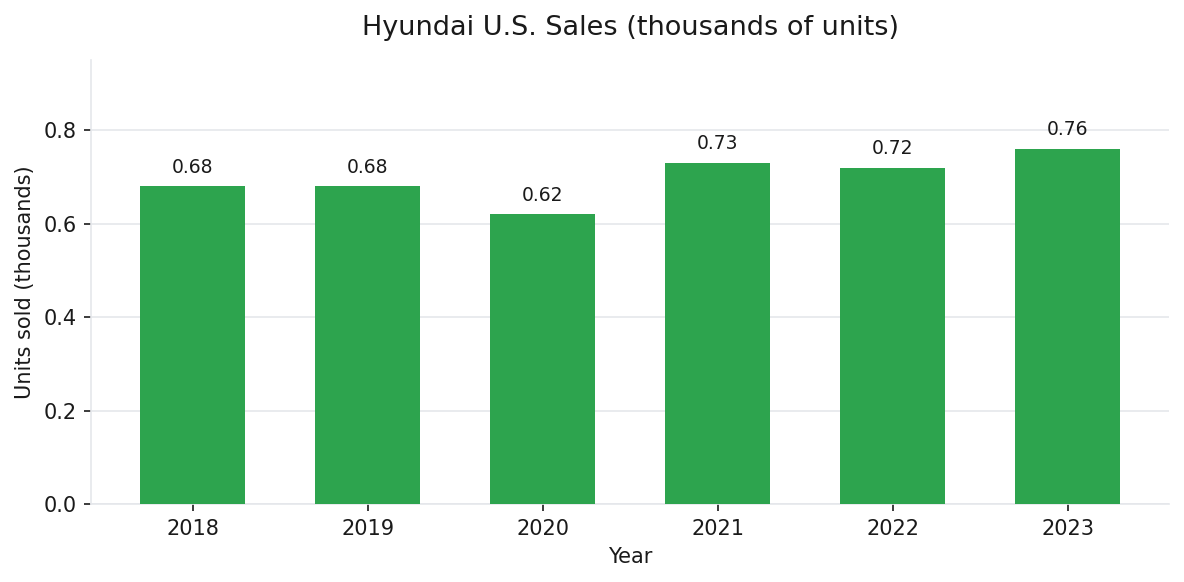
Hyundai U.S. annual vehicle sales 2018-2023
Hyundai U.S. annual sales
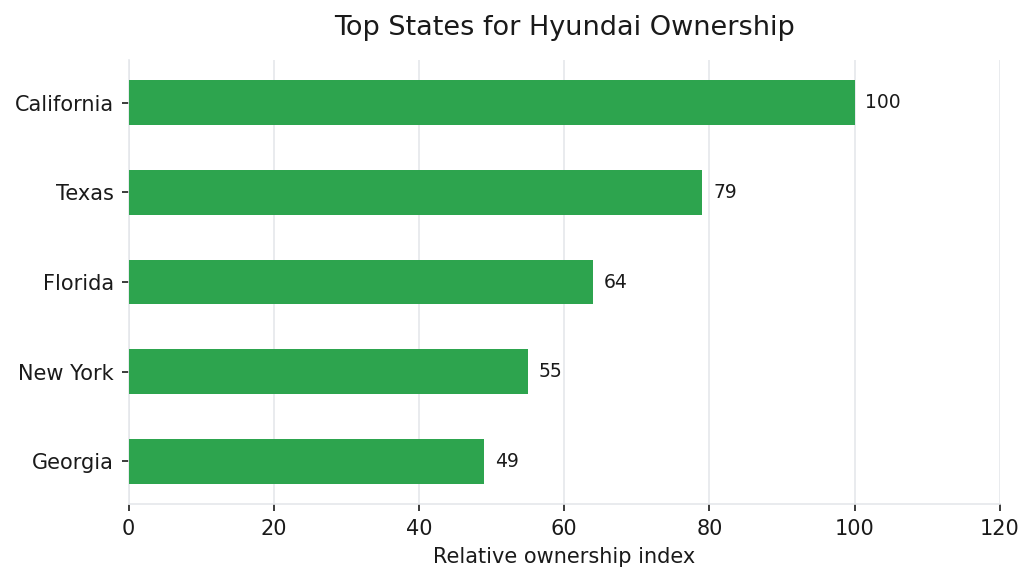
Top U.S. states for Hyundai vehicle ownership
Top states for Hyundai ownership

Used-car checklist

What to Verify on a Used Hyundai

Six checks specific to used Hyundais.

Theta II recall and KSDS

On a 2011–2014 Sonata or 2013–2014 Santa Fe Sport, confirm 15V-568 or 17V-226 is closed. On any settlement car (2011–2019 Sonata, 2013–2019 Santa Fe Sport, 2014–2015 and 2018–2019 Tucson with the 2.0L or 2.4L Theta II), ask a dealer to confirm KSDS (campaign 953). The lifetime short-block warranty depends on it.

Replaced engine? One more recall

If the engine was replaced under the Theta II recalls, 18V-934 checks the high-pressure fuel pipe that could leak after the swap. Ask for the engine-replacement invoice and listen for knocking at idle.

Immobilizer or turn-key

Turn-key Hyundais from 2011 to 2022 without an immobilizer were a theft target. Push-button start means an immobilizer. On a turn-key car, look for the campaign 993 window decals, inspect the ignition cylinder and ask whether it was ever stolen or recovered. See the theft campaign section.

Park-outside ABS fires

Several generations of Elantra, Tucson, Santa Fe, Santa Fe Sport and Accent have ABS or HECU recalls with a park-outside advisory (23V-651, 22V-056, 20V-543, 20V-520/21V-303). The NHTSA lookup must show them closed on this VIN.

Tow-hitch modules

If the car has a tow-hitch harness, check 23V-181 (2019–2023 Santa Fe, 2022–2023 Santa Cruz), 22V-633 (2020–2022 Palisade) and 25V-893 (2022–2024 Tucson with the optional Mobis harness). All three carry a park-outside advisory.

EV charging unit and battery

On a 2022–2024 Ioniq 5 or 2023–2025 Ioniq 6, confirm 24V-868 (ICCU) is repaired; it supersedes 24V-204. On a 2019–2020 Kona Electric, ask for proof of the battery-system replacement under 21V-127.

World Manufacturer Identifier

Hyundai VIN prefixes (WMI)

Prefix registrations and example decodes come from NHTSA's vPIC database. Several of these WMIs are shared with Kia or Genesis, so check that the decoded make really says Hyundai.

5NP
Hyundai (U.S.) · Passenger car

Alabama-built cars. A 2015 Sonata decodes to the Alabama plant; the Elantra was built there until 2023.

5NM
Hyundai Motor Manufacturing Alabama · SUV (MPV)

Alabama-built Santa Fe and Tucson. A 2024 Tucson decodes to Montgomery.

5NT
Hyundai Motor Manufacturing Alabama · Truck

The Santa Cruz pickup, built in Montgomery.

7YA
Hyundai Motor Group Metaplant America · MPV

Georgia Metaplant. A 2025 Ioniq 5 decodes here. Also registered for Kia.

KMH
Hyundai Motor Co. (Korea) · Passenger car

Korean-built Hyundai cars.

KM8
Hyundai Motor Co. (Korea) · SUV (MPV)

Korean-built SUVs and crossovers. Kona and Ioniq 5 decode to Ulsan.

5XY
Kia Georgia · MPV

Kia's West Point, Georgia plant code. Some 2010s Santa Fe and Santa Fe Sport models built there carry it.

Worked example

Worked example: reading a Hyundai VIN

Example VIN (demo only, not a real vehicle): 5NPE24AF1FH000000

5NPE24AF1FH000000
5NP
1–3 · WMI
Hyundai passenger car, built in the U.S.
E24AF
4–8 · Vehicle descriptor (VDS)
Hyundai's codes for model, body, engine and restraints. This pattern decodes as a Sonata sedan with the 2.4L GDI Theta II engine.
1
9 · Check digit
Calculated from the other 16 characters using the federal formula. If one character is mistyped or altered, the check digit usually stops matching.
F
10 · Model year
F = 2015 (federal year-code table)
H
11 · Assembly plant
Decodes to the Alabama plant (HMMA).
000000
12–17 · Serial number
Production sequence. A zeroed demo serial is used here on purpose.
Buyer check: a 2015 Sonata with the 2.4L Theta II is inside the settlement range (2011–2019 Sonata), so ask a dealer to confirm KSDS (campaign 953) for the VIN. If it is turn-key rather than push-button start, it is also in the anti-theft campaign 993 range. The year and plant you decode should match the title, the windshield VIN plate and the door-jamb label.

Buyer notes by model

Top Hyundai Models: What to Check

Open a model for the checks that matter most.

Hyundai Sonata

The Sonata has more NHTSA campaigns than any other Hyundai model, and most of the risk is in the engine. 2011–2012 cars are in Theta II recall 15V-568 and 2013–2014 cars in 17V-226; if the engine was replaced, 18V-934 must be closed too. Every 2011–2019 Sonata with the 2.0L or 2.4L Theta II is a settlement car, so ask for KSDS (campaign 953). Turn-key 2011–2019 Sonatas are in the anti-theft campaign 993 range. A 2023 Sonata needs oil-pump recall 23V-526 (park outside) closed.

Hyundai Elantra

2011–2015 Elantras are in ABS-module fire recall 23V-651, which carries a park-outside advisory. 2019–2020 cars with the 2.0L Nu engine need piston-ring recall 21V-301. Turn-key Elantras from 2011 to 2022 lack an immobilizer and are in the anti-theft campaign 993 range, so look for the decals and ask whether it was ever stolen. 2021–2022 Elantras have front seat-belt recalls (22V-218, 22V-354), and 2023 cars need 23V-526.

Hyundai Tucson

Three Tucson generations each have their own ABS fire recall with a park-outside advisory: 2010–2013 (23V-651), 2014–2015 (22V-056) and 2016–2021 (HECU, 20V-543). 2014–2015 and 2018–2019 Tucsons with the 2.0L or 2.4L Theta II are settlement cars, and a 2017 Tucson is in bearing recall 21V-727. Turn-key 2011–2022 Tucsons are in the anti-theft range. On 2022–2024 cars with the optional Mobis tow hitch, check 25V-893; on 2023–2024, check 23V-526. A 5NM prefix means it was built in Alabama.

Hyundai Santa Fe and Santa Fe Sport

The names are confusing, so decode the VIN first. From 2013 to 2018 Hyundai sold the two-row Santa Fe Sport alongside a three-row Santa Fe (called Santa Fe XL for 2019). 2013–2014 Santa Fe Sport is in Theta II recall 17V-226 (plus 18V-934 after an engine swap), and the settlement lists 2013–2019 Santa Fe Sport. ABS fire recalls with a park-outside advisory cover 2013–2015 Santa Fe Sport (20V-520, 21V-303), 2016–2018 Santa Fe and 2017–2018 Santa Fe Sport (22V-056). The 2017 Santa Fe 3.3L is in 17V-578, and 2019–2023 cars with a tow hitch need 23V-181. Some early-2010s models carry Kia Georgia's 5XY prefix.

Hyundai Kona and Kona Electric

2019–2021 Konas with the 2.0L Nu engine are in piston-ring recall 21V-301, and 2023 Konas need 23V-526. Turn-key 2018–2022 Konas are in the anti-theft campaign 993 range. The 2019–2020 Kona Electric has high-voltage battery recalls 20V-630 and 21V-127 with a park-outside advisory; the 21V-127 remedy replaces the battery system, so ask for the dealer record.

Hyundai Palisade

On 2020–2022 Palisades with a tow hitch, confirm tow-hitch module recall 22V-633. 2023–2024 cars are in oil-pump controller recall 23V-526 and 2025 cars in 25V-291. All three carry a park-outside advisory. Hyundai lists certain turn-key 2020–2021 Palisades in anti-theft campaign 993.

Hyundai Ioniq 5 and Ioniq 6

The recall that matters most is the Integrated Charging Control Unit. If it fails, the 12-volt battery stops charging and the car can lose drive power. 24V-868 covers 2022–2024 Ioniq 5 and 2023–2025 Ioniq 6 and replaces 24V-204. Cars fixed under the earlier campaign need the new remedy too. A 7YA prefix means the Ioniq 5 was built at the Georgia Metaplant, and KM8 means Korea.

FAQ

Common questions about Hyundai VINs

What VIN prefix do Hyundai vehicles use?

Hyundai vehicles assembled in the United States carry VINs beginning with 5NP, 5NM, or 5NT depending on the model. Sonata sedans built in Montgomery, Alabama use 5NPE prefixes. Elantra models assembled at the same facility use 5NPD, or 5NPL from the 2021 model year. Santa Fe SUVs use 5NM, though some early-2010s Santa Fe models built at Kia's Georgia plant start with 5XY. Korean-manufactured Hyundai vehicles imported to the US start with KMH, or KM8 for SUVs. The Ioniq 5 electric vehicle assembled in Georgia uses the 7YA prefix tied to that facility. Knowing the prefix helps verify whether the vehicle was actually assembled in the US, which some buyers prefer for parts availability reasons.

What does a free Hyundai VIN check on VinNumber.net show?

The free decoder reads the VIN in NHTSA's vPIC database and returns the model, model year, body, engine, drive type and assembly plant. Hyundai VINs in vPIC start with prefixes such as 5NP, 5NM, 5NT, KMH and KM8. The same lookup lists NHTSA safety recalls for that make, model and model year. Each of our 12 Hyundai model pages adds what NHTSA and the EPA have published: owner complaints, technical service bulletins, defect investigations, fuel economy and, where NHTSA has tested the car, NCAP crash ratings. It is not a vehicle history report: it doesn't show accidents, title brands, odometer readings or theft records.

Where is the VIN on a Hyundai vehicle?

Hyundai places the VIN on a plate at the driver side base of the windshield, visible from outside. The same number appears on the certification sticker inside the driver door jamb. Hyundai owner's manuals for models such as the Sonata, Tucson and Santa Fe also show the VIN punched into the floor under the front passenger seat, beneath a small cover. The number stamped on the engine is a separate engine number, not the VIN. All VIN locations must display the same 17-character sequence, and any discrepancy should be investigated before completing a purchase.

Which Hyundai models have the most documented recalls?

The Hyundai Sonata carries the most recall events in the Hyundai lineup, driven by its high production volume and the major Theta II engine defect campaign that covered more than 1.6 million Hyundai and Kia vehicles across multiple model years. The Santa Fe and Tucson have also accumulated significant recall counts tied to the same engine issue and to separate airbag and brake system campaigns. The Hyundai Elantra received multiple recalls in its seventh generation related to seat belt, airbag, and rearview camera components; the fuel pump recall applies to the Elantra N version. Ioniq 5 has had early recall campaigns related to its integrated charging control unit (ICCU), which can stop charging the 12-volt battery.

Should I check for the Hyundai Theta II engine recall before buying used?

Absolutely. The Theta II engine recall is one of the most significant defect campaigns in recent Hyundai history and covers 2011-2014 Sonata and 2013-2014 Santa Fe Sport models; the related settlement extends lifetime short-block coverage to 2011-2019 Sonata, 2013-2019 Santa Fe Sport and 2014-2015 and 2018-2019 Tucson models. NHTSA's VIN recall lookup at nhtsa.gov shows whether the recall is still open on a specific vehicle; dealer service records show whether an engine replacement was performed under the extended warranty. Vehicles that experienced engine seizure before the recall was addressed may carry internal bearing damage even after repair. This is the single most important item to verify on any Hyundai from this era.

How can I tell if a used Hyundai has an engine immobilizer?

Push-button start means the car has an immobilizer. Turn-key Hyundais from 2011–2022 without an immobilizer were targeted by thieves, and Hyundai's anti-theft software campaign 993 covers them (cars that can't take the software get an ignition-cylinder protector instead). Hyundai says immobilizers became standard on all Hyundai vehicles produced from November 2021. On a turn-key car, look for the anti-theft decals on the front side windows, ask for the dealer record and ask whether the car was ever stolen or recovered.

Does the Theta II lifetime engine warranty carry over to a used Hyundai?

The settlement covers 2011–2019 Sonata, 2013–2019 Santa Fe Sport and 2014–2015 and 2018–2019 Tucson with the genuine 2.0L or 2.4L Theta II GDI engine. The lifetime warranty covers the short block for class vehicles owned by individual consumers that have completed the knock-sensor detection software update (KSDS, campaign 953), except in cases of exceptional neglect. Hyundai said it applies to original and subsequent owners. Ask a Hyundai dealer to confirm KSDS for the VIN, and keep maintenance records.

Why do some Hyundai recalls say to park outside?

NHTSA lists a park-outside advisory when a defect can cause a fire even with the car switched off. For Hyundai that includes ABS and brake-control module recalls (for example 23V-651, 22V-056 and 20V-543), tow-hitch harness modules (23V-181, 22V-633, 25V-893), oil-pump controllers (23V-526, 25V-291) and the 2019–2020 Kona Electric battery (20V-630, 21V-127). Until the recall is repaired, park outside and away from buildings.

Which recall matters most on a used Ioniq 5 or Ioniq 6?

The ICCU recall. NHTSA campaign 24V-868 covers 2022–2024 Ioniq 5 and 2023–2025 Ioniq 6: the Integrated Charging Control Unit can be damaged and stop charging the 12-volt battery, which can cause a loss of drive power. It replaces campaign 24V-204, so a car repaired under the earlier campaign also needs the 24V-868 remedy. Check the VIN in NHTSA's lookup.