Between June and August of this year, tropical storms working through the Gulf Coast and southeastern seaboard damaged an estimated 45000 vehicles, according to the most recent industry tracking data. That number understates the impact because roughly 482000 water-damaged units were already circulating on US roads before the season even started. When the NICB ran its annual post-storm analysis, the bureau flagged a pronounced early migration pattern with flood branded titles appearing in wholesale auction lanes across Pennsylvania, Ohio, Michigan, and Illinois within eight to ten weeks of the first major landfall events, a timeline that veteran investigators say has compressed significantly compared to what they observed after the 2017 and 2018 hurricane cycles. Rebecca Duarte, who runs vehicle fraud analysis out of the NICB's Great Lakes regional office, told me the velocity of movement this year caught her unit off guard. Historically the lag between a catastrophic flood event in the Gulf states and the first branded units surfacing in Midwest and Northeast auction lanes ran closer to four or five months, but this cycle her team started flagging suspicious VIN activity in NMVTIS by mid-August with title applications coming through Oklahoma and then reappearing in Pennsylvania within days, and nobody I spoke with had seen that kind of turnaround before. That compression suggests either the washing circuits have gotten considerably more efficient or that the sheer volume of uninsured flood losses is pushing inventory into informal channels faster than the branded pipeline can absorb it, and most people I talk to lean toward the second explanation. The NICB's own estimate puts it at somewhere between 15 and 20 percent of flood damaged vehicles never generating an insurance claim at all, which means they bypass salvage designation entirely and enter the resale stream with clean titles that accurately reflect zero insurance history but completely omit the fact that the vehicle sat in four feet of storm surge for the better part of a week.
Title washing geography has not changed much in the last ten years, but the operational tempo clearly has, and the mechanics of how these vehicles move from flooded parking lots to northern auction lanes remain stubbornly consistent even as individual jurisdictions try to close gaps. Oklahoma remains one of six states that feed data into NMVTIS but do not query it before processing an out of state title transfer, a gap that fraud networks have been exploiting since at least 2012. Investigators in multiple jurisdictions have told me the pipeline runs south to north, with the first stop being a cooperative jurisdiction where the flood brand gets stripped and the second stop being a northern wholesale auction where the now clean titled vehicle enters a legitimate dealer's used inventory without any disclosure obligation attaching. Louisiana and Mississippi used to be where most of the washed titles originated but Mississippi tightened its statutes in 2018 with Senate Bill 2277, which closed the most obvious loophole by requiring branded designations to carry forward on rebuilt salvage, and Louisiana strengthened its NMVTIS integration around the same time. The circuits adapted, as they always do, shifting routing toward jurisdictions where administrative friction is lowest, and the volume of out-of-state transfers is high enough that individual applications do not attract scrutiny. Paul Menendez, a DMV enforcement supervisor who works auto fraud cases out of the greater Philadelphia corridor, told me his office pulled NMVTIS records on 23 vehicles that came through a single wholesale auction in Allentown during the first week of September 2025, and nine of them carried flood brands in their originating state that did not appear on the Pennsylvania title application. Every one of those nine showed a brief registration in Oklahoma lasting between four and eleven days before the transfer into Pennsylvania, a pattern so consistent it practically constitutes a signature.
The 2025 cycle is particularly difficult from an enforcement perspective because of something that gets insufficient attention in the policy discussions about flood vehicle fraud, and that is the proportion of damage coming from uninsured vehicles in areas where comprehensive coverage rates have been declining for years. The insurance industry's own data shows comprehensive coverage penetration dropping in several Gulf Coast and inland flood prone counties, partly because premium increases have priced out older vehicle owners and partly because lenders on paid off vehicles no longer require it. When a storm dumps 30 inches of rain on a county where 35 or 40 percent of the registered fleet lacks comprehensive coverage, those vehicles get flooded and sold privately without any institutional record of the water damage ever being created, no total loss declaration, no salvage certificate issued by the state, and no entry in NMVTIS. The vehicle history report comes back clean because there is genuinely nothing to report from the data sources that feed it. Janet Kowalski, who spent fourteen years as a forensic vehicle inspector for a major insurance carrier before moving into independent consulting, told me the only way to catch these units is a hands on inspection competent enough to identify the forensic indicators of submersion and that the wholesale auction floor, where units move through the lane in under 90 seconds, was never designed to accommodate that kind of scrutiny. Even experienced buyers miss the subtle indicators because the vehicles have been detailed and dried out well before they reach the block, and the connector terminal oxidation and mold colonization in the HVAC plenum that betray flood history do not show up until weeks or months after purchase, when it is somebody else's problem.
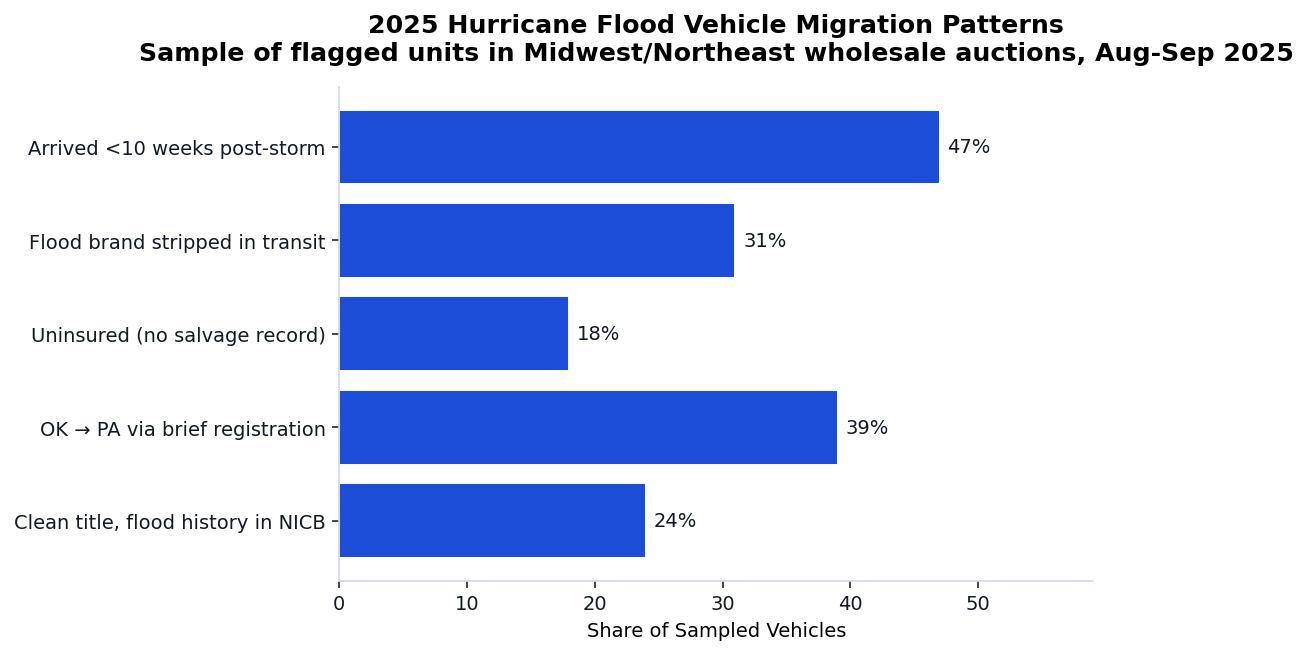
Northern wholesale auctions are seeing a particular concentration of units tracing back to the June and July storm systems, and investigators say the early movers tend to be late model vehicles with relatively low mileage because those carry the highest resale margin and justify the cost of running them through a washing circuit. A three or four year old crossover with under 50000 miles that took on water to the floor pan can lose 60 to 70 percent of its retail value carrying a flood brand, but with a clean title, that same vehicle brings something approaching full market price at auction, and that spread funds the entire operation. I have pulled NMVTIS files on vehicles that moved through three states in under three weeks with no genuine change of ownership, just title transfers designed to create distance between the flood event and the final retail transaction. Thomas Birch, an auto theft task force detective with the Ohio Bureau of Criminal Investigation, told me his unit flagged 37 vehicles at two Columbus area wholesale auctions in August that showed title irregularities consistent with flood washing, and when they ran the VINs through the NICB database the flood history came back immediately on all but four, which means the washing had only succeeded in stripping the brand from the state title record and not from the insurance loss database. Enforcement can work that gap, but a retail buyer running a standard vehicle history check would never see it because consumer grade reports do not always pull from the same sources law enforcement uses, and frankly, most buyers do not even know to ask.
Federal prosecution of title washing operations remains difficult because the statute requires proof of intent and knowledge, which is hard to establish when the operation uses multiple intermediary buyers who may or may not understand what they are facilitating. The Northern District of Texas obtained convictions in a flood washing ring in 2024 that moved over 200 vehicles from the Houston area through Oklahoma into the upper Midwest, but that case took nearly two years to build and required cooperation between four state DMV fraud units and the FBI, and nobody involved in the prosecution thought that model would scale. NMVTIS itself is only as good as the data states put into it, and the queries receiving states actually run before issuing new titles, and the early appearance of the 2025 hurricane inventory in northern wholesale lanes suggests the supply chain connecting Gulf Coast flood zones to Midwest and Northeast retail markets is operating with less friction than it has in years.