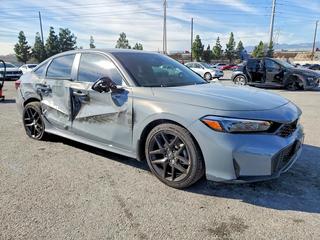
About the Honda Civic
Over 300,000 Civics sell annually in the US, making it one of the highest-volume nameplates in both new and used markets since 1973. Parts interchangeability keeps 1990s models atop national theft rankings, while used buyers regularly encounter odometer rollbacks, salvage titles from minor collisions, and undisclosed modification histories on Si and Type R variants.
A VIN number lookup on this Honda Civic includes real high-resolution auction photos sourced directly from Copart and IAAI, the largest salvage auction operators in the United States.
Honda Civic Model Generations
What a Honda Civic VIN Check Reveals
A VIN number check on any Honda Civic pulls records from state DMV offices, NHTSA databases, insurance industry filings, and salvage auction records across all 50 states. The report covers the following data categories:
- Accident and collision history
- Full odometer timeline
- Open safety recalls from NHTSA
- Title brands (salvage, flood, lemon law, total loss)
- Theft and recovery records
- Lien and ownership history
- Structural and frame damage
- Airbag deployment records
- State inspection history
- Prior vehicle use (fleet, rental, taxi, auction)
Honda Civic VIN Number Location
Where to find the VIN on a Civic
As one of the most stolen cars in the US, Civic's VIN appears in three places, the dashboard plate at the base of the driver's side windshield, the door jamb sticker, and the door sill plate beneath the driver's door on most trim levels. Theft recoveries often show dashboard tampering; the door sill label is typically overlooked by thieves and provides a reliable cross-reference.
The VIN also appears on the vehicle registration, insurance documents, and title. All locations should match. A mismatch between VIN plates is a potential indicator of a rebuilt or salvage vehicle.
Common Issues Found in VIN Reports for the Honda Civic
VIN history reports on used Honda Civic vehicles frequently show accident and collision claims, title discrepancies, and odometer irregularities. Any open NHTSA recall notices tied to the specific VIN will appear in the report, along with the recall completion status where that data is available.
Honda vehicles carrying a VIN prefix of 1HG, 2HG, 3HH, 5FN, JHM are traceable through all 50 state DMV systems and the National Motor Vehicle Title Information System (NMVTIS). Coverage for vehicles registered after 1990 is generally comprehensive.
NHTSA Safety Recalls
Honda Civic — last 3 model years
What Civic owners report across recent generations
2022–present (11th generation)
Steering dominates owner reports for this generation, and the 2022 has drawn hundreds of NHTSA steering complaints. Owners describe a momentary sticky feeling or extra effort when making small corrections, mostly at highway speeds, and CarComplaints shows steering as the leading 2022 category. In 2024 Honda recalled 2022–2025 Civics after finding that the steering gearbox worm wheel could swell and the spring preload was set too high, raising friction. Dealers replace the spring, spring seat and end cap and redistribute or add grease. Outside steering, owner complaints are comparatively light. [1] [2] [3]
2016–2021 (10th generation)
On the 2016, steering is again the largest NHTSA complaint category. Owners describe steering that feels sticky or notchy around center at highway speeds, often after 15 to 20 minutes of driving, and on CivicForums and Reddit 2016 owners say dealers replaced the steering gearbox. A recall for some 2017–2018 Civics addressed a torque sensor magnet that could come loose and apply assist in the wrong direction during a full lock turn. CarComplaints lists failed air conditioning as the top 2016 problem, and NHTSA complaints mention compressor, condenser and evaporator repairs. [4] [5] [6] [7] [8]
2012–2015 (9th generation)
This generation draws fewer complaints than the two after it. On the 2012, air bag reports lead the NHTSA list, many describing the passenger air bag indicator showing off with someone seated or the air bag warning light staying on. CarComplaints ranks paint chipping first for 2012, followed by brake complaints and stalling. Recall 15V574 covers 2014–2015 Civics built in 2014 whose CVT software could damage the drive pulley shaft, which could break and cause a loss of acceleration or front wheel lock-up. For 2014, CarComplaints shows mostly minor items such as seat comfort. [9] [10] [11] [12]
What to check before buying
Use the NHTSA recall lookup by VIN to confirm the 2024 steering gearbox recall on 2022 and later cars, the steering recall on 2017–2018 cars and the CVT software update on 2014–2015 cars. Ask for records of steering gearbox replacement and air conditioning repairs on 2016–2021 cars. On the drive, cruise at highway speed for at least 20 minutes and make small corrections to feel for catching, and on a 2012 check that the passenger air bag indicator behaves normally.
- NHTSA recalls and owner complaints, 2022 Honda Civic
- NHTSA recall 24V-744, 2022–2025 Civic and 2023–2025 CR-V steering gearbox
- CarComplaints.com, 2022 Honda Civic problems
- NHTSA recalls and owner complaints, 2016 Honda Civic
- NHTSA recall 18V-663, 2017–2018 Civic steering gearbox
- CivicForums thread, 2016 Civic LX steering sticky, stiff and jerky
- r/civic thread, 2016 EX steering issue
- CarComplaints.com, 2016 Honda Civic problems
- NHTSA recalls and owner complaints, 2012 Honda Civic
- NHTSA recalls and owner complaints, 2014 Honda Civic
- CarComplaints.com, 2012 Honda Civic problems
- CarComplaints.com, 2014 Honda Civic problems
Updated September 25, 2026 · Summarized in our own words by VinNumber.net from public owner reports; individual experiences vary.