Honda VIN Number Check

Enter any Honda VIN to decode it and see open NHTSA recalls for free. Then check the Takata air bag, fuel pump and salt-corrosion campaigns below for your model year.

1HG 19X 2HG 5J6 5FN JHM

Free decode with open NHTSA recalls. 17 characters, no I, O or Q.

About Honda VINs

How Honda VINs are built

Honda vehicles assembled in the United States carry prefixes such as 1HG, 19X, 5FN, 5J6 and 7FA, while models imported from Japan begin with JHM. Accord units built in Ohio use the 1HG prefix, while Ohio-built CR-Vs use 5J6. A free VIN decode on any Honda shows its factory specs, assembly plant and engine, plus any open NHTSA recalls.

The first three characters identify the maker and, for Honda, usually the country and the type of vehicle. NHTSA's vPIC decodes US-built Hondas with 1HG (Accord, Marysville, Ohio), 19X (Civic, Greensburg, Indiana), 5J6 (CR-V and Element, East Liberty, Ohio), 7FA (CR-V, Greensburg) and 5FN/5FP (Pilot, Odyssey, Passport and Ridgeline, Lincoln, Alabama). 2HG and 2HK are Alliston, Ontario, Canada; 3HG and 3CZ are Celaya, Mexico; JHM and JHL are Japan, and SHH is Swindon, England (2017–2021 Civic Hatchback). The 11th character and the full decode confirm the plant.

Honda vehicles manufactured for the US market carry VIN prefixes of 1HG, 2HG, 3HG, 5FN, 5J6, JHM. The VIN number encodes the country of manufacture (Japan), production plant, vehicle line, body style, engine type, model year, and a unique production sequence number.

HQMinato, Tokyo, Japan
FoundedSeptember 1948
CEOToshihiro Mibe
First US car plantMarysville, Ohio (Accord, 1982)
US sales 20241,291,490
US sales 20251,297,144

Sources: HQ, founded, CEO: Honda company overview · Marysville: Honda manufacturing · Sales (Honda brand): American Honda 2025 sales release

NHTSA campaign data

Which model years each recall covers

Drag the year line to your car’s model year. Bars it crosses are the campaigns to confirm on the VIN.

2017
Do Not Drive Park outside (fire risk) Safety recall Product update (not a recall)
21 campaigns cross 2017
2002200620102014201820222026
SAFETY RECALL · 21V-215 · 23V-858
Low-pressure fuel pump may fail; engine can stall while driving
2013–2023 Accord, 2016–2021 Civic, 2013–2023 CR-V, 2013–2023 Odyssey, 2015–2021 Pilot, 2018–2023 HR-V, 2017–2020 Ridgeline, 2019–2021 Passport, 2018–2019 Fit, 2019–2022 Insight. The fuel pump inside the tank can fail. 21V-215 covered certain 2019–2020 models first; 23V-858 (December 2023) covers a wider range of 2013–2023 vehicles (also several Acura models).
What to askCoverage depends on the pump fitted at the factory; check the VIN for both campaigns.

Coverage depends on build dates and equipment (engine, transmission, trim). A listed year doesn't mean every vehicle from that year is included; the VIN lookup decides. "Takata" marks campaigns NHTSA files under its Takata inflator investigation (EA15-001); the do-not-drive row follows NHTSA's Takata do-not-drive list. Salt-belt campaigns cover only vehicles sold or registered in the listed states. Many campaigns also include Acura models.

Honda Recalls: How to Check a Specific VIN

  1. Enter the full 17-character VIN in the NHTSA recall lookup. It shows open safety recalls, including every Takata campaign.
  2. Then use Honda's recall lookup, which also lists Honda service campaigns.
  3. On a 2001–2003 Honda, check NHTSA's Takata do-not-drive list first. An unrepaired "Alpha" inflator is the most dangerous open recall on any used Honda.
  4. If a car was ever registered in a salt-belt state, check the corrosion campaigns too, even if it is now in the South. Recall repairs are free at Honda dealers.
Full list: every campaign in this timeline
Selected Honda recalls worth confirming on a used-car VIN (NHTSA campaign data)
CampaignIssueModels & years
NHTSA Takata do-not-drive listDo Not Drive Takata "Alpha" air bag inflators: NHTSA do-not-drive warning2001–2002 Accord, 2001–2002 Civic, 2002 CR-V, 2002 Odyssey, 2003 Pilot. Also the 2002–2003 Acura TL and 2003 Acura CL. NHTSA says these older "Alpha" inflators have up to a 50% chance of rupturing in a crash and tells owners of unrepaired vehicles not to drive them. The repair is free. Filed under NHTSA's Takata inflator investigation (EA15-001).
15V-320 · 16V-061Takata driver air bag inflator may rupture (moisture and heat over time)2001–2007 Accord, 2001–2005 Civic, 2002–2011 CR-V, 2003–2011 Element, 2002–2004 Odyssey, 2003–2008 Pilot, 2006–2014 Ridgeline, 2009–2013 Fit, 2010–2014 Insight. 15V-320: 2001–2007 Accord, 2001–2005 Civic, 2002–2006 CR-V, 2003–2011 Element, 2002–2004 Odyssey, 2003–2008 Pilot and 2006 Ridgeline. 16V-061 (dual-stage inflator): 2007–2011 CR-V, 2009–2013 Fit, 2010–2014 Insight, 2007–2014 Ridgeline and 2011–2015 CR-Z. Filed under NHTSA's Takata inflator investigation (EA15-001).
15V-370 · 16V-344 · 17V-029 · 18V-041 · 18V-662Takata passenger air bag inflator may rupture; phased by zone2003–2007 Accord, 2001–2005 Civic, 2002–2006 CR-V, 2003–2011 Element, 2002–2004 Odyssey, 2003–2008 Pilot, 2006–2014 Ridgeline, 2007–2008 Fit. 15V-370 covered the early Accord, Civic, CR-V, Element, Odyssey and Pilot; 16V-344, 17V-029 and 18V-041 added vehicles state by state starting with the hot, humid Zone A states, and 18V-662 finished the Element and Ridgeline (2014 Ridgeline nationwide). Filed under NHTSA's Takata inflator investigation (EA15-001).
16V-346 · 17V-030 · 18V-042 · 18V-661Takata passenger air bag inflator may rupture (later models); phased by zone2008–2012 Accord, 2006–2011 Civic, 2007–2011 CR-V, 2009–2015 Pilot, 2009–2013 Fit, 2010–2014 Insight. Also the Accord Crosstour and Crosstour (2010–2015) and the FCX Clarity. 18V-661 (September 2018) completed the rollout, including 2014–2015 Pilots nationwide. Filed under NHTSA's Takata inflator investigation (EA15-001).
19V-182 · 19V-499 · 19V-500 · 19V-501 · 19V-502Replacement Takata inflator installed in an earlier repair may itself explode2001–2012 Accord, 2001–2011 Civic, 2002–2011 CR-V, 2003–2011 Element, 2002–2004 Odyssey, 2003–2015 Pilot, 2006–2014 Ridgeline, 2007–2013 Fit, 2010–2014 Insight. These cars already had a Takata inflator replaced, under an earlier recall or as a service part. 19V-182 covers replacement driver inflators with a manufacturing error; 19V-499 and 19V-500 (driver) and 19V-501 and 19V-502 (passenger) cover replacement inflators that can still degrade. Filed under NHTSA's Takata inflator investigation (EA15-001).
17V-545 · 18V-268 · 19V-378Replacement passenger air bag may have been installed incorrectly2003–2012 Accord, 2001–2011 Civic, 2002–2011 CR-V, 2003–2015 Pilot, 2007–2013 Fit. Vehicles whose passenger frontal air bag was replaced during an earlier Takata repair. An incorrectly installed air bag may not protect the passenger properly.
20V-027Replacement non-azide (NADI) driver inflator may absorb moisture and rupture2000 Accord, 2000 Civic, 2000–2001 CR-V, 2000–2001 Odyssey. Only vehicles that received a replacement driver air bag module during a repair. This inflator is not a Takata part.
21V-215 · 23V-858Low-pressure fuel pump may fail; engine can stall while driving2013–2023 Accord, 2016–2021 Civic, 2013–2023 CR-V, 2013–2023 Odyssey, 2015–2021 Pilot, 2018–2023 HR-V, 2017–2020 Ridgeline, 2019–2021 Passport, 2018–2019 Fit, 2019–2022 Insight. The fuel pump inside the tank can fail. 21V-215 covered certain 2019–2020 models first; 23V-858 (December 2023) covers a wider range of 2013–2023 vehicles (also several Acura models).
24V-744Steering gearbox may be built incorrectly; steering becomes hard2022–2025 Civic, 2023–2025 CR-V, 2023–2025 HR-V. Also the Civic Type R, hybrids and Acura Integra. The recall followed NHTSA engineering analysis EA23-003 into steering complaints.
23V-228Road salt may corrode the frame; rear trailing arm can detach2007–2011 CR-V. A detached trailing arm affects steering and handling. Only vehicles sold or ever registered in the 22 salt-belt states and Washington, D.C. are included.
26V-365Rear subframe may corrode at the suspension mounts2016–2022 Pilot, 2017–2023 Ridgeline, 2019–2023 Passport. Filed June 2026 (also 2014–2020 Acura MDX). Rear suspension parts can fail. Only vehicles sold or ever registered in the 22 salt-belt states and Washington, D.C. are included.
20V-769CVT drive shaft coating may degrade; drive shaft can break2013–2015 Accord. Four-cylinder Accords with the CVT. A broken drive shaft means loss of drive power, or the car can roll away in Park without the parking brake. Only vehicles sold or ever registered in the 22 salt-belt states and Washington, D.C. are included.
23V-7513.5L V6 connecting rod bearing may wear and seize2016–2019 Pilot, 2017–2019 Ridgeline, 2018–2019 Odyssey. 2016 and 2018–2019 Pilot, 2017 and 2019 Ridgeline and 2018–2019 Odyssey (also Acura MDX and TLX). Engine damage can cause a stall.
18V-663Electric power steering torque sensor magnet may come loose2017–2018 Civic, 2017–2018 CR-V. A loose magnet can cause unintended steering input. Dealers replace the steering gearbox.
17V-442Fuel supply pipe may disconnect and leak2017 CR-V. 2WD and AWD models. Fire risk.
23V-158Front seat belt buckle may not latch2017–2020 CR-V, 2018–2020 Odyssey, 2018–2019 Accord, 2019 Insight. A manufacturing issue in the buckle channel can stop the belt from latching.
24V-064 · 26V-332Passenger seat weight sensor may crack and short circuit2016–2022 Accord, 2016–2022 Civic, 2017–2022 CR-V, 2017–2022 Pilot, 2018–2022 Odyssey, 2019–2022 HR-V. 24V-064 (2020–2022 models): the passenger air bag may not be switched off when it should be. 26V-332 (May 2026) covers a much wider range of 2016–2026 Hondas and Acuras, where the cracked sensor can make the air bags deploy unintentionally in a crash. Also Ridgeline, Passport, Fit and Insight.
26V-227Side and side curtain air bags may deploy unexpectedly (software)2018–2022 Odyssey. Filed April 2026 after NHTSA preliminary evaluation PE25-018.
16V-933 · 17V-725 · 18V-170Second-row outboard seat may not latch and can tip forward2011–2017 Odyssey. Three separate campaigns: 16V-933 (seat release lever, 2011–2016), 17V-725 (seat slid between positions, 2011–2017) and 18V-170 (walk-in release, 2014–2016).
18V-795 · 20V-437Power sliding door may not latch or may not open from outside2018–2020 Odyssey. 18V-795: the door latch may stick and not catch the striker, so the door can open while driving. 20V-437: water can freeze the outer handle cables in cold weather.
04V-176Automatic transmission second gear may overheat and break2003–2004 Accord, 2002–2004 Odyssey, 2003–2004 Pilot. Heat can chip or break the second-gear teeth and lock up the transmission. The remedy revised the oil cooler return line, with an inspection on higher-mileage vehicles.
11V-395Transmission secondary shaft bearing may break2005–2010 Accord, 2007–2010 CR-V, 2005–2008 Element. Automatic transmissions. Pieces of a broken bearing can lodge in the parking pawl, so the car can roll after being put in Park, and the engine can stall. The remedy was a transmission software update.
12V-486 · 20V-768Park outside Driver power window master switch may fail or melt2002–2006 CR-V. Moisture can enter the switch, which can overheat, smoke and catch fire even when the car is parked. 20V-768 (December 2020) recalled the same vehicles again. NHTSA's record tells owners to park outside, away from structures, until it is repaired.
12V-222Power steering hose may crack and leak fluid2003–2007 Accord. V6 models. Leaking fluid can reach hot engine parts. Fire risk.
14V-112Fuel pump strainer cover may deteriorate and leak fuel2005–2010 Odyssey. Vans built June 2004 to September 2010. Fire risk.
17V-418Battery sensor case may let water in and short circuit2013–2016 Accord. Part of the battery management system. Fire risk.
24V-763High-pressure fuel pump may crack and leak fuel2023–2024 Accord, 2025 Civic, 2023–2025 CR-V. 2023–2024 Accord and Accord Hybrid, 2023–2025 CR-V Hybrid only, and 2025 Civic and Civic Hybrid. Fire risk.
24V-900Fuel filler neck may separate and leak fuel2023–2025 Pilot, 2023–2024 Passport. The filler neck tube and filler pipe can come apart. Fire risk.
25V-391Brake pedal pivot pin not secured; pedal can shift2023–2025 Pilot. Also Acura MDX and TLX. A shifted pedal can reduce braking and keep the brake lights on or off.
25V-031Fuel injection control unit software may stall the engine2023–2025 Pilot. A software error can cause a stall or loss of power (also Acura MDX Type S and TLX Type S).
25V-785Hybrid control module may reset; loss of drive power2023–2025 Accord. 2023–2025 Accord Hybrid only. A software error can reset the integrated control module CPU while driving.
21V-932Hood latch striker may separate; hood can open while driving2016–2019 Pilot, 2017–2020 Ridgeline, 2019 Passport. A damaged striker can come off the hood.

Air bags

Honda and Takata: what to check on a 2001–2015 Honda

Honda was the automaker hit hardest by the Takata inflator recalls in the US. Most cars have long been fixed, but a few groups still matter when you buy used: the oldest "Alpha" inflators, cars that missed the zone-by-zone rollout, and cars whose earlier repair is itself under recall.

Do not drive: "Alpha" inflators

2001–2002 Accord and Civic, 2002 CR-V and Odyssey and 2003 Pilot (and the 2002–2003 Acura TL and 2003 CL). NHTSA says these inflators have up to a 50% chance of rupturing in a crash. Source: NHTSA do-not-drive list, NHTSA consumer alert.

Driver inflators

15V-320 (2001–2007 Accord, 2001–2005 Civic, 2002–2006 CR-V, 2003–2011 Element, 2002–2004 Odyssey, 2003–2008 Pilot, 2006 Ridgeline) and 16V-061 (2007–2011 CR-V, 2009–2013 Fit, 2010–2014 Insight, 2007–2014 Ridgeline).

Passenger inflators by zone

15V-370, then 16V-344/16V-346, 17V-029/17V-030, 18V-041/18V-042 and 18V-661/18V-662, rolled out state by state from 2016 to 2018. A car ever registered in a hot, humid state was called first, so check the VIN, not today's state.

Repairs that need repairing

Replacement inflators: 19V-182, 19V-499, 19V-500, 19V-501 and 19V-502. Incorrect installation: 17V-545, 18V-268, 19V-378. A car with a closed 2015 Takata recall can still have one of these open.

Sources: NHTSA: Takata do-not-drive warning · NHTSA consumer alert (Honda Alpha inflators) · Honda recall lookup · NHTSA recall records (EA15-001)

Honda models

Honda Models

Open a model for its VIN check, generations, recalls and owner complaints.

About Honda

🎙️ Listen to this article

Motorcycles First, Cars Second

Honda's origins are anything but typical. The story begins with Soichiro Honda, a spirited entrepreneur who was initially turned away by Toyota. Undeterred, Honda founded his own company in 1948, focusing on motorcycles rather than cars. This decision laid the groundwork for a future automotive giant. The company quickly became a powerhouse in the motorcycle industry, establishing a strong reputation for reliability and innovation.

The gamble on motorcycles paid off significantly. By the 1960s, Honda had become the largest motorcycle manufacturer in the world. This success enabled the company to gather the resources and engineering expertise necessary to venture into the automobile market. Honda's journey from motorcycles to cars is a testament to the vision and tenacity of its founder.

The Little Cars That Could

Honda's entry into the US car market in 1969 with the N600 was a bold move. The N600 was a small, efficient car that marked Honda's transition from two wheels to four. It paved the way for future models that would capture the American public's imagination. By the mid-1970s, Honda had introduced the CVCC engine, which was revolutionary for its time. This engine met the US emissions standards without the need for a catalytic converter, setting Honda apart from its competitors.

The introduction of the Honda Civic and Accord further cemented the brand's reputation. These models became staples on American roads, known for their durability and fuel efficiency. They quickly gained a loyal following, making Honda a household name in the US. The Civic, in particular, became synonymous with practicality and reliability, while the Accord offered a slightly larger option with the same trusted Honda qualities.

Performance and the Type R Legacy

Honda's push into the performance car segment reached its zenith with the introduction of the NSX supercar in 1990. The NSX was a game-changer, offering a mid-engine layout and performance that rivaled European exotics. It featured cutting-edge technology and design, further enhancing Honda's reputation for innovation.

Another key player in Honda's performance story is the Type R series. The first Type R, based on the Honda Integra, debuted in 1995 and quickly gained a cult following. Known for their high-revving engines and sharp handling, Type R models have become icons in the automotive world. Enthusiasts eagerly await each new iteration, drawn by the promise of exhilarating driving experiences.

Honda in America Today

Honda's impact on the American automotive landscape is profound. The company has been manufacturing cars in Ohio since 1982, a move that underscored its commitment to the US market. This facility has produced millions of vehicles over the years, including popular models like the Accord and Civic. It has also played a crucial role in Honda's ability to adapt to changing market demands.

Honda's lineup in the US now includes a wide array of vehicles, from the practical Fit to the versatile CR-V. The Ridgeline pickup has carved out a niche by offering a unique combination of truck capability and car-like comfort. Honda also made a foray into the luxury market with its Acura brand, launched in 1986. Acura has been well-received, offering premium options like the MDX and TLX.

In recent years, Honda has embraced hybrid technology, with models such as the Insight and Accord Hybrid leading the charge. These vehicles offer impressive fuel efficiency without sacrificing performance, aligning with Honda's tradition of innovation. As environmental concerns grow, Honda's hybrid offerings are more relevant than ever.

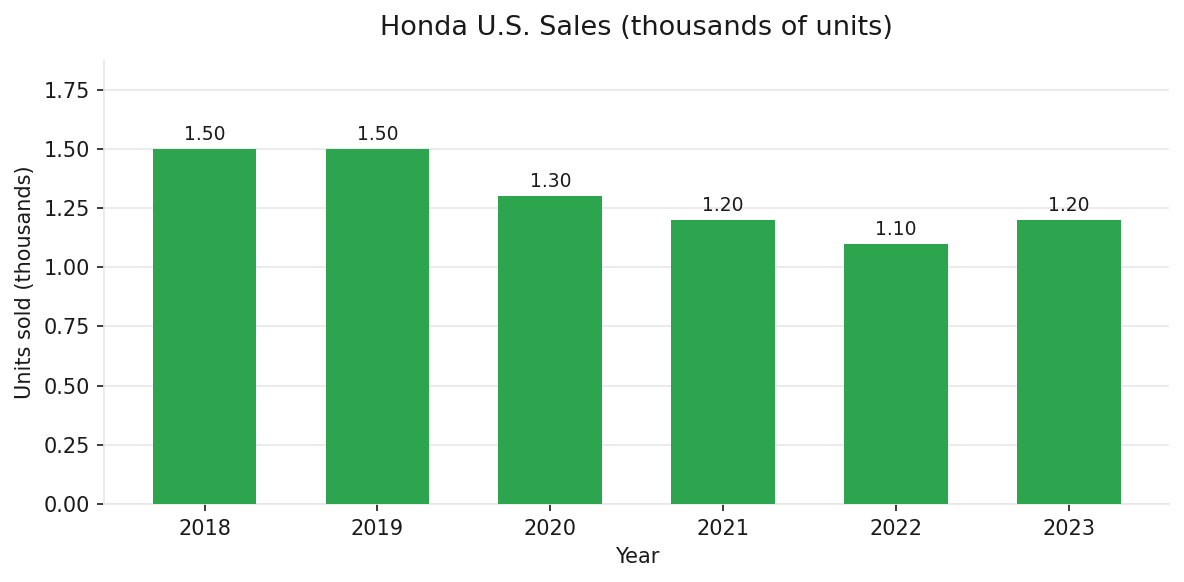
Honda U.S. annual vehicle sales 2018-2023
Honda U.S. annual sales
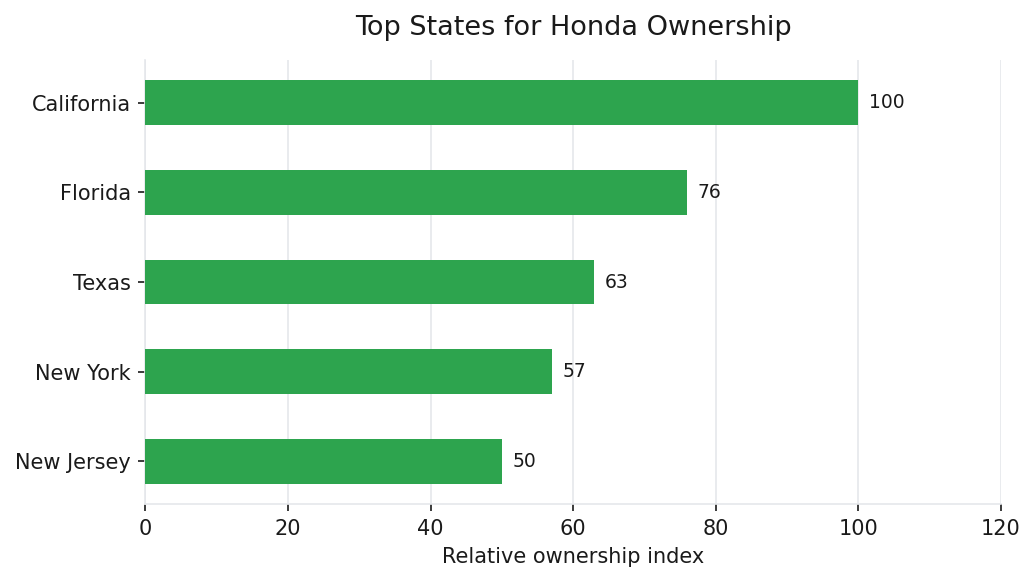
Top U.S. states for Honda vehicle ownership
Top states for Honda ownership

Used-car checklist

What to Verify on a Used Honda

Six checks specific to used Hondas.

Takata air bags

2001–2003 cars: NHTSA do-not-drive list. Driver 15V-320/16V-061, passenger 15V-370 and the zone campaigns, and the 2019 repair-of-the-repair campaigns 19V-182 and 19V-499 to 19V-502. See the Takata section.

Fuel pump (2013–2023)

23V-858 and 21V-215 cover a failing in-tank fuel pump on many Accord, Civic, CR-V, Odyssey, Pilot, HR-V, Ridgeline and Passport models. A stall at speed is the risk.

Salt-belt corrosion

2007–2011 CR-V: rear trailing arm 23V-228. 2016–2022 Pilot, 2017–2023 Ridgeline and 2019–2023 Passport: rear subframe 26V-365 (June 2026). 2013–2015 Accord CVT: drive shaft 20V-769. These follow the car's registration history, not where it is now.

Steering and brakes

2022–2025 Civic and 2023–2025 CR-V and HR-V: steering gearbox 24V-744. 2017–2018 Civic and CR-V: power steering sensor 18V-663. 2023–2025 Pilot: brake pedal pin 25V-391.

Air bag sensing (2016–2022)

Passenger seat weight sensor: 24V-064 and the much wider 26V-332 (May 2026). 2018–2022 Odyssey: side air bag software 26V-227. These are new enough that many cars still have them open.

1.5L turbo oil dilution

2017–2018 CR-V and 2016–2018 Civic 1.5T: ask whether Honda's software product update was done and check the oil for a fuel smell or a rising level. It is not an NHTSA recall. Bulletins: 2018, 2019.

World Manufacturer Identifier

Honda VIN prefixes (WMI)

Prefix registrations and example decodes come from NHTSA's vPIC database. The prefix tells you the maker and usually the country; the 11th character and the full decode tell you the plant.

1HG
American Honda · Passenger car

A 2004 and a 2018 Accord decode to Marysville, Ohio.

19X
American Honda · Passenger car

A 2019 Civic decodes to Greensburg, Indiana.

5J6
American Honda · SUV

A 2017 CR-V and a 2005 Element decode to East Liberty, Ohio.

7FA
American Honda · SUV

A 2019 CR-V decodes to Greensburg, Indiana.

5FN / 5FP
American Honda · SUV, minivan and truck

A 2016 Pilot and a 2018 Odyssey (5FN) and a 2017 Ridgeline (5FP) decode to Lincoln, Alabama.

2HG / 2HK
Honda of Canada Mfg.

A 2016 Civic (2HG) and a 2017 CR-V (2HK) decode to Alliston, Ontario, Canada.

3HG / 3CZ
Honda de México

A 2015 Fit (3HG) and a 2019 HR-V (3CZ) decode to Celaya, Mexico.

JHM / SHH
Honda Motor Co. (Japan) / Honda of the UK

A 2010 Fit (JHM) decodes to Sayama, Japan; a 2017 Civic Hatchback (SHH) to Swindon, England.

Worked example

Worked example: reading a Honda VIN

Example VIN (demo only, not a real vehicle): 5J6RW2H51HL000000

5J6RW2H51HL000000
5J6
1–3 · WMI
American Honda, SUV built in the US.
RW2H5
4–8 · Vehicle descriptor (VDS)
Honda codes for model, body, engine and trim. This pattern decodes as a CR-V EX with the 1.5L turbo engine.
1
9 · Check digit
Calculated from the other 16 characters using the federal formula. If one character is mistyped or altered, the check digit usually stops matching.
H
10 · Model year
H = 2017 (federal year-code table)
L
11 · Assembly plant
Decodes to East Liberty, Ohio.
000000
12–17 · Serial number
Production sequence. A zeroed demo serial is used here on purpose.
Buyer check: a 2017 CR-V can be covered by fuel supply pipe recall 17V-442, power steering sensor recall 18V-663, seat belt buckle recall 23V-158, fuel pump recall 23V-858 and seat weight sensor recall 26V-332; the VIN decides which apply. With the 1.5L turbo, also ask about the oil dilution software update. A CR-V starting with 2HK or 7FA is the same model from Alliston or Greensburg.

Buyer notes by model

Top Honda Models: What to Check

Open a model for the checks that matter most.

Honda Accord

2001–2002: Takata do-not-drive list. 2001–2012: Takata driver and passenger campaigns and the 2019 repair-of-the-repair recalls. 2003–2004 V6: transmission 04V-176; 2003–2007 V6: steering hose 12V-222; 2005–2010: transmission bearing 11V-395. 2013–2015 CVT: drive shaft 20V-769 (salt states); 2013–2016: battery sensor 17V-418. 2013–2023: fuel pump 23V-858. 2016–2022: seat sensor 26V-332. 2023–2024: high-pressure fuel pump 24V-763; 2023–2025 Hybrid: 25V-785.

Honda Civic

2001–2002: Takata do-not-drive list; 2001–2011: Takata campaigns. 2016: parking brake 16V-725. 2016–2018 1.5T: oil dilution product update. 2016–2021: fuel pump 23V-858. 2017–2018: power steering sensor 18V-663. 2022–2025: steering gearbox 24V-744. 2025: high-pressure fuel pump 24V-763. Civics decode to Greensburg (19X), Alliston (2HG) or, for the 2017–2021 hatchback, Swindon (SHH).

Honda CR-V

2002: Takata do-not-drive list; 2002–2011: Takata campaigns. 2002–2006: window switch 12V-486/20V-768. 2007–2010: transmission bearing 11V-395; 2007–2011: rear trailing arm 23V-228 (salt states). 2013–2023: fuel pump 23V-858. 2017: fuel pipe 17V-442; 2017–2018: steering sensor 18V-663 and 1.5T oil dilution update; 2017–2020: seat belt buckle 23V-158. 2023–2025: steering gearbox 24V-744.

Honda Pilot, Passport and Ridgeline

2003 Pilot: Takata do-not-drive list; 2003–2015 Pilot and 2006–2014 Ridgeline: Takata campaigns. 2003–2004 Pilot: transmission 04V-176. 2016–2019 Pilot, 2017–2020 Ridgeline, 2019 Passport: hood latch 21V-932. V6 rod bearings 23V-751. Salt states: rear subframe 26V-365 (2016–2022 Pilot, 2017–2023 Ridgeline, 2019–2023 Passport). 2023–2025 Pilot: brake pedal pin 25V-391, FI-ECU software 25V-031, filler neck 24V-900.

Honda Odyssey

2002: Takata do-not-drive list; 2002–2004: Takata campaigns and transmission 04V-176. 2005–2010: fuel pump strainer 14V-112. 2011–2017: second-row seats 16V-933, 17V-725, 18V-170. 2013–2023: fuel pump 23V-858. 2018–2020: sliding doors 18V-795/20V-437 and seat belt buckle 23V-158. 2018–2022: side air bag software 26V-227. Odysseys decode to Lincoln, Alabama (5FN).

Honda HR-V, Fit and Element

HR-V 2018–2023: fuel pump 23V-858; 2023–2025: steering gearbox 24V-744. Fit 2007–2013: Takata campaigns; 2018–2019: fuel pump. Element 2003–2011: Takata driver and passenger campaigns; 2005–2008: transmission bearing 11V-395. US HR-Vs and Fits decode to Celaya, Mexico (3CZ, 3HG) or Japan.

FAQ

Common questions about Honda VINs

What VIN prefix do Honda vehicles use?

Honda vehicles assembled in the United States carry VINs starting with 1HG, 19X, 5J6, 7FA or 5FN; 2HG and 2HK mean the car was built in Alliston, Ontario, Canada. Civics built in Indiana begin with 19X. Accords assembled in Ohio use the 1HG prefix, while Ohio-built CR-Vs use 5J6. Japanese-imported Honda models start with JHM, identifying Japan as the country of origin. Pilot and Passport SUVs built in Lincoln, Alabama carry a VIN starting with 5FN. Knowing the country prefix helps verify whether the vehicle was assembled where the seller claims.

What does a free Honda VIN check on VinNumber.net show?

The free decoder reads the VIN in NHTSA's vPIC database and returns the model, model year, body, engine, drive type and assembly plant. Honda VINs in vPIC start with prefixes such as 1HG, 19X, 2HG, 5J6 and 5FN. The same lookup lists NHTSA safety recalls for that make, model and model year. Each of our 12 Honda model pages adds what NHTSA and the EPA have published: owner complaints, technical service bulletins, defect investigations, fuel economy and, where NHTSA has tested the car, NCAP crash ratings. It is not a vehicle history report: it doesn't show accidents, title brands, odometer readings or theft records.

Where is the VIN on a Honda vehicle?

Honda places the VIN on a metal plate at the lower driver side corner of the windshield, visible from the exterior. The number also appears on a sticker in the driver door jamb alongside the tire pressure and weight rating information. On Accord and Civic sedans, the VIN is additionally stamped on the engine firewall. The Pilot and Passport are unibody SUVs with no separate frame, so their stamped VIN is on the body structure; the owner's manual shows the exact spot. All locations should display the same 17-character sequence.

Which Honda models have the most recalls on record?

The Honda Accord and Civic carry the longest recall histories in the Honda lineup, largely due to their decades-long production runs and high sales volumes. Both models were central to the Takata airbag inflator recall, one of the largest safety campaigns in US automotive history. The fifth-generation CR-V (2017–2022) received multiple recalls related to the fuel system (fuel supply pipe, fuel tank and fuel pump) and steering. The Odyssey has campaigns tied to the automatic transmission (2002–2004) and, on the 2018–2020 models, the sliding doors.

Is my used Honda on the Takata do-not-drive list?

NHTSA's do-not-drive warning covers unrepaired 2001–2002 Accord and Civic, 2002 CR-V and Odyssey and 2003 Pilot vehicles (and the 2002–2003 Acura TL and 2003 CL), whose older "Alpha" Takata inflators have up to a 50% chance of rupturing in a crash. If the VIN shows an open Takata recall, don't drive the car; the repair is free at Honda dealers. Later Hondas through about 2015 are in other Takata campaigns, so check the VIN in NHTSA's lookup either way.

Which Honda recalls only apply in salt-belt states?

Three Honda campaigns are limited to vehicles sold or ever registered in 22 northern and eastern states plus Washington, D.C.: 23V-228 (2007–2011 CR-V frame corrosion near the rear trailing arm), 20V-769 (2013–2015 Accord CVT drive shaft) and 26V-365 (rear subframe corrosion on the 2016–2022 Pilot, 2017–2023 Ridgeline and 2019–2023 Passport, filed June 2026). A car that moved south still counts, so check the VIN rather than the current state.

Is the CR-V and Civic 1.5L turbo oil dilution problem a recall?

No. Honda handled it as a product update, not an NHTSA safety recall: 2017–2018 CR-Vs and 2016–2018 Civics with the 1.5L turbo in cold-weather states got updated engine and transmission software, and Honda extended the warranty on affected vehicles. Because it isn't a recall, NHTSA's lookup won't show it. Ask the dealer whether the update was done, and check the oil for a fuel smell or a level above the full mark.

What is the Honda fuel pump recall?

Recalls 21V-215 and 23V-858 replace an in-tank low-pressure fuel pump that can fail and stall the engine while driving. 23V-858 (December 2023) covers certain 2013–2023 Accord, CR-V and Odyssey, 2016–2021 Civic, 2015–2021 Pilot, 2018–2023 HR-V, 2017–2020 Ridgeline, 2019–2021 Passport and other Honda and Acura models; 21V-215 covered certain 2019–2020 models earlier. Not every vehicle in those years is included, so check the VIN.