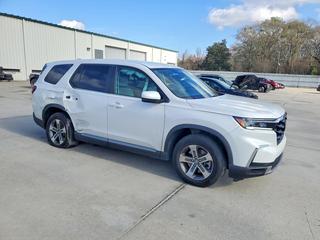
About the Honda Pilot
Unlike most midsize SUVs, the Pilot's family-oriented use profile means many examples carry straightforward ownership histories—but insurance claims for collision damage and rental fleet returns remain common. Buyers should watch for undisclosed structural repairs on units that avoided salvage branding through careful insurer negotiations, a recurring issue since the model's 2003 introduction.
A VIN number lookup on this Honda Pilot includes real high-resolution auction photos sourced directly from Copart and IAAI, the largest salvage auction operators in the United States.
Honda Pilot Model Generations
What a Honda Pilot VIN Check Reveals
A VIN number check on any Honda Pilot pulls records from state DMV offices, NHTSA databases, insurance industry filings, and salvage auction records across all 50 states. The report covers the following data categories:
- Accident and collision history
- Full odometer timeline
- Open safety recalls from NHTSA
- Title brands (salvage, flood, lemon law, total loss)
- Theft and recovery records
- Lien and ownership history
- Structural and frame damage
- Airbag deployment records
- State inspection history
- Prior vehicle use (fleet, rental, taxi, auction)
Honda Pilot VIN Number Location
Where to find the VIN on a Pilot
The Pilot's VIN sits at the base of the driver's side windshield. Three secondary labels, door jamb sticker, B-pillar label, and a cargo area floor sticker, reflect its role as a three-row family hauler. Pilots frequently see towing and roof rack use that can cause undisclosed structural stress. The cargo area label sometimes shows sun damage or adhesive failure on high-mileage examples, so inspect it carefully.
The VIN also appears on the vehicle registration, insurance documents, and title. All locations should match. A mismatch between VIN plates is a potential indicator of a rebuilt or salvage vehicle.
Common Issues Found in VIN Reports for the Honda Pilot
VIN history reports on used Honda Pilot vehicles frequently show accident and collision claims, title discrepancies, and odometer irregularities. Any open NHTSA recall notices tied to the specific VIN will appear in the report, along with the recall completion status where that data is available.
Honda vehicles carrying a VIN prefix of 1HG, 2HG, 3HH, 5FN, JHM are traceable through all 50 state DMV systems and the National Motor Vehicle Title Information System (NMVTIS). Coverage for vehicles registered after 1990 is generally comprehensive.
NHTSA Safety Recalls
Honda Pilot — last 3 model years
What Pilot owners report across recent generations
2023–present (4th generation)
Owner data is still thin for this generation. On the 2025, NHTSA complaints most often involve the collision mitigation braking system, with owners describing hard, unexpected braking on open roads. CarComplaints has only about ten reports for 2023, led by battery failure, a wheel sensor failure and a tailgate that stopped opening. Recalls cover 2023–2025 models whose fuel filler neck tube and pipe may separate and leak, and a brake pedal pivot pin that may not be secured. [1] [2]
2016–2022 (3rd generation)
The 2016, first year of this generation, draws by far the most NHTSA complaints. Owners describe stalling with warning lights, batteries that drain, fuel injector trouble and engine failures. CarComplaints ranks transmission problems first, with jerking when accelerating, and points to a late 2016 Honda bulletin on torque converter judder between 20 and 60 mph. Recalls cover connecting rod bearings that may wear and seize the engine on 2016 and 2018–2019 models, 2016 fuel tanks that may leak and a hood latch striker on 2016–2019 models. [3] [4]
2009–2015 (2nd generation)
Owner trouble is modest for this generation. On the 2011, many NHTSA complaints concern the front air bag inflator recalls, along with brake, steering and vibration reports, and some owners mention worn suspension compliance bushings. CarComplaints notes a small trend of engine hesitation when accelerating on the 2012 and 2013, adding that most owners do not experience it. Several recalls cover front air bag inflators across this generation. [5] [6]
What to check before buying
Run the VIN through the NHTSA recall lookup, including the air bag inflator recalls on 2009–2015 models, the connecting rod bearing recall on 2016 and 2018–2019 models and the fuel filler and brake pedal recalls on 2023–2025 models. Ask for transmission fluid service and battery records. On the drive, feel for judder between 20 and 60 mph, hesitation when accelerating and any unexpected automatic braking.
- NHTSA recalls and owner complaints, 2025 Honda Pilot
- CarComplaints.com, 2023 Honda Pilot problems
- NHTSA recalls and owner complaints, 2016 Honda Pilot
- CarComplaints.com, 2016 Honda Pilot problems
- NHTSA recalls and owner complaints, 2011 Honda Pilot
- CarComplaints.com, 2013 Honda Pilot problems
Updated September 25, 2026 · Summarized in our own words by VinNumber.net from public owner reports; individual experiences vary.