Kia VIN Number Check

VIN prefix: 5XX, KNA, KND

Enter any Kia VIN to decode vehicle specs and check open NHTSA safety recalls, free.

No login No credit card Official NHTSA data

What is a Kia VIN Check? A Kia VIN check is a report generated from a 17-character Vehicle Identification Number that compiles publicly available data on a specific Kia vehicle. It draws from government recall databases, insurance records, state title agencies, and law enforcement theft reports. Buyers use it to verify that the vehicle's condition and history match what the seller claims.

Key Takeaways

  • Kia and Hyundai jointly faced recalls covering roughly 2.4 million vehicles related to Theta II engine defects, one of the most significant recall campaigns in US automotive history [1].
  • Kia models lacking electronic immobilizers contributed to a surge in vehicle theft claims in 2022 and 2023, with affected models appearing in national theft rate reports at rates well above the segment average [2].
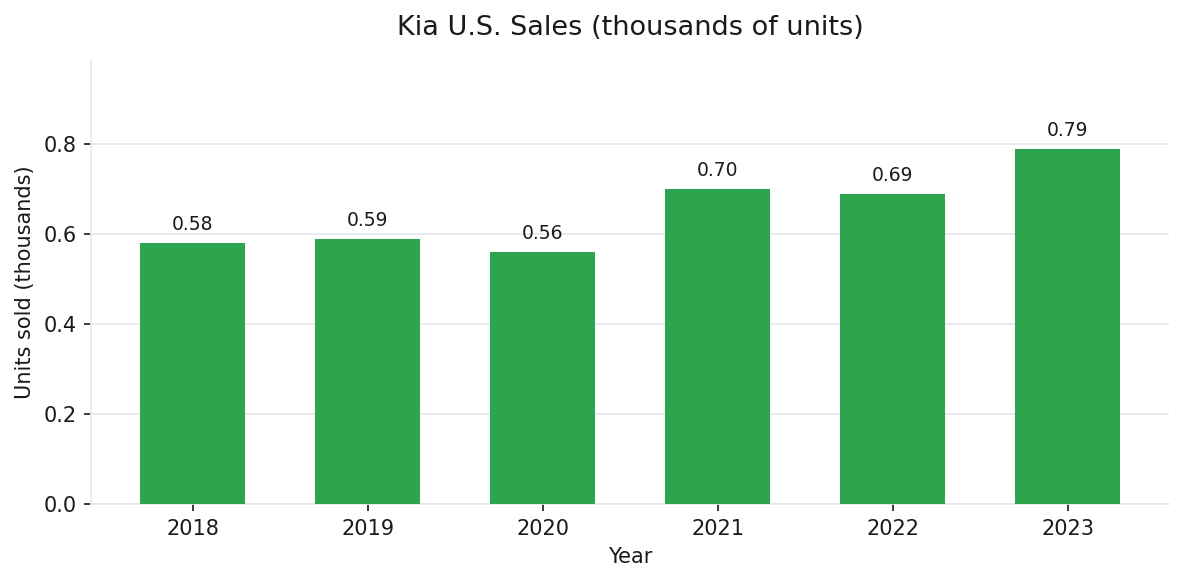
  • Kia America sold over 750,000 vehicles in the US in a single recent model year, making it one of the ten best-selling automotive brands in the country [3].
  • The National Insurance Crime Bureau reported Kia vehicles appeared disproportionately in regional theft hotspot data following the 2022 social media theft trend, with some metro areas recording hundreds of incidents per month [4].
  • Consumer Reports reliability surveys rated the Telluride and K5 above the segment average, while older Theta II engine-equipped Optima and Sorento trims continue to generate below-average scores [5].

What a Kia VIN Number Check Reveals

Click any item to see what data sources feed each check.

Kia VIN Prefixes Explained

PrefixAssembly LocationTypical ModelsNotes
5XXWest Point, Georgia, USATelluride, Sorento (US spec)Built at Kia's Georgia Manufacturing Plant; common on large SUVs
KNAHwaseong / Gwangmyeong, South KoreaSportage, Sorento, K5Most common WMI for Korean-assembled passenger cars and crossovers
KNDGwangmyeong, South KoreaSoul, RioAssigned primarily to smaller body styles and subcompact platforms
KNHSouth Korea (various)Carnival, specific trim variantsLess common; appears on select minivan and specialty configurations
5XYWest Point, Georgia, USAEV6 (US-assembled variants), TellurideShared WMI for US plant SUV and EV crossover production

WMI codes are the first three characters of the VIN. Always verify the prefix against the window sticker if country of origin matters for financing or import purposes.

A Brief History of Kia

TIMELINE

Kia's Journey, 1944 to Today

Click or hover any milestone to see details. Drag to scroll on mobile.

1944
Founded
Kia is founded in South Korea as Kyungsung Precision Industry, initially manufacturing steel tubing and bicycle parts. The name means "rise from Asia."
RECALLS

Kia US Recall Scope by Year

Estimated vehicles affected, in thousands, across three major campaign families. Hover any bar for details.

Engine defects (Theta II & later)
Anti-theft / immobilizer
Other (electrical, trim, seats, fuel, lights)

Figures are approximate NHTSA campaign scope estimates in thousands of vehicles, cumulative across Kia US models. The 2025 spike reflects 12 separate campaigns including the 250,547-unit K5 fuel tank recall (25V794) and the 201,149-unit Telluride trim recall (25V494). The 2026 YTD column covers campaigns filed through July 2026, dominated by the 462,869-unit Telluride power seat fire recall (26V430) and the 141,032-unit Carnival fuel line recall (26V232). Actual affected VIN counts vary by campaign.

🎙️ Listen to this article

Steel Tubes to Steel Wheels

The name "Kia" is derived from Sino-Korean characters that mean "rising from Asia." This is quite fitting, given Kia's journey from a humble beginning to becoming a global automotive player. Founded in 1944, Kia began as a manufacturer of steel tubing and bicycle parts. These early years laid the foundation for what would become South Korea's first domestic car manufacturer.

By 1957, Kia had expanded into manufacturing motorcycles, and in 1974, it produced its first car. However, it wasn't until the mid-1980s that Kia made its significant leap into the automobile industry. Partnering with Ford, Kia entered the US market in 1986 with models based on Ford's technology. These models, such as the Kia Pride, gained a foothold in the market, slowly but surely placing Kia on the automotive map.

The late 1990s presented a significant challenge. The Asian financial crisis of 1997 nearly led Kia to bankruptcy. It was a tumultuous time marked by financial instability and uncertainty. However, salvation came in 1998 when Hyundai Motor Company acquired a significant stake in Kia, forming a partnership that would prove pivotal for both companies.

The Design Revolution

One of the most transformative periods in Kia's history came with the arrival of Peter Schreyer in 2006. The former Audi designer was appointed to revolutionize Kia's image, moving the brand from being seen as bland and uninspiring to one of style and sophistication. Central to this transformation was the introduction of the "tiger nose" grille, which became a defining feature of Kia vehicles.

Schreyer's influence extended beyond aesthetics. His design philosophy emphasized creating cars that were not only visually appealing but also of high quality. This shift was evident in models like the Kia Sorento and Kia Sportage. These vehicles showcased a blend of style, comfort, and practicality, attracting a new wave of buyers looking for affordable yet stylish cars.

Telluride and the Quality Leap

The Kia Telluride marked a significant milestone for the brand. Launched in 2019, the Telluride was praised for its spacious interior, impressive performance, and upscale features. It quickly garnered numerous awards, including being named the best car in America by multiple automotive outlets. The Telluride wasn't just a hit with critics; it resonated with consumers, pushing Kia further into the spotlight as a manufacturer of high-quality vehicles.

Alongside the Telluride, the Kia Stinger sport sedan made waves in the automotive industry. The Stinger was a bold move for Kia, a sporty departure from the brand's traditional offerings. It punched above its weight class by offering performance and features typically associated with higher-end luxury brands. This model helped shift perceptions of Kia, showing that the company could compete with the best in the industry.

Kia's Electric Future

Kia's commitment to innovation is evident in its push toward electric vehicles. The Kia EV6 is a testament to this direction. As an all-electric crossover, the EV6 has received global recognition, including prestigious design awards that highlight its futuristic and sleek aesthetic. This model represents Kia's ambition to lead in the growing electric vehicle market.

Another noteworthy development in Kia's lineup is the revival of the Carnival minivan. While minivans may not have the glamorous reputation of SUVs or sedans, the Carnival sets itself apart with its focus on versatility and comfort for family-oriented buyers. Its modern design and technology-rich features make it a strong contender in its segment.

Why VIN History Matters for Kia Buyers

For anyone considering purchasing a used Kia, understanding the vehicle's history through its VIN (Vehicle Identification Number) is crucial. Certain Kia models, similar to Hyundai, faced issues regarding theft vulnerability due to the absence of an immobilizer. This makes it essential for buyers to check for completed recalls and any theft reports associated with the vehicle.

Checking the VIN can provide valuable insights into the car's VIN history, including previous accidents, ownership changes, and maintenance records. This information is vital in making an informed decision, ensuring that the vehicle you purchase is reliable and safe.

As Kia continues to innovate and expand its offerings, its future looks bright. From its early days of manufacturing bicycle parts to producing award-winning vehicles, Kia has indeed risen from Asia to become a formidable force in the automotive industry. Understanding the vehicle's history is a key step in joining the community of satisfied Kia owners.

Common Kia Recalls and Issues by Model

Includes major NHTSA recall campaigns through July 2026. Vehicle counts reflect official NHTSA campaign scope figures.

ModelYearsIssueScopeCampaign
Optima, Sorento2011-2019Theta II engine metal debris from manufacturing defects, creating engine seizure and stalling risk~2.4 million vehicles across Kia and Hyundai combinedMultiple, 2015-2019
Sportage2008-2011Brake fluid leak near ABS module creating fire risk under the hoodTens of thousands of US-market vehiclesMultiple, 2016-2020
Soul, Forte, Sportage, Optima2011-2021Missing or inadequate electronic immobilizer enabling USB cable ignition bypass, widely publicized in 2022~3.4 million vehicles, addressed via free anti-theft software rolloutConsumer advisory 2023
Telluride2020-2024Front power seat motor overheat creating fire risk while parked or driving, initial recall repair proved insufficient and was expanded in 2026~462,869 vehicles (initial + expanded campaign combined)24V407, 26V430
Niro Hybrid, PHEV, EV2023-2025Passenger seat wiring assembly damage that can prevent front airbags and seat belts from deploying~80,255 vehicles25V024
Seltos, Soul2021-2023Piston oil ring manufacturing defect leading to engine damage during normal operation~137,256 vehicles25V099
Sorento2021-2023HVAC blower motor wiring harness inadequate for load, creating fire risk under the dash~39,536 vehicles25V649
Sorento2024-2025Body Domain Control Unit software error causing loss of low beam headlights and taillights, FMVSS 108 non-compliance~74,469 vehicles25V006
K52021-2024Damaged fuel tank check valve allowing air ingress and tank expansion, contacting hot exhaust and melting the tank~250,547 vehicles, one of the largest single Kia campaigns of 202525V794
Telluride, K52023-2025Door belt molding and rear window trim delamination and detachment from the vehicle body~301,000 vehicles combined across two related campaigns25V493, 25V494
EV92025Rear gear drive unit motor shaft improperly welded, causing loss of drive power~342 vehicles, limited early production25V115
Sportage PHEV, Sportage2023-2025Software error causing instrument panel screen failure when equipped with a Genuine Kia tow hitch harness~5,046 vehicles25V874
Telluride2025Seat back frame manufacturing error that may fail to properly restrain occupants in a crash~85,515 vehicles26V105
K5, Sportage, Sorento, EV9, Carnival, K42025-2026Instrument cluster software error affecting multiple 2025-2026 model year vehicles~42,677 vehicles across the multi-model campaign26V046
K4, Telluride2026-2027Rear center and third-row center seat belt anchor buckle latching failure~14,870 vehicles26V135
Carnival2022-2026Fuel pipe to fuel rail connection can leak, creating fire risk under the hood~141,032 vehicles26V232
Telluride2027Driver seat belt emergency locking retractor may lock and prevent seat belt extension, FMVSS 209 non-compliance~6,264 vehicles, filed before the model year officially went on sale26V356

Where to Find the VIN on a Kia

The most accessible VIN location on any Kia is the lower corner of the driver-side windshield, visible from outside the vehicle without opening a door. On Kia SUVs including the Telluride, Sorento, and Sportage, the VIN also appears on the front frame rail under the hood, stamped directly into the metal. This secondary location is harder to alter and is the one most used by mechanics verifying authenticity.

On sedans such as the K5 and Forte, an additional VIN stamp typically appears on the firewall. The driver-side door jamb sticker is another standard location. Beyond the physical vehicle, the VIN appears on the title, insurance card, and registration. When evaluating a used Kia, confirm the door jamb sticker matches the windshield plate exactly, since mismatches can indicate a replaced panel or a title-washing situation.

5 Red Flags When Buying a Used Kia

  1. Low mileage on a 2011-2019 Optima or Sorento. A Theta II-equipped Optima or Sorento with under 60,000 miles can mask engine defects that accumulate regardless of mileage. Sellers sometimes offload these vehicles before symptoms appear. Require documented proof that the NHTSA recall was completed at a Kia dealership.
  2. No recall completion record on 2011-2021 theft-vulnerable models. The immobilizer gap affected Soul, Forte, Sportage, and Optima trims. If the VIN report shows no recall completion for an affected model, the vehicle may still be a prime theft target. Verify via NHTSA's recall lookup whether the software patch was applied.
  3. Salvage or rebuilt title from 2022 or 2023. The peak theft years produced recovered vehicles with ignition damage, interior stripping, and pursuit-related collisions. Insurance settlements often undervalued actual repairs. An independent mechanical inspection is essential before buying any salvage-titled theft-era Kia.
  4. Multiple state title transfers within 24 months. A Kia that changed hands frequently across state lines signals curbstoning by unlicensed dealers who flip vehicles to obscure problems. Each title transfer can also reset odometer disclosure obligations, making rollback fraud easier to conceal.
  5. Aftermarket ignition or steering column repairs noted. Any reference to a "replaced ignition" or "new key cylinder" on a 2011-2021 Kia signals likely theft recovery. Repair quality for ignition bypass damage varies widely, and the cause should be confirmed through the vehicle history report before completing a purchase.

Frequently Asked Questions

Kia vehicles sold in the United States carry one of several WMI prefixes depending on assembly location. Korean-built models typically begin with KNA, KND, or KNH, while vehicles from Kia's Georgia plant use 5XX or 5XY. The first three characters of the VIN quickly indicate whether a Kia was domestically produced or imported, which can affect financing terms and parts sourcing.
A Kia VIN report draws from state DMV title records, NHTSA recall databases, insurance claim filings, and law enforcement theft reports. It reveals title brands, open recalls, and odometer consistency. Recall completion status for Theta II engine campaigns and immobilizer-related theft patches are among the most critical data points for Kia buyers.
The primary location is the lower corner of the driver-side windshield, visible from outside without opening the door. Additional stamps appear on the door jamb sticker, the front frame rail on SUVs, and the firewall on sedans. All locations must match, and the number also appears on the title, registration, and insurance card.
The Optima and Sorento carry the largest recall footprint due to the Theta II engine campaigns. The Soul and Forte are heavily represented because of the immobilizer-gap theft vulnerability. The Telluride and K5 have had more limited campaigns involving sunroof retention and airbag components. A VIN-specific NHTSA lookup is the only reliable way to confirm whether repairs were completed.
Kia models from 2011 through roughly 2021 without a standard electronic immobilizer became high-profile theft targets after a 2022 social media trend. Theft reports processed through law enforcement and insurers typically appear in vehicle history data, including recovery status and documented damage. A positive theft entry in the VIN report is a serious red flag warranting careful evaluation.

Bottom Line

Running a VIN check before buying any used Kia is among the lowest-cost, highest-value steps available to a buyer. The Theta II engine recall, the immobilizer theft vulnerability, and title-washing risk on recovered 2022-2023 vehicles create documented hazards invisible from a test drive. A VIN report surfaces recall history, title status, odometer records, and theft incidents that sellers may not volunteer, making it an essential step before any purchase.

Article Sources

  1. NHTSA press release on the 462,000-vehicle Kia Telluride “park outside” fire recall (campaign 26V430) that expanded the earlier 24V407 campaign after the initial repair proved insufficient https://www.nhtsa.gov/press-releases/park-outside-recall-kia-tellurides
  2. NHTSA Vehicle Theft Prevention overview covering the 2022 social-media theft surge and vulnerable Kia and Hyundai model years https://www.nhtsa.gov/vehicle-safety/vehicle-theft-prevention
  3. Kia US media newsroom, source for US monthly and annual sales figures, model launch announcements, and safety campaign notices https://www.kianewscenter.com/news/all
  4. NHTSA recall lookup portal for checking whether any open safety recall affects a specific VIN, including all Kia campaigns cited in this article https://www.nhtsa.gov/recalls
  5. Consumer Reports Kia brand hub with model-level reliability, owner satisfaction, and road test data across the current Kia lineup https://www.consumerreports.org/cars/kia/