A position by position breakdown of the 17 character Vehicle Identification Number, what each section encodes, where to find the VIN on the vehicle, and how to use a free decoder to verify what a seller is claiming about any used car.
Definition: The Vehicle Identification Number is a 17 character code, a mix of letters and digits, that the federal system uses to tag one specific vehicle. The system does not allow duplicates. The regulation that made the current format mandatory is 49 CFR Part 565, which went into effect for the 1981 model year.
Key Takeaways
- Federal regulation 49 CFR Part 565 is the rule that made the 17 character VIN mandatory on all vehicles sold in the United States beginning with the 1981 model year.
- Three sections make up the VIN. Positions 1 through 3 cover the manufacturer, positions 4 through 8 cover the vehicle's configuration, and positions 10 through 17 cover the individual unit's production details — with position 9 reserved for the check digit.
- The only reason position 9 exists is to catch errors. A weighted formula runs across all the other 16 characters, and when the result at position 9 does not come out right, it means somewhere in the VIN a character is wrong — miscopied, altered, or fabricated.
- A VIN appears in multiple locations on the vehicle, and all of them should match each other and the title exactly.
- The free VIN decoder that NHTSA runs at vpic.nhtsa.dot.gov reads directly from the decoding maps that manufacturers file with the agency, and entering a VIN into it is a matter of seconds.
Every vehicle on a US road built since 1981 carries a 17 character code that works like a serial number with built in context. The code tells you where the vehicle was assembled, who built it, what engine it carries, what model year was assigned to it, and which number it was off the assembly line. None of that comes from the listing. All of it comes from the VIN.
ISO 3779 is the international standard that establishes the 17 character length and the division into three sections, and the US system is built on top of it. [2] What the US adds on its own is a mandatory ninth character, the check digit, calculated from the other 16 using a weighted formula. That character is the only one in the entire VIN whose value is computed rather than assigned.
The sections below go through each group of positions in the VIN, one range at a time. The examples are based on actual buying situations where checking the VIN ahead of time would have prevented a costly mistake.
Positions 1 through 3: the World Manufacturer Identifier
The first three characters are called the World Manufacturer Identifier, or WMI. Together, they tell you the country of final assembly and the manufacturer. The assignments come from SAE International, and each combination is registered to a specific manufacturer at a specific plant country.
The first character is the country of assembly, not the country where the brand is headquartered. A Toyota Camry assembled in Georgetown, Kentucky starts with a 4 (United States), not a J (Japan). A BMW built in Spartanburg, South Carolina also starts with a 4. A Mini built in Oxford, England starts with a S. The country code tells you where the vehicle came off the line, and that is a meaningful fact because assembly location affects safety standards, import history, and in some cases the trim and equipment level available in a particular market.
The second character typically identifies the manufacturer within that country, though the assignment rules allow some variation. The third character gets more specific. It usually points to a manufacturer's division, a vehicle type, or a specific segment of the product line. When a manufacturer produces more than 500 vehicles of a particular type per year, all three characters together form a unique WMI registered with SAE. Smaller manufacturers use a 9 as the third character and encode additional identifier information in positions 12 through 14.
Example: A used SUV listed for sale shows the VIN starting with WBA. The W means Germany, and WBA is a code assigned to a German-assembled passenger vehicle from a specific manufacturer. If the seller describes the vehicle as imported from Canada, the WMI alone is enough to show that description is wrong. The vehicle left a German factory.
Positions 4 through 8: the Vehicle Descriptor Section
Positions 4 through 8 make up the Vehicle Descriptor Section, or VDS. The information packed into these five positions includes the model designation, the body style, what engine the vehicle has, what transmission type is fitted, and in some cases the restraint system. The meaning of each position within the VDS is not standardized across the industry.
Every manufacturer files its own decoding map with the National Highway Traffic Safety Administration, NHTSA, and the same position number at Ford means something entirely different from the same position at Toyota. NHTSA collects all of these manufacturer submitted decoding maps in its Product Information Catalog, known as vPIC. [4] When you enter a VIN at vpic.nhtsa.dot.gov, the decoder looks up positions 4 through 8 against the manufacturer's own filed map and returns the actual specifications the factory built into that vehicle.
Example: Two vehicles carry identical first three characters, meaning the same manufacturer and the same country, but their positions 5 and 8 are different. Putting both through the NHTSA decoder shows that one is a base model with a four cylinder engine and no sunroof, and the other is a premium trim with a six cylinder and full glass roof. The listing price reflects the premium trim. The VIN confirms the base model is what is actually sitting in the driveway.
🔧 Interactive: tap any position to decode it
Interactive VIN position breakdown showing what each of the 17 characters encodes
Tap any position above
Each of the 17 characters encodes a specific piece of information about the vehicle. Tap a position to see what it means.
Position 9: the check digit
Position 9 is not a vehicle attribute. The value in this position is a single character. It is either a digit, anything from 0 through 9, or the letter X. The value does not describe the vehicle in any way. It is calculated from the other 16 characters using a weighted formula that assigns a numeric value to each letter and digit, multiplies each by a position weight, adds the products, and takes the remainder when divided by 11. If the remainder is 10, the check digit is X.
The purpose is error detection. If someone copies a VIN wrong, even by a single character, the check digit will almost always fail to match the recalculated value. The same formula catches fabricated VINs, because constructing a 17 character string that passes the check digit validation while also matching a real manufacturer, a valid model year, and a plausible sequence number is not trivial. A VIN that fails the check digit test is either a transcription error or an attempt at fraud. Either way, it is not a VIN to transact on.
The check digit is mandatory for all vehicles sold in the United States and Canada. Vehicles built exclusively for other markets, including some European and Japanese domestic models, may use position 9 for a different purpose, which means the check digit formula does not apply to them the same way. If you are evaluating an import, use the NHTSA decoder to confirm whether the check digit validation is relevant for that specific WMI.
Position 10: the model year code
The 10th character encodes the model year. The code uses a 30 character cycle that runs through the letters A through Y, skipping I, O, Q, U, and Z, and then the digits 1 through 9 before restarting. The sequence covers 30 model years per cycle. A is 1980 and also 2010. B is 1981 and 2011. It continues in that pattern through Y, then 1 through 9, then loops back to A again for 2040.
Because the codes repeat every 30 years, the letter T could mean 1996 or 2026. For passenger cars, multipurpose passenger vehicles, and trucks with a gross vehicle weight rating of 10,000 pounds or less, position 7 is also significant. If position 7 is a letter, the vehicle belongs to the second cycle, 2010 through 2039. If position 7 is a digit, the vehicle belongs to the first cycle, 1980 through 2009. Vehicles outside those weight classes do not follow this disambiguation rule, so for heavy trucks the NHTSA decoder is the reliable way to confirm the model year.
One common point of confusion is that the model year is not always the calendar year the vehicle was physically built. Manufacturers routinely begin production of a new model year in the middle of the prior calendar year. A vehicle assigned a 2026 model year might have rolled off the assembly line in July or August of 2025. The model year in position 10 reflects the year the manufacturer assigned, which is the year that governs the safety standards the vehicle was built to meet, not necessarily the year production happened.
🔧 Interactive: tap a year to see its position 10 code
Interactive model year code lookup showing which character at position 10 corresponds to each model year from 1980 to 2039
Tap a year to see its position 10 code
The model year code cycles through 30 characters (A-Y skipping I, O, Q, U, Z, then 1-9) before repeating. Each character maps to exactly one model year within a 30 year window.
Position 11: the manufacturing plant
The 11th character identifies the specific manufacturing plant where the vehicle was assembled. The code is assigned by the manufacturer, and its meaning varies from one manufacturer to another. A Ford plant code of A does not map to the same location as a GM plant code of A. The NHTSA vPIC decoder is the reliable way to look up which plant a given code refers to, since the plant code mappings are part of each manufacturer's filed decoding map with the agency.
Positions 12 through 17: the production sequence number
The last six characters are the sequential production number. This is the part of the VIN that makes each vehicle unique within its manufacturer, model year, and plant. The sequence typically starts at a defined number, often 100001 for the first unit, and increments with each vehicle produced at that plant during that model year. Federal regulation requires the VIN to be unique for a minimum of 60 years within each manufacturer and WMI combination, a requirement established by the 2008 amendment to 49 CFR Part 565. In practice, the six digit sequence accommodates up to 999,999 units within a single model year at a single plant before any overlap becomes possible, which is well above the production volumes of any single plant in any single year.
Where to find the VIN on the vehicle
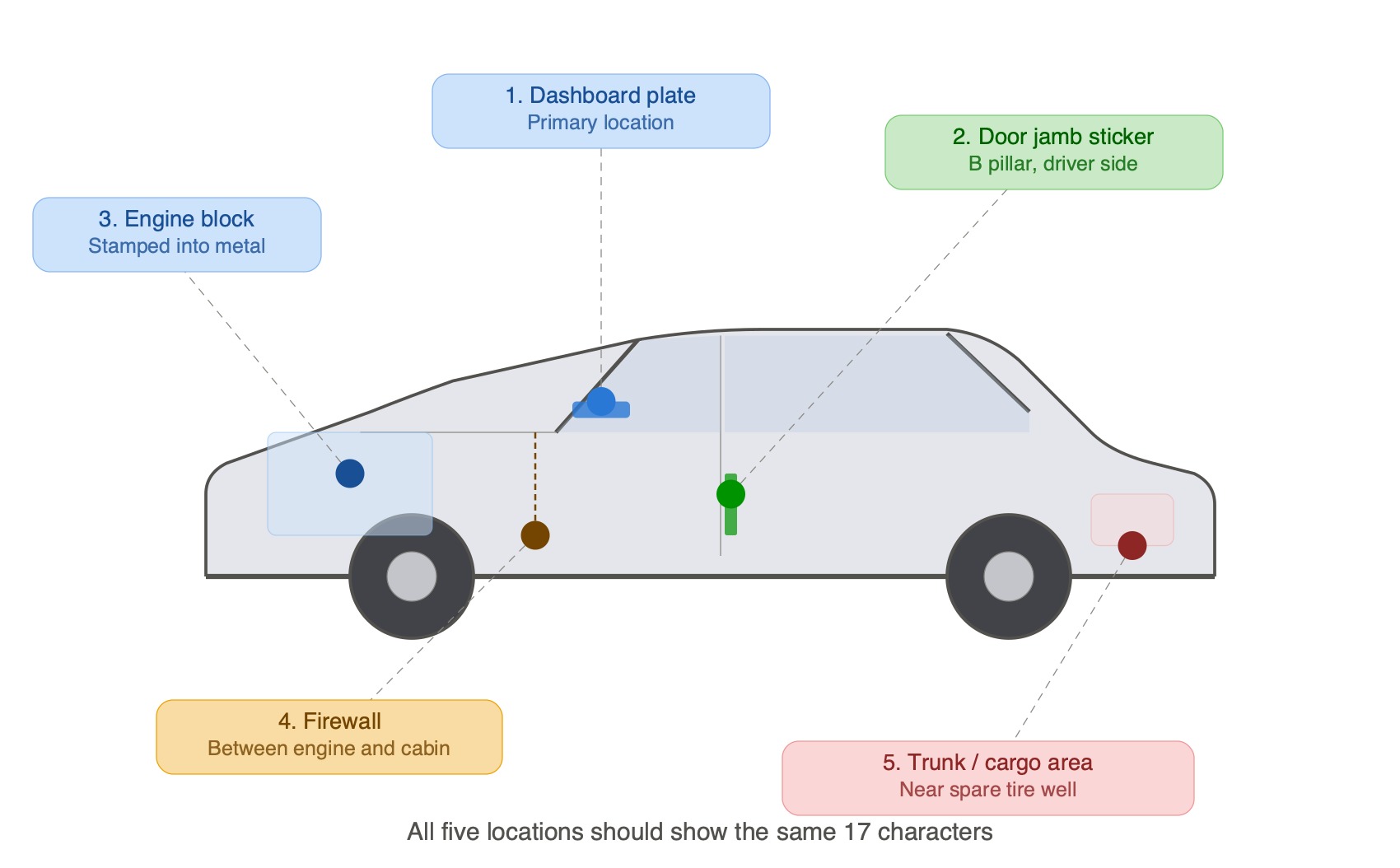
Federal regulation requires the VIN to be readable through the windshield from outside the vehicle, without moving any part of the car. [1] The primary location is a metal plate on the driver's side dashboard, visible through the lower left corner of the windshield. The plate is riveted to the instrument panel and manufactured from a material designed to self-destruct if someone attempts to peel it. That destruction feature is the factory's way of preventing a plate from being swapped between vehicles without obvious evidence of tampering.
The VIN also appears in several other locations on the vehicle. The most common secondary location is the sticker on the driver's side door jamb, on the inner wall of the B pillar, visible when the front door is open. That sticker is produced separately from the dashboard plate at a different point in the assembly process, which means the two should match exactly on any legitimate vehicle. On a cloned or rebuilt vehicle, at least one of them will not. The engine bay carries additional stamps on the firewall, the front crossmember, or the block itself, depending on the manufacturer. Factory stamps from a die press have consistent depth and even spacing across all 17 characters. A restamp looks different. The depth varies, the characters sit at slightly different angles, and the spacing between them is not uniform.
Many manufacturers also stamp partial VINs on the frame rail, under the spare tire floor, and on inner wheel wells. Getting to those stamps requires more effort than reading the dashboard, and altering them requires equipment that most curbstone operations do not have. The VIN is also printed on the vehicle's title, registration, insurance documents, and service records.
The 17 characters should be identical at every location on the vehicle, and they should also be the same 17 characters printed on the title and registration documents. If two of those locations read differently from each other, that is a finding. It needs an explanation before any transaction proceeds.
📍 Where to find the VIN on the vehicle
Five locations where the VIN appears on a vehicle
Dashboard plate
Metal plate on the driver's side dashboard, at the base of the windshield. Required by federal regulation to be readable from outside the vehicle. Check the rivets, look for scratches, adhesive, or inconsistent stamping depth.
Door jamb sticker
On the inner wall of the B pillar, driver side, visible when the front door is open. Also shows GVWR and tire pressures.
Engine block
Stamped into the cast metal near the front of the engine. Cannot be removed without leaving visible damage.
Firewall
The metal panel between the engine bay and the passenger cabin. Many manufacturers stamp the VIN here.
Trunk / cargo area
Usually near the spare tire well. Not present on all models, but worth checking when accessible.
All five locations should show the same 17 characters. A mismatch between any two is a red flag.
Example: A buyer is looking at a used pickup truck. She reads the dashboard VIN through the windshield, walks to the driver's side, opens the door, and checks the door jamb sticker. Position 6 on the sticker does not match position 6 on the dashboard plate. One of those locations has been altered. The transaction stops there, and it should.
How to use a free VIN decoder
NHTSA's free decoder is at vpic.nhtsa.dot.gov. There is not much to it. You enter the 17 character VIN, and the system looks up the vehicle's attributes by reading the manufacturer's own decoding map, returning the model, body style, engine, and plant information as the factory recorded it when the VIN was assigned. The output is what the manufacturer told NHTSA it built, and that is the most direct confirmation available that the vehicle is what the seller claims it is.
For a position-by-position breakdown of what each character means, see how to read a VIN number. VinNumber added something NHTSA's tool was never designed to do. On top of the same factory spec data, VinNumber's decoder queries NMVTIS, a federal database maintained by the Department of Justice that aggregates title history, salvage and junk records, and total loss reports from participating states and insurance carriers. The NHTSA decoder tells you what the vehicle was built to be. The NMVTIS record tells you what happened to it afterward. Running both takes less than two minutes and covers the two questions that matter most before any used vehicle changes hands.
Example: A listing on a dealer's website describes the vehicle as a 2024 model with a V6 engine. The buyer runs the VIN through the NHTSA decoder, and the output shows a 2022 model year (position 10 is off by two years) and a four cylinder engine (positions 4 through 8 do not match the description). The listing is wrong on two independent facts. That is not a clerical error. That is a vehicle being misrepresented.
5 VIN Decoding Mistakes That End Up Costing Buyers Money
1. Trusting the listing without running the VIN
An online listing can say whatever the seller wants about the year, the engine, or the trim level. The broader 20-point pre-purchase checklist covers what to verify beyond the VIN. What the factory actually built is recorded in the VIN, and no listing can change that. The whole point of the standardized 17 character system is that the vehicle carries its own verifiable identity. Treating the listing as the authoritative description instead of the VIN is choosing the seller's word over a federal record.
2. Checking only one VIN location
The VIN plate on the dashboard is the most visible one on the vehicle, and for that same reason it is the one a thief can replace most easily. The way to catch a VIN cloning attempt is to read the dashboard VIN and then compare it against the door jamb sticker, the firewall stamp, and the frame rail. A full walkthrough of all physical VIN locations is in where to find the VIN on any vehicle. A legitimate vehicle matches at every location. A cloned vehicle will not. Checking one location and stopping is a partial check, not a complete one.
3. Ignoring a failed check digit
A VIN that fails the check digit formula is either miscopied or altered. Proceeding with a purchase on a VIN that does not validate is proceeding without knowing whether the vehicle is what it claims to be. The check digit formula is simple enough to calculate by hand, and the NHTSA decoder runs it automatically. A failed check digit is a stop sign, not a yellow flag.
4. Mixing up the model year and the production date
If position 10 reads T, the vehicle was assigned a 2026 model year. That does not mean the vehicle was built in 2026. Assembly might have wrapped up months before, maybe June or July of 2025. Registration documents and insurance policies use the model year, not the production date, and the model year governs which safety standards the vehicle was built to comply with. The two numbers are not interchangeable.
5. Assuming the VIN tells you the vehicle's history
The VIN encodes what the vehicle is. Nothing that happened to the vehicle after it rolled off the line is in there. Accident records, title brands, odometer readings logged at each change of ownership, insurance claims, and theft reports — those come from NMVTIS and the insurance databases, not from decoding the VIN itself. The VIN is the starting point for a history check, not the history check itself.
Frequently asked questions
What does each character in a VIN stand for?
The first three characters tell you where the vehicle was assembled and who manufactured it. The next five positions, 4 through 8, encode the vehicle's model, body style, engine, and safety equipment configuration. Position 9 is the check digit, calculated from the other 16. Position 10 is the model year code. Position 11 is the assembly plant. Positions 12 through 17 are the sequential production number that makes this specific vehicle unique.
Can I decode a VIN for free?
NHTSA operates a free VIN decoder at vpic.nhtsa.dot.gov that returns decoded vehicle specifications for any 17 character VIN from the 1981 model year forward. [4] The tool pulls directly from manufacturer-filed decoding maps and returns the model, body style, engine, plant, and other factory specs. For title history and NMVTIS records, VinNumber's decoder combines the NHTSA factory data with the federal title and salvage database.
Why does my VIN only have 13 characters?
Vehicles built before the 1981 model year were not subject to the 17 character VIN standard. Before that, manufacturers used their own formats, and 13 character codes were common for US vehicles built in the 1970s and earlier. A short VIN is normal for pre-1981 vehicles. The NHTSA decoder does not cover those vehicles, and their identification requires manufacturer-specific resources.
Is it safe to share my VIN with a buyer or seller?
The VIN is not private. Anybody walking past a parked car can read it through the windshield, and registration records in many states include it as part of the public file. Giving the VIN to a buyer or a seller is expected and appropriate. It is the mechanism that allows both sides of a transaction to verify the vehicle's identity and history before money changes hands.
How can I tell if a VIN has been tampered with?
Start with the dashboard plate. Look at the rivets holding it in place, and check whether they match the rest of the dashboard hardware. What you are looking for is scratches near the edges, tool marks on the rivet heads, or any sign that the plate material has been disturbed. Compare the dashboard VIN against the door jamb sticker character by character. Then check the firewall stamp in the engine bay for uneven character depth or inconsistent spacing. If any location does not match the others, or if any location shows physical evidence of alteration, the vehicle's identity cannot be confirmed without a professional inspection.
The Bottom Line
The VIN is 17 characters that answer two questions before any money changes hands. The first question is whether the vehicle is what the seller says it is, and the VIN decoder answers that by confirming the factory specifications. The second question is what happened to the vehicle since the factory, and the history report answers that from NMVTIS, insurance records, and auction data.
Running the decoder takes less than a minute. Every physical location on the vehicle that carries a VIN adds another layer of confirmation, and comparing those locations costs nothing beyond the time it takes to open a door. The alternative is buying based on what someone else says, and that is a different kind of transaction entirely.
Article Sources
- NHTSA. "49 CFR Part 565, Vehicle Identification Number (VIN) Requirements." https://www.ecfr.gov/current/title-49/subtitle-B/chapter-V/part-565
- ISO. "ISO 3779, Road Vehicles, Vehicle Identification Number (VIN), Content and Structure." https://www.iso.org/standard/52200.html
- Edmunds. "Free VIN Decoder & Lookup: Check Any VIN Number." https://www.edmunds.com/how-to/how-to-quickly-decode-your-vin.html
- NHTSA. "vPIC, Product Information Catalog and Vehicle Listing." https://vpic.nhtsa.dot.gov/
- Federal Register. "Vehicle Identification Number Requirements, Final Rule (2008)." https://www.federalregister.gov/documents/2008/04/30/08-1197/vehicle-identification-number-requirements