
About BMW VINs
How BMW VINs are built
BMW vehicles manufactured in Germany begin with WBA for standard models and WBS for M-performance variants. US-assembled BMW X-series SUVs built in Spartanburg, South Carolina carry a 5UX prefix (5YM on X5 M and X6 M models); 4US was used on Spartanburg-built cars such as the Z3 and first-generation Z4 roadsters. High-performance BMW M models carry a significant premium on the used market, making VIN number checks on these vehicles important for identifying unreported track damage, salvage titles, and odometer manipulation.
The first three characters identify the maker and plant region. NHTSA's vPIC decodes WBA cars to German plants such as Munich and Dingolfing (a 2016 328i decodes to Rosslyn, South Africa), WBS to BMW M GmbH, WBY to BMW i models (i3 Leipzig, i4 Munich) and WBX to the X1 and X2 from Regensburg and the first X3 from Graz, Austria. US-built SUVs from Spartanburg use 5UX, with 5YM for X5 M and X6 M; 4US was used on Spartanburg-built Z3 and early Z4 roadsters. The 11th character and the full decode confirm the plant.
BMW vehicles manufactured for the US market carry VIN prefixes of WBA, WBS, WBY, 4US, 5UX. The VIN number encodes the country of manufacture (Germany), production plant, vehicle line, body style, engine type, model year, and a unique production sequence number.
Sources: HQ, founded: BMW Group history · CEO: BMW Group press release, May 13, 2026 · Sales, Spartanburg: BMW of North America full-year 2025 sales release
NHTSA campaign data
Which model years each recall covers
Drag the year line to your car’s model year. Bars it crosses are the campaigns to confirm on the VIN.
Coverage depends on build dates and equipment (engine, steering wheel, options). A listed year doesn't mean every vehicle from that year is included; the VIN lookup decides. "Takata" marks campaigns NHTSA files under its Takata inflator investigation (EA15-001). "Do not drive" and "Park outside" mean NHTSA's recall record carries that advisory. 3 Series includes the M3, 5 Series the M5 and i5, 7 Series the i7; several campaigns also cover the X4, 6 and 8 Series, MINI or Toyota Supra. BMW motorcycles are not included.
BMW Recalls: How to Check a Specific VIN
- Enter the full 17-character VIN in the NHTSA recall lookup. It shows open safety recalls, including the do-not-drive and Takata campaigns above.
- Then use BMW USA's recall lookup (recalls from 1999 on), and ask a BMW center to check for open service programs.
- For 2000–2006 cars, ask about replacement air bags and sport steering wheels: several Takata campaigns cover parts installed after the car was built.
- If a do-not-drive or park-outside recall is open, follow it until the repair is done. Recall repairs are free at BMW centers.
Full list: every campaign in this timeline
| Campaign | Issue | Models & years |
|---|---|---|
| 13V-172 · 14V-428 · 20V-018 | Do Not Drive Takata passenger inflator may rupture: E46 3 Series | 2000–2006 3 Series. Sedans, coupes, convertibles, wagons and M3. 13V-172 and 14V-428 replaced the original inflator; 20V-018 (February 2020) replaces the non-desiccated inflators that were fitted as interim remedy parts. Filed under NHTSA's Takata inflator investigation (EA15-001). NHTSA's record tells owners not to drive the vehicle until it is repaired. |
| 15V-318 · 17V-047 · 19V-698 | Do Not Drive Takata driver inflator may rupture, including replacement modules | 2000–2006 3 Series, 2001–2003 5 Series, 2001–2003 X5. 15V-318: original driver modules on 2002–2006 3 Series. 17V-047 and 19V-698 cover cars that may have had a driver air bag module installed as a replacement part, for example after a crash, on 2000–2002 3 Series, 2001–2002 5 Series and 2001–2003 X5. Filed under NHTSA's Takata inflator investigation (EA15-001). NHTSA's record tells owners not to drive the vehicle until it is repaired. |
| 19V-015 · 25V-748 | Do Not Drive Optional sport steering wheel may carry a Takata driver inflator | 2000–2003 5 Series, 2000–2004 X5. Only cars whose original wheel was swapped for the optional sport steering wheel. 25V-748 (October 2025) adds 2000–2001 X5s whose sport wheel has a Takata PSDI-4 inflator. Filed under NHTSA's Takata inflator investigation (EA15-001). NHTSA's record tells owners not to drive the vehicle until it is repaired. |
| 16V-364 · 17V-020 · 18V-030 · 19V-017 · 20V-016 | Do Not Drive Takata passenger inflator may rupture: X5 and X6 | 2007–2013 X5, 2008–2014 X6. Filed in stages from 2016 to 2019; 20V-016 (2020) replaces non-desiccated interim inflators again. Includes the X5 M, X6 M and X6 ActiveHybrid. Phased by region, starting with vehicles ever registered in hot, humid states. Filed under NHTSA's Takata inflator investigation (EA15-001). NHTSA's record tells owners not to drive the vehicle until it is repaired. |
| 16V-071 · 20V-017 | Takata driver inflator may rupture (2006–2015 models) | 2006–2013 3 Series, 2008–2013 1 Series, 2013–2015 X1, 2007–2010 X3, 2007–2013 X5, 2008–2014 X6. About 840,000 vehicles in 16V-071 (February 2016). 20V-017 replaces the driver air bag again on cars that got a non-desiccated interim part. On the X5 and X6 only the inflator is replaced. Filed under NHTSA's Takata inflator investigation (EA15-001). |
| 24V-513 | Replacement sport or M-sport steering wheel may have an inflator that can explode | 2006–2012 3 Series. About 394,000 sedans and wagons (July 2024), including the 335d. Dealers inspect the steering wheel and replace the driver air bag module if needed. |
| 19V-852 · 19V-853 · 21V-401 | Takata non-azide driver inflator (NADI) may explode or underinflate | 2000–2001 3 Series. 1999–2001 sedans and wagons and 2000–2001 coupes and convertibles. 21V-401 replaces inflators that were inspected but not replaced under the 2019 campaigns. |
| 17V-676 · 19V-579 | Blower regulator wiring may overheat and melt | 2006–2011 3 Series, 2008–2012 1 Series. 17V-676: about 703,000 E90-generation 3 Series. 19V-579: 2008–2012 128i and 135i. Can cause a fire even when the car is unattended. |
| 17V-683 · 19V-273 · 22V-119 | PCV valve heater may short circuit and overheat | 2006–2013 3 Series, 2006–2011 5 Series, 2008–2013 1 Series, 2007–2011 X3, 2007–2011 X5, 2006–2011 Z4. 22V-119 (March 2022, about 917,000 vehicles) supersedes 17V-683 and 19V-273 and adds a fused wiring harness. Six-cylinder N51/N52-era engines. Fire risk. |
| 13V-044 | Positive battery cable connector may lose contact; engine can stall | 2007–2011 3 Series, 2008–2012 1 Series, 2009–2011 Z4. A loss of electrical power can stall the car. Dealers replace and secure the connector. |
| 12V-126 | Park outside Battery cable bulkhead connector may loosen and overheat | 2004–2010 5 Series. Also 2004–2010 6 Series, M5 and M6. The connector is in the trunk; overheating can start a fire even when the car is not in use. NHTSA's record tells owners to park outside, away from structures, until it is repaired. |
| 14V-176 · 23V-707 | VANOS housing bolts may loosen or break; engine can stall | 2010–2012 3 Series, 2010–2012 1 Series, 2010–2012 5 Series, 2010–2011 X3, 2010–2012 X5, 2011–2012 X6, 2010–2011 Z4. 14V-176 covered N20/N55-era turbo and six-cylinder cars; 23V-707 (October 2023) recalls 2010–2012 models with aluminum bolts on the variable camshaft timing unit. |
| 24V-608 | Electric coolant pump connector may short circuit | 2012–2016 3 Series, 2014–2016 4 Series, 2014–2016 2 Series, 2012–2016 5 Series, 2012–2015 X1, 2013–2017 X3, 2016–2018 X5, 2012–2016 Z4. About 721,000 vehicles (August 2024) with the 2.0L four-cylinder, including the 228i, 328i, 428i, 528i, X1 28i, X3 28i, 2015–2018 X4 28i and 2016–2018 X5 xDrive40e. Water can reach the connector. Fire risk. |
| 11V-521 · 18V-248 | Auxiliary water pump circuit board may overheat (V8 and V12 turbo) | 2010–2012 5 Series, 2009–2012 7 Series, 2010–2012 X5, 2008–2012 X6. 550i, 750i/Li, 760Li, X5 50i and X5 M, X6 50i and X6 M, ActiveHybrid 7 and X6. 18V-248 (2018) replaces the pump again. Fire risk. |
| 25V-636 · 26V-441 | Park outside Engine starter relay may corrode and short circuit | 2016–2021 3 Series, 2018–2022 5 Series, 2017–2019 7 Series, 2021–2022 4 Series, 2022 2 Series, 2019–2022 Z4, 2020–2022 X3. 25V-636 (about 200,000 vehicles): 2019–2021 330i, 2020–2022 530i, X3 and X4, 2019–2022 Z4, 2021–2022 430i and 2022 230i (also Toyota Supra). 26V-441 (July 2026): plug-in hybrids 330e, 530e and 740Le. Dealers replace the starter. NHTSA's record tells owners to park outside, away from structures, until it is repaired. |
| 24V-576 · 25V-644 · 26V-056 | Starter motor may overheat after repeated start attempts | 2019–2020 X5, 2019–2020 X7, 2020 X6, 2020–2022 7 Series, 2020–2024 3 Series, 2021–2024 5 Series, 2021–2024 4 Series, 2022–2023 2 Series, 2021–2022 Z4, 2021–2024 X3. 24V-576 was a software fix; 25V-644 (September 2025) replaces the starter, including on cars already updated. 26V-056 (January 2026) covers 2021–2024 models; owner letters went out in July 2026. Also 8 Series and X4. Fire risk. |
| 24V-104 · 24V-739 | Integrated brake system may lose power assist or disable ABS and stability control | 2023–2025 X1, 2024–2025 X5, 2024–2025 X6, 2023–2025 X7, 2024–2025 5 Series, 2023–2025 7 Series. 24V-104: about 267,000 BMW, MINI and Rolls-Royce vehicles; 24V-739 (October 2024) adds more. Includes i5, i7, XM and X2. Dealers replace the integrated brake unit. |
| 22V-541 | Do Not Drive High-voltage battery may short circuit internally | 2022–2023 i4 / iX. A small group of 2022–2023 iX and 2022 i4 (July 2022). Owners were also told not to charge the car and to park it outside. Dealers replace the battery. NHTSA's record tells owners not to drive the vehicle until it is repaired. NHTSA's record tells owners to park outside, away from structures, until it is repaired. |
| 22V-944 · 25V-395 | Software may shut down the high-voltage system; loss of drive power | 2022–2025 i4 / iX, 2024 5 Series, 2023–2024 7 Series. 22V-944: battery control unit software on 2022–2023 iX, i4 and 2023 i7. 25V-395 (July 2025): drive motor software on 2022–2025 i4, 2022–2024 iX, 2023–2024 i7 and 2024 i5. Fixed over the air or by a dealer. |
| 16V-746 | Fuel pump connector wires may loosen and melt | 2007–2011 X5, 2008–2011 X6, 2010–2012 5 Series. Also 5 Series Gran Turismo and 2012 6 Series. The connector can leak fuel or the pump can stop, stalling the engine. |
| 17V-138 | Front driveshaft universal joint may wear and fail | 2011–2013 X5, 2011–2014 X6. Water and debris can enter the joint. If it fails, the front wheels are no longer driven. |
| 18V-755 · 21V-907 · 21V-586 | Diesel EGR cooler may leak; high-pressure fuel pump may fail | 2013–2018 3 Series, 2014–2016 5 Series, 2015 7 Series, 2015–2017 X3, 2014–2018 X5. 328d, 535d, 740Ld, X3 xDrive28d and X5 xDrive35d. 18V-755 and 21V-907: a leaking EGR cooler can melt the intake manifold (fire risk). 21V-586: the high-pressure fuel pump may fail and stall the engine. |
| 10V-446 · 13V-045 | Brake vacuum pump may leak oil into the booster | 2004–2010 5 Series, 2002–2008 7 Series, 2007–2010 X5. 10V-446: 2004–2010 5 and 6 Series and 2002–2008 7 Series. 13V-045: 2007–2010 X5 V8. Power braking assist can be reduced or lost. |
| 12V-502 | Comfort Access 7 Series may roll away if left in Neutral | 2005–2008 7 Series. Shift-by-wire cars with Comfort Access, built August 2004 to July 2008. The driver can exit with the transmission in Neutral and no parking brake. Followed NHTSA engineering analysis EA12-002. |
| 21V-598 | Engine software may cut brake assist during start | 2020 3 Series, 2020 5 Series, 2020–2021 7 Series, 2020 X3, 2019–2021 Z4. M340i, 540i, X3 M40i, X4 M40i, 745Le, Z4 M40i and Toyota Supra. Mechanical braking remains available. |
| 19V-684 | Back-up camera image may not appear | 2019–2020 3 Series, 2018–2020 5 Series, 2019–2020 7 Series, 2018–2020 X3, 2019–2020 X5, 2019–2020 X6, 2019–2020 X7. About 257,000 vehicles, also X4 and 8 Series. Software update. |
| 19V-096 | Driver seat and seat belt bolts may not be tightened | 2019 X5. Early 2019 X5 xDrive40i and xDrive50i. Dealers torque the bolts. |
| 25V-857 | Steering wheel may turn by itself while stationary | 2025–2026 X3. About 37,000 new-generation X3s (December 2025). Steering software update, over the air or at a dealer. |
| 24V-534 | Interior cargo rail may detach in a rear crash | 2018–2023 X3. About 282,000 X3 sDrive30i, xDrive30i, M40i and X3 M. Dealers replace the attachment bolts. |
| 16V-333 | Child seat lower anchor bars may be damaged | 2011–2017 X3. Also 2015–2017 X4. Dealers weld a reinforcing bracket. |
| 25V-106 | Rear door locks may unlock and open with a single pull | 2022–2024 X3. X3 sDrive30i and xDrive30i. Fails the federal door lock standard (FMVSS 206). |
| 19V-349 | B-pillar trim may not absorb enough head impact | 2016–2019 X1. About 106,000 X1 sDrive28i and xDrive28i (FMVSS 201). Dealers replace the upper B-pillar trim. |
| 26V-525 | Driveshaft-to-differential connection may be damaged; rollaway risk | 2021–2023 5 Series, 2024–2026 7 Series. 2021–2023 540i and M550i, 2024–2026 750e and 2022–2026 840i (August 2026). Can cause a loss of drive power or let the car roll if the parking brake is off. |
| 26V-096 | A/C wiring harness may be damaged during cabin filter replacement | 2024–2026 5 Series, 2023–2025 7 Series. Includes i5, i7, M5 and M5 Touring (February 2026). A damaged harness can short circuit. Fire risk. |
Air bags
Takata on older BMWs: original, replacement and sport-wheel inflators
BMW's Takata recalls reach beyond the factory air bags. Several campaigns cover replacement modules installed after a crash and optional sport steering wheels, so a car can be affected even if its original air bags were never recalled.
E46 3 Series (2000–2006)
Passenger: 13V-172, 14V-428, 20V-018. Driver: 15V-318. NHTSA's records tell owners not to drive these cars until repaired.
Replacement modules and sport wheels
17V-047 and 19V-698: replacement driver modules (2000–2003). 19V-015 and 25V-748: optional sport steering wheels on 2000–2003 5 Series and 2000–2004 X5. All carry a do-not-drive advisory.
Sources: NHTSA recall records and Takata investigation EA15-001 · BMW USA recall lookup
About BMW
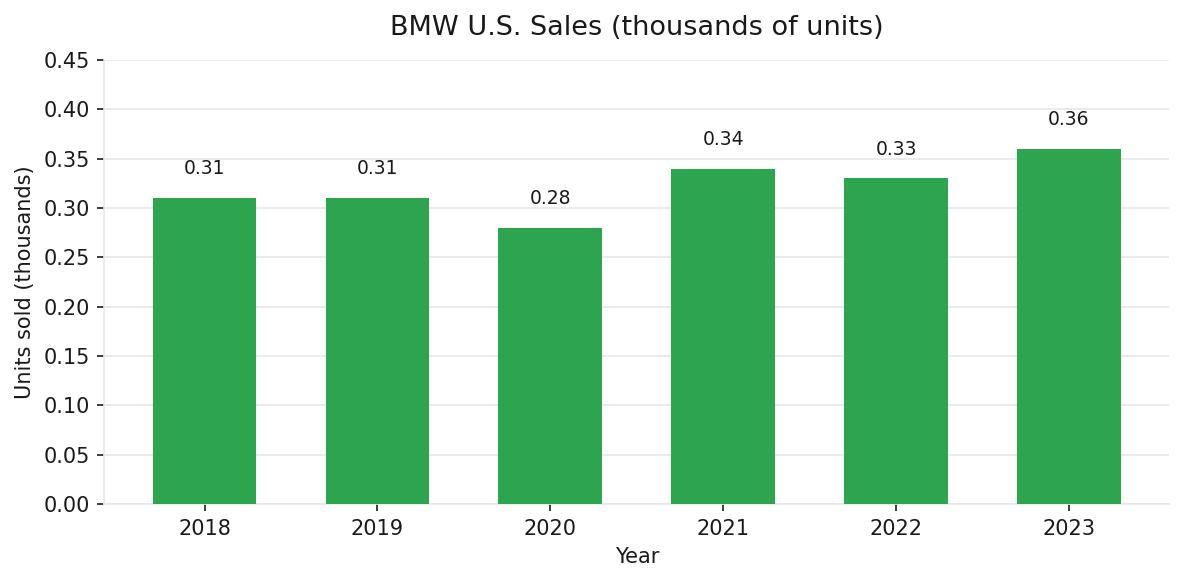
Founded in 1916, BMW, or Bayerische Motoren Werke, initially found its footing in the production of aircraft engines. The origins of this renowned brand are deeply rooted in the sky, with its iconic blue and white logo symbolizing the spinning propellers of an aircraft against the Bavarian sky. Over the decades, BMW transitioned from the clouds to the roads, becoming a name synonymous with luxury, performance, and engineering excellence.
From Propellers to Pistons
Back in 1916, in the midst of World War I, BMW began its journey as a manufacturer of aircraft engines. After the war, with the Treaty of Versailles restricting Germany's aircraft production, BMW sought new directions. By 1923, they ventured into the world of motorcycles, launching the R32. This motorcycle laid the foundation for BMW's engineering prowess, which would later be seen in their automobiles.
The leap to four wheels came in 1928 when BMW acquired Fahrzeugfabrik Eisenach, an automotive manufacturer. Their first car, the BMW 3/15, was unveiled soon after. However, the march towards becoming a leading car manufacturer was not without its challenges. During the Nazi era, BMW's factories were turned towards the war effort, primarily producing aircraft engines for the German military.
Post-World War II, BMW faced significant setbacks. Allied bombings had destroyed much of their manufacturing capabilities. The company had to rebuild almost from scratch, facing both financial and infrastructural challenges. BMW relaunched itself into the automobile industry with models like the 501, nicknamed "Baroque Angel," which, despite its elegance, did little to stabilize the company financially.
The Car That Saved BMW
The 1960s brought a turning point for BMW. The introduction of the Neue Klasse, a line of compact sedans and coupes, marked a revival for the company. These cars were defined by their sporty handling, modern design, and innovative engineering. The success of the Neue Klasse laid the groundwork for future BMW models and was instrumental in establishing the brand as a leader in producing engaging, driver-focused vehicles.
Out of this evolution came the 3 Series in 1975, a car that would set the benchmark for sports sedans for nearly four decades. With its perfect blend of performance, practicality, and prestige, the 3 Series solidified BMW's reputation for creating the "Ultimate Driving Machine," a tagline that would become synonymous with the brand's commitment to delivering an exhilarating driving experience.
The M Division and Driving Pleasure
BMW's M Division, established in 1972, took the brand's performance to another level. Originally tasked with supporting BMW's racing program, the division eventually began producing high-performance versions of BMW models. The M3 and M5, born out of this division, became icons of refined power and driving thrill.
The M Division is celebrated for its ability to blend luxury with adrenaline-pumping performance. Each M car is meticulously engineered to deliver peak performance on the track while remaining comfortable and practical for everyday use. The division's efforts have cemented BMW's place in the hearts of driving enthusiasts worldwide.
BMW in the United States
BMW's influence extends globally, with a significant presence in the United States. The introduction of the X5 in 1999 marked BMW's successful foray into the SUV market, which they aptly termed Sports Activity Vehicles. The X5 combined the brand's signature driving dynamics with the practicality and versatility of an SUV, paving the way for the proliferation of the X Series models.
The opening of the Spartanburg plant in South Carolina in 1994 was a strategic move that strengthened BMW's footprint in the American market. This facility has become the global hub for BMW's X models, producing the X3, X4, X5, X6, and X7. The plant not only caters to the growing demand for SUVs but also reflects BMW's commitment to innovation and sustainable manufacturing practices.
BMW has embraced the electric future with models like the i3 and i4, showcasing their dedication to sustainable mobility without compromising on the driving pleasure that BMW is known for. These electric models represent BMW's vision of combining luxury, performance, and environmental responsibility, ensuring that they remain at the forefront of automotive innovation.
Despite the shift towards electrification, BMW remains committed to its inline-6 engine configuration, a hallmark of the brand. Known for their smoothness and performance, BMW's inline-6 engines are a testament to their dedication to engineering excellence and driving pleasure.
Before You Buy a Used BMW
Understanding a vehicle's past is crucial, especially when it comes to BMWs. These vehicles, known for their luxury and performance, are also infamous for their rapid depreciation. This depreciation makes used BMWs an attractive option for buyers seeking luxury at a more affordable price point. However, the allure of a used BMW can sometimes mask potential pitfalls.
Run the VIN through our free VIN decoder to confirm what the car was when it left the factory (model, model year, engine and assembly plant, from NHTSA's vPIC database) and to see NHTSA safety recalls for that model year. The BMW model pages on this site add owner complaints, service bulletins, defect investigations, EPA fuel economy and crash ratings where NHTSA publishes them. We don't provide vehicle history reports, so accidents, title brands and odometer readings aren't part of the lookup. For title brands, the federal NMVTIS program is the official source, and an independent mechanic's pre-purchase inspection is worth the cost.
Used-car checklist
What to Verify on a Used BMW
Six checks specific to used BMWs.
Takata air bags
2000–2006 3 Series, 2000–2004 5 Series and X5, and 2007–2014 X5 and X6 have do-not-drive campaigns. 2006–2015 driver bags: 16V-071/20V-017. See the Takata section.
Park-outside and fire-risk recalls
Starter relay 25V-636/26V-441 (park outside); starter overheating 25V-644/26V-056; 2004–2010 5 Series battery cable 12V-126 (park outside); blower wiring 17V-676; PCV heater 22V-119.
Cooling system
2.0L four-cylinder electric water pump 24V-608 (fire risk); V8/V12 auxiliary water pump 18V-248. Cooling problems outside these recalls are common on older BMWs, so ask for repair records.
Brakes
2023–2025 integrated brake 24V-104/24V-739; brake vacuum pump 10V-446/13V-045; B58 brake assist software 21V-598.
Engine stalling and drive power
VANOS bolts 14V-176/23V-707; battery cable 13V-044; fuel pump connector 16V-746; diesel fuel pump 21V-586; i4, iX, i5 and i7 drive software 25V-395.
N63 V8 cars
2009–2014 550i, 650i, 750i, X5 50i and X6 50i: ask whether the N63 Customer Care Package was done and check oil use. A 2018 class action settlement covered oil consumption and battery drain.
World Manufacturer Identifier
BMW VIN prefixes (WMI)
Prefix registrations and example decodes come from NHTSA's vPIC database. The prefix tells you the maker and region; the 11th character and the full decode tell you the plant.
A 2019 330i decodes to Munich, a 2019 530i to Dingolfing and a 2016 328i to Rosslyn, South Africa. Later Z4s are WBA too: a 2023 Z4 decodes to Graz, Austria.
A 2021 M3 Competition decodes to BMW M GmbH, Munich.
A 2017 i3 decodes to Leipzig and a 2022 i4 eDrive40 to Munich.
A 2020 X1 and a 2019 X2 decode to Regensburg; a 2006 X3 to Graz, Austria.
A 2004 and a 2019 X5, a 2019 X3 and a 2020 X7 decode as 5UX; a 2020 X5 M as 5YM.
A 2004 Z4 2.5i decodes to Spartanburg. Used on US-built roadsters, not on X SUVs.
Worked example
Worked example: reading a BMW VIN
Example VIN (demo only, not a real vehicle): 5UXCR6C52KL000000
K = 2019 (federal year-code table)Buyer notes by model
Top BMW Models: What to Check
Open a model for the checks that matter most.
BMW 3 Series and M3
2000–2006 (E46): Takata do-not-drive 14V-428, 20V-018, 15V-318 and replacement modules 17V-047; 2000–2001 NADI 21V-401. 2006–2013 (E90): driver Takata 16V-071/20V-017, sport wheel 24V-513, blower wiring 17V-676, PCV heater 22V-119, VANOS 23V-707. 2012–2016: water pump 24V-608. 2019–2024: starter 25V-636 (park outside), 26V-056.
BMW 5 Series and M5
2000–2003: replacement and sport-wheel Takata modules 17V-047/19V-015. 2004–2010: battery cable 12V-126 (park outside) and brake vacuum pump 10V-446. 2006–2011: PCV heater 22V-119. 2010–2013 550i: aux water pump 18V-248 and the N63 program. 2018–2022: starter relay 25V-636/26V-441. 2021–2023: driveshaft 26V-525. 2024–2026: integrated brake, A/C harness 26V-096.
BMW X5 and X6
2000–2004: Takata sport wheel 19V-015/25V-748 (do not drive). 2007–2014: passenger Takata 19V-017/20V-016 (do not drive), driver 20V-017, fuel pump connector 16V-746, PCV heater, V8 vacuum pump 13V-045. 2011–2014: front driveshaft 17V-138. 2019–2020: starter 25V-644, seat bolts 19V-096. 2024–2025: integrated brake 24V-739.
BMW X3
2007–2010: driver Takata 20V-017. 2007–2011: PCV heater 22V-119. 2011–2017: child seat anchors 16V-333. 2013–2017: water pump 24V-608. 2018–2023: cargo rail 24V-534. 2020–2022: starter relay 25V-636 (park outside). 2022–2024: rear door locks 25V-106. 2025–2026: steering 25V-857. US X3s decode as 5UX (Spartanburg); the first generation was WBX (Graz).
BMW 7 Series
2002–2008: brake vacuum pump 10V-446. 2005–2008: Comfort Access rollaway 12V-502. 2009–2012: V8/V12 aux water pump 18V-248 and the N63 program. 2017–2019 740Le: starter relay 26V-441 (park outside). 2020–2022: starter 25V-644. 2023–2026: integrated brake, A/C harness, i7 drive software, 750e driveshaft 26V-525.
BMW X1, 2 and 4 Series, Z4 and i4
X1: 2013–2015 driver Takata 20V-017, 2012–2015 water pump 24V-608, 2016–2019 B-pillar trim 19V-349, 2023–2025 integrated brake. 2 and 4 Series: 2014–2016 water pump; 2021–2024 starter recalls. Z4: 2006–2011 PCV heater, 2019–2022 starter relay 25V-636. i4 and iX: battery 22V-541 (do not drive) and drive software 25V-395.
BMW X1 → · 2 Series → · 4 Series → · Z4 → · i4 →
FAQ
Common questions about BMW VINs
What VIN prefix do BMW vehicles use?
BMW vehicles manufactured in Germany carry VINs beginning with WBA (cars), WBS (M performance models), or WBY (electric vehicles including the i3 and i4). BMW X models assembled in Spartanburg, South Carolina use a 5UX prefix, making them among the most common BMW VINs on US roads. The X3, X4, X5, X6, X7, and XM are all assembled in South Carolina and carry US-origin VINs. BMW motorcycles and MINI vehicles carry separate VIN prefixes under their respective brand identifiers.
What does a free BMW VIN check on VinNumber.net show?
The free decoder reads the VIN in NHTSA's vPIC database and returns the model, model year, body, engine, drive type and assembly plant. BMW VINs in vPIC start with prefixes such as WBA, WBS, WBY, WBX and 5UX. The same lookup lists NHTSA safety recalls for that make, model and model year. Each of our 13 BMW model pages adds what NHTSA and the EPA have published: owner complaints, technical service bulletins, defect investigations, fuel economy and, where NHTSA has tested the car, NCAP crash ratings. It is not a vehicle history report: it doesn't show accidents, title brands, odometer readings or theft records.
Where is the VIN on a BMW?
BMW places the VIN on a plate at the bottom of the driver side windshield. It also appears on a sticker inside the driver door jamb and is printed on the vehicle certification label. On X-Series SUVs, the VIN is stamped on the front of the engine block and on a plate in the engine compartment. On older BMW sedans, the VIN is also stamped on the firewall near the battery. The e-drive on BMW i models has an additional battery module serial number separate from the vehicle VIN.
Which BMW models have the most documented recalls?
The BMW X5 appears in more NHTSA recall campaigns than any other BMW model (more than 110 since its 2000 launch), followed by the 3 Series and 5 Series, which have long production runs and high US sales volumes. Both series were affected by the Takata airbag inflator recall across multiple model years. X5 campaigns include fuel pump wiring (16V-746), Takata passenger air bag inflators on 2007–2013 models, front seat and seat belt attachment bolts, and starter motors on 2019–2020 models. The BMW 7 Series has periodic recalls tied to its electronics, such as the 2005–2008 shift-by-wire rollaway recall (12V-502) and starter and integrated brake campaigns on recent models; NHTSA lists no 7 Series air suspension recall. More recent BMW electric models have received software-related over-the-air recall completions.
Which BMW models are on a Takata do-not-drive warning?
NHTSA's records carry a do-not-drive advisory for unrepaired 2000–2006 3 Series cars (passenger recalls 13V-172, 14V-428 and 20V-018, driver recall 15V-318), 2000–2003 cars with replacement driver modules (17V-047, 19V-698), 2000–2003 5 Series and 2000–2004 X5 models with the optional sport steering wheel (19V-015, 25V-748), and 2007–2013 X5 and 2008–2014 X6 models in the passenger campaigns 16V-364, 17V-020, 18V-030, 19V-017 and 20V-016. If the VIN shows one of these open, don't drive the car; BMW centers repair it free.
Which BMWs should be parked outside until the recall is fixed?
NHTSA's records tell owners to park outside and away from structures for the starter relay recalls 25V-636 (certain 2019–2022 330i, 430i, 530i, X3, X4, Z4 and 230i models) and 26V-441 (2016–2020 330e, 530e and 740Le plug-in hybrids), the 2004–2010 5 and 6 Series battery cable recall 12V-126, and the 2022–2023 iX and 2022 i4 high-voltage battery recall 22V-541, which also says not to drive or charge the car.
Is the BMW electric water pump a recall?
Yes, for some engines. Recall 24V-608 (August 2024, about 721,000 vehicles) covers the electric coolant pump on 2012–2018 models with the 2.0L four-cylinder, such as the 228i, 328i, 428i, 528i, X1, X3, X4, Z4 sDrive28i and X5 xDrive40e, because a poorly sealed connector can short circuit and start a fire. Recalls 11V-521 and 18V-248 cover the auxiliary water pump on 2008–2012 V8 and V12 models. Water pump failures on other engines are a wear item, not a recall.
Was the BMW N63 V8 oil consumption problem a recall?
No. BMW handled it with the N63 Customer Care Package (service bulletin SI B11 06 14), which inspects and replaces parts such as injectors, sensors, the vacuum pump and crankcase vent lines on 2009–2014 550i, 650i, 750i, X5 xDrive50i and X6 xDrive50i models. A 2018 class action settlement (Bang v. BMW of North America) reimbursed certain costs for oil consumption and battery drain. Separate safety recalls, such as auxiliary water pump recall 18V-248, still apply to some of these cars.