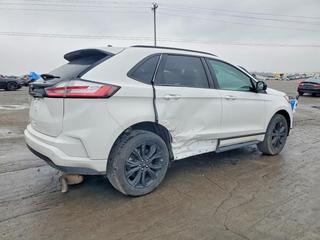
A free NHTSA vPIC decode tells you which Ford Edge you are looking at. Then check its model year against 43 NHTSA recall campaigns and what owners have reported.
VIN prefix2FM
Free decode plus the NHTSA recalls for its model year. 17 characters, no I, O or Q.
Ford Edge
About the Ford Edge
Ford sold the Edge in the US for model years 2007–2024. Across those years NHTSA lists 43 vehicle recall campaigns and 14,045 owner complaints. The 2013 has the most complaints of any model year (2,445). EPA rates it at 18–25 mpg combined. A free VIN decode gives you NHTSA vPIC’s record for the car (model year, engine, plant) and the NHTSA recalls for its model year. It won’t show theft, flood or lemon-law history.
US model years2007–2024
EPA classSmall Sport Utility Vehicle
NHTSA recall campaigns43
Owner complaints14,045 at NHTSA
Auction lot photo, for illustration
Generations
Ford Edge at a glance
One generation in the data, 2007–2024: 43 NHTSA recall campaigns and 14,045 owner complaints.
NHTSA has 43 campaigns on file for Edge model years 2007–2024, and the 2017 shows up in more of them than any other year (8), ahead of the 2015 (7). Move the line to your model year to see which apply.
2017
Air bag inflator, fire risk or do-not-drive/park-outside advisorySafety recallCanada only
Pick a row
What to ask
Source: NHTSA recall database, vehicle campaigns only; row text is NHTSA’s summary. A listed year does not mean every car is covered, so check the VIN.
Canada rows: Transport Canada recalls database. Transport Canada recalls that match an NHTSA campaign are folded into that row by VinNumber.net; rows with the Canadian flag have no NHTSA match. Contains information licensed under the Open Government Licence – Canada · Transport Canada.
Owner reports · NHTSA complaints
What Ford Edge owners report
Owner summaries + NHTSA data
Between them, the 2013 and 2011 hold 4,248 of the 14,045 complaints, or 30%. Tap any bar or generation.
14,045NHTSA complaints, 2007–2024
301mention a crash
74mention a fire
279injuries reported
Owner complaints by model yearEdge: 14,045 complaints · most for the 2013 (2,445)
2007··2010····2015····2020····
Top complaint areas · Edge
Mentions in 14,045 complaints, 2007–2024.
Engine and cooling3,174
Electrical system2,620
Brakes2,325
Powertrain (transmission, driveline)2,167
Air bags1,200
Structure and body926
Crashes 301Fires 74Injuries 279
2007–2024
NHTSA data summary
The 2013 is the outlier. On its own it has 2,445 of the ’s 14,045 complaints (17%), more than any other Edge model year. By area, nothing stands out. Engine and cooling leads with 3,174, with the electrical system (2,620) and the brakes (2,325) close behind.
What Edge owners report across recent generations
Owner summary
2015–2024 (2nd generation)
Coolant trouble dominates NHTSA complaints for the 2017, with many owners of 2.0-liter EcoBoost models describing coolant getting into a cylinder, misfires and dealers calling for a new engine. CarComplaints notes a trend of the engine dying while driving on the 2015. Recalls cover front brake hoses that may rupture and rear brake hoses that may leak on 2015–2018 models, a driver air bag that may not fully inflate on 2016–2017 models and torque converter weld studs on 2017–2018 models with the 2.0-liter engine. [1][2]
2007–2014 (1st generation)
A door ajar warning that stays on even with every door closed is the leading NHTSA complaint for the 2013, and CarComplaints calls it the chief problem for that year. Owners also report brake trouble and batteries that drain. Recalls cover a fuel line pulse damper that may crack and leak on 2012–2013 models with the 2.0-liter engine and a halfshaft that may disengage while driving on 2012–2014 models. [3][4]
✓
What to check before buying
Run the VIN through the NHTSA recall lookup, including the fuel line and halfshaft recalls on 2012–2014 models and the brake hose, air bag and torque converter recalls on 2015–2018 models.
On 2.0-liter models, ask for records of coolant loss or engine replacement and check the coolant level.
On the drive, watch for misfires, stalls and a door ajar warning that will not clear.
Counts: NHTSA complaints file, records to October 1, 2026, one count per complaint; areas are NHTSA component groups.
Owner summary updated September 25, 2026.
Owner opinions · Reddit
What Ford Edge owners say on Reddit
Summarized from public threads
For Edge owners on Reddit, the 2015 to 2018 2.0 EcoBoost is the one to worry about. Many describe coolant intrusion showing up somewhere between moderate and high mileage, with white smoke, rough running and coolant loss ending in an engine replacement, and several treat it as a matter of time rather than luck. Owners of 2020 and newer models are much happier, describing a comfortable, roomy and peppy SUV with few repairs. The weak spot on later models is the eight-speed automatic, with reports of low-speed shudder, torque converter replacements and full transmission swaps, plus some infotainment bugs and a failed AC unit.
Pros
2020 and newer owners often report many miles with few repairs
Comfortable, spacious cabin that works well on long trips
Peppy acceleration, especially on the ST and ST-Line
Cons
Coolant intrusion on the 2015 to 2018 2.0 EcoBoost, often ending in a new engine
Transmission shudder and torque converter or transmission replacements on later models
Water pump concerns on the V6 and some infotainment bugs
EPA lists 75 Edge versions for model years 2007–2024. The lowest tailpipe CO₂ is 360 g/mi (2019). Pick a model year and powertrain to see each version.
Edge2007–2024
18–25 mpg · CO₂ 360–494 g/mi
2024
23combined MPG
380CO₂ grams per mile (tailpipe)
$2,900EPA yearly fuel cost
6/10Smog rating
1 = worst · 10 = cleanest
5/10Greenhouse gas rating
California LEV-III ULEV50 · Federal Tier 3 Bin 50Emission standard
Cleanest gas version of 2024: AWD · Auto (S8), 4 cyl, 2.0 L, Turbo — 23 MPG · 380 g/mi
Best (lowest) CO₂ by model year
Gas
Annual fuel cost is EPA’s estimate at its current fuel-price assumptions (15,000 miles a year, 55% city driving), so older years are priced at today’s fuel prices. Smog rating and emission standard can differ by sales area (federal vs. California); both are shown. Greenhouse-gas ratings start with the 2013 model year. Source: fueleconomy.gov.
Compare rivals
Edge vs Toyota RAV4 vs Nissan Murano
NHTSA + EPA data
Take 2007–2024. NHTSA lists 43 recall campaigns for the Edge, against 49 for the Toyota RAV4 and 18 for the Nissan Murano. Pick a range to compare.
NHTSA recalls (vehicle campaigns for all powertrain versions; equipment and tire campaigns left out), complaints (not sales-adjusted) and 5-Star overall ratings for the latest year rated for all three; EPA mpg, engines and drive. Rivals: same EPA class, picked by VinNumber.net.
Ford Edge VIN number location
Where to find the VIN on an Edge
Tap a spot. Every location should show the same 17 characters.
Ford placed the Edge's primary VIN plate at the base of the driver's side windshield. The door jamb sticker and B-pillar label provide secondary identification. On earlier Edge models (2007-2014), some firewall stamps were applied during assembly, open the hood and look at the firewall behind the engine for a faint stamped number if the primary locations show any inconsistency.
The title, registration and insurance card show the VIN as well. All locations should match.
FAQ
Common Ford Edge VIN questions
Which Ford Edge model years have the most owner complaints?
The 2013 leads with 2,445, ahead of the 2011 (1,803) and 2017 (1,366). Those first two alone make up 30% of the 14,045 Edge complaints filed with NHTSA, not adjusted for sales.
How many recalls has the Ford Edge had?
NHTSA’s recall records show 43 vehicle campaigns for model years 2007–2024, leaving out equipment and tire campaigns.
Which Ford Edge recalls are high risk?
16V-384 and 17V-024 cover air bag inflators that can rupture. 21V-158, 18V-046, 19V-001 and 17V-123 cover air bag inflator modules and how they deploy. NHTSA’s record names a fire risk in 14V-682, 08V-301, 15V-712, 10V-659, 11V-128, 12V-438, 14V-002, 18V-548 and 1 more. Do-not-drive advisories came with 16V-384, 17V-024, 18V-046 and 19V-001. Each should show as closed on a VIN check.
What fuel economy does the Ford Edge get?
It varies. EPA rates the 2007–2024 Edge at 18–25 mpg combined, depending on engine and drive (fueleconomy.gov).
How does the Ford Edge compare with the Toyota RAV4 and Nissan Murano on recalls?
For 2007–2024 models the Edge has 43 NHTSA recall campaigns. The Toyota RAV4 has 49, the Nissan Murano 18. Complaints run 14,045, 7,219 and 2,664 in that order, with no sales adjustment.
What crash rating does the Ford Edge have?
NHTSA’s 5-Star Safety Ratings give the 2024 Edge 5 stars overall. Both rated versions, FWD and AWD, get that score.