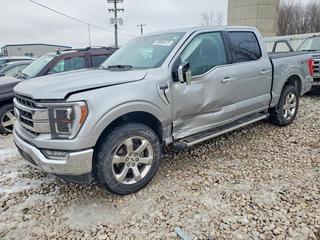
About the Ford F-150
The Ford F-150 has been the best-selling vehicle in the United States for over four decades. Its sheer volume in the used market means that buyers encounter a wide range of history profiles, from well-maintained personal trucks to heavily worked fleet units, theft recoveries, and flood-damaged vehicles from Gulf Coast markets.
A VIN number lookup on this Ford F-150 includes real high-resolution auction photos sourced directly from Copart and IAAI, the largest salvage auction operators in the United States.
Production years: 1975-present
Body type: Full-size pickup truck
What a Ford F-150 VIN Check Reveals
A VIN number check on any Ford F-150 pulls records from state DMV offices, NHTSA databases, insurance industry filings, and salvage auction records across all 50 states. The report covers the following data categories:
- Accident and collision history
- Full odometer timeline
- Open safety recalls from NHTSA
- Title brands (salvage, flood, lemon law, total loss)
- Theft and recovery records
- Lien and ownership history
- Structural and frame damage
- Airbag deployment records
- State inspection history
- Prior vehicle use (fleet, rental, taxi, auction)
Ford F-150 VIN Number Location
Where to find the VIN on a F-150
As one of the most stolen and most frequently totaled trucks in the US, the F-150 carries its primary VIN on a riveted plate at the base of the driver's side dashboard, visible through the windshield. The frame rail near the front axle carries a stamped number, critical after the 2015 switch to aluminum body panels, since collision repairs often replace cab sections without transferring all VIN stamps. Cross-check the door jamb sticker and frame stamp: a mismatch signals a rebuilt or cloned title.
The VIN also appears on the vehicle registration, insurance documents, and title. All locations should match. A mismatch between VIN plates is a potential indicator of a rebuilt or salvage vehicle.
Common Ford F-150 Issues Found in VIN Reports
F-150 trucks from northern states frequently show rust and frame corrosion claims in VIN history reports. The 2015-2017 EcoBoost engines had documented timing chain issues, and vehicles from these years are worth checking for related recall completion. Tailgate theft is also common on F-150s, and a VIN check will surface any structural damage claims filed after theft-related vandalism. Flood damage appears regularly on units from Texas and Louisiana markets.
NHTSA Safety Recalls
Ford F-150 — last 3 model years
What F-150 owners report across recent generations
2021–present (14th generation)
The 2021, first year of this generation, collected a long list of recalls, among them failing windshield wiper motors and arms, loose underbody insulators that could damage the aluminum driveshaft, a false low fluid pressure code that could shift the transmission into neutral, and intake valves that could break on some 2.7-liter EcoBoost engines. NHTSA complaints still center on the 10-speed automatic, with hard downshifts and unexpected neutral events, and CarComplaints lists 10-speed issues first for 2021, ahead of rodent-damaged wiring and oil consumption. Rear axle hub bolts on trucks with the heavy-duty tow package were also recalled. [1] [2]
2015–2020 (13th generation)
Owners of 2018–2020 trucks with the 10-speed automatic (10R80) file many NHTSA complaints about harsh or delayed shifts, clunky downshifts and, in some reports, unexpected shifts into neutral. On F150Forum, 2018 owners describe hard shifts into second, and some say resetting the adaptive learning helped. CarComplaints lists hard shifting as the top 2018 problem, followed by oil consumption and engine rattle. The 3.5-liter EcoBoost adds cam phaser complaints, with rattling or rough running on cold starts. A small 2017–2018 recall covered a few 10-speeds that could lose Park because of a missing roll pin. [3] [4] [5] [6]
2009–2014 (12th generation)
Transmission and steering complaints stand out on this generation. Recall 19V075 covers 2011–2013 trucks with the 6-speed automatic that could unexpectedly downshift into first gear regardless of speed, and NHTSA complaints for the 2013 are full of those sudden downshifts. CarComplaints ranks failed power steering first for 2013, followed by erratic shifting and brake failure, and 2012 owners describe a Service Power Steering Now message with a stiff wheel. A recall for 2013–2014 trucks with the 3.5-liter engine addressed a brake master cylinder seal that could leak and cause a loss of front braking. [7] [8] [9]
What to check before buying
Check the VIN in the NHTSA recall lookup, since all three generations have transmission-related campaigns. Ask for records of transmission software updates, adaptive relearns or repairs on 10-speed trucks, cam phaser work on EcoBoost engines, and power steering repairs on 2011–2014 trucks. Start the engine cold and listen for a rattle, then on the drive feel for harsh downshifts, sudden drops into a low gear or a stiff steering wheel, and test the wipers.
- NHTSA recalls and owner complaints, 2021 Ford F-150 SuperCrew
- CarComplaints.com, 2021 Ford F-150 problems
- NHTSA recalls and owner complaints, 2018 Ford F-150 SuperCrew
- NHTSA recall 18V-213, 2017–2018 F-150 10-speed Park roll pin
- F150Forum thread, 2018 10 speed shifting hard
- CarComplaints.com, 2018 Ford F-150 problems
- NHTSA recalls and owner complaints, 2013 Ford F-150 SuperCrew
- NHTSA recalls and owner complaints, 2012 Ford F-150 SuperCrew
- CarComplaints.com, 2013 Ford F-150 problems
Updated September 25, 2026 · Summarized in our own words by VinNumber.net from public owner reports; individual experiences vary.