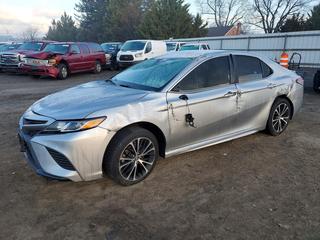
Toyota Camry VIN Number Check

VIN prefix: 4T (cars/SUVs KY/IN); 5TF, 5TD (trucks TX); 2T (Canada); JT (Japan)

Insurance claims, title brands, prior use — all in one Toyota Camry VIN report.

About the Toyota Camry

Toyota Camry at auction
View Real Auction Photos — Toyota Camry

A VIN number lookup on this Toyota Camry includes real high-resolution auction photos sourced directly from Copart and IAAI, the largest salvage auction operators in the United States.

Production years: 1983-present

Body type: Midsize sedan

Toyota Camry Model Generations

1 1983–1986
2 1987–1991
3 1992–1996
4 1997–2001
5 2002–2006
6 2007–2011
7 2012–2017
8 2018–2024
9 2025–present

Wide-body US-market timeline.

What a Toyota Camry VIN Check Reveals

A VIN number check on any Toyota Camry pulls records from state DMV offices, NHTSA databases, insurance industry filings, and salvage auction records across all 50 states. The report covers the following data categories:

  • Accident and collision history
  • Full odometer timeline
  • Open safety recalls from NHTSA
  • Title brands (salvage, flood, lemon law, total loss)
  • Theft and recovery records
  • Lien and ownership history
  • Structural and frame damage
  • Airbag deployment records
  • State inspection history
  • Prior vehicle use (fleet, rental, taxi, auction)

Toyota Camry VIN Number Location

Where to find the VIN on a Camry

Before completing a used Camry purchase, locate the VIN on the lower driver's side dashboard plate and compare it to the door jamb sticker. Fleet-returned Camrys frequently show rental agency asset tags placed over or beside the door jamb sticker, check for adhesive residue or overspray. The engine block carries a secondary stamp, and the trunk lid often has a label near the latch.

The VIN also appears on the vehicle registration, insurance documents, and title. All locations should match. A mismatch between VIN plates is a potential indicator of a rebuilt or salvage vehicle.

Common Toyota Camry Issues Found in VIN Reports

Camry is among the most common fleet and rental vehicles in the US, and VIN checks frequently reveal prior commercial fleet use. Odometer discrepancies are occasionally found on high-mileage Camrys traded out of fleet.

NHTSA Safety Recalls

Toyota Camry — last 3 model years

Loading NHTSA recall data…

What Camry owners report across recent generations

2018–2024 (8th generation)

The 8-speed automatic draws the most owner complaints on this generation, concentrated in the 2018. NHTSA complaints describe hesitation when pulling away, jerky or harsh shifts and some transmission failures, and CarComplaints ranks transmission failure and rough shifting at low mileage as the top 2018 problems, followed by Entune and Bluetooth glitches. Recalls include oversized pistons on some 2018 2.5-liter engines that could cause stalling, fuel pump campaigns, and a vacuum pump on 2018–2019 cars whose vane cap could break and suddenly cut brake assist. [1] [2]

2012–2017 (7th generation)

Owners of the 2012 report a transmission shudder at light throttle, often around 25 to 35 mph or 45 to 60 mph, and many NHTSA complaints mention the torque converter, some also a software update from the dealer. CarComplaints lists transmission failure, a foul smell from the air conditioning and stuttering as the top 2012 problems. Later years draw fewer powertrain complaints, although steering is the largest NHTSA category for the 2015, with many owners saying the electric power steering pulls to one side. [3] [4] [5]

2007–2011 (6th generation)

The defining complaint is oil burning in the 2.4-liter four-cylinder, mostly on 2007–2009 cars. Owners on NHTSA, CarComplaints and CamryForums describe topping up oil between changes, and some say the engine ran low enough to need major repairs or replacement. CarComplaints says the 2007 leads this trend and links it to the piston rings. One forum owner reported using about a quart every 600 to 800 miles at around 90,000 miles, past the deadline of a Toyota warranty program for pistons and rings. Reddit owners still ask whether every 2007–2009 car is affected. [6] [7] [8] [9]

What to check before buying

Run the VIN through the NHTSA recall lookup, and on 2018–2019 cars confirm the vacuum pump recall is closed. Ask for records of transmission software updates or torque converter work on 2012 and later cars, and of oil consumption tests or piston and ring work on 2007–2011 four-cylinders. On the drive, accelerate gently between 25 and 60 mph to feel for shudder, hesitation or harsh shifts, and check the dipstick before you start.

Check Another Toyota Model