Audi VIN Number Check

Enter any Audi VIN to decode it and see open NHTSA recalls for free. Then check the Takata air bag, fire-risk and TDI diesel campaigns below for your model year.

WAU WA1 WUA TRU

Free decode with open NHTSA recalls. 17 characters, no I, O or Q.

About Audi VINs

How Audi VINs are built

Audi vehicles manufactured in Germany carry VIN prefixes beginning with WAU for cars and WA1 for SUVs and crossovers. The e-tron electric SUVs carry a WA1 prefix (the e-tron GT sedan uses WAU). Audi vehicles frequently appear in VIN checks related to hail damage claims, which are particularly common on sunroof-equipped models traded out of the midwest and central states.

The first three characters identify the maker and vehicle type, not the factory. Audi AG registers WAU for passenger cars and WA1 for SUVs; Audi Sport GmbH uses WUA on RS models and the R8, and Audi Hungaria uses TRU on TTs built in Győr. A W prefix does not always mean Germany: NHTSA's vPIC decodes a 2018 Q5 to San José Chiapa, Mexico, a 2017 Q7 to Bratislava, Slovakia, a 2019 e-tron to Brussels, Belgium and a 2015 S3 to Győr, Hungary. The 11th character and the full 17-character decode confirm the plant, model and year.

Audi vehicles manufactured for the US market carry VIN prefixes of WAU, WA1, TRU. The VIN number encodes the country of manufacture (Germany), production plant, vehicle line, body style, engine type, model year, and a unique production sequence number.

HQIngolstadt, Germany
Founded1909 (August Horch, Zwickau)
CEOGernot Döllner (since 2023)
ParentVolkswagen Group
US sales 2024196,576
US sales 2025164,942

Sources: HQ: AUDI AG legal notice · Founded: History of the Four Rings · CEO: audi.com biography · Sales: Audi of America year-end release, via Audi Club North America (Jan 2026)

NHTSA campaign data

Which model years each recall covers

Drag the year line to your car’s model year. Bars it crosses are the campaigns to confirm on the VIN.

2018
Do Not Drive Safety recall Emissions fix (TDI)
10 campaigns cross 2018
2002200620102014201820222026
DO NOT DRIVE · 18V-369
Brake caliper pistons may have insufficient coating; reduced braking
2018 Q5. 2018 Q5 and SQ5 (also several 2018 Volkswagen models). NHTSA's record tells owners not to drive the vehicle until it is repaired.
What to askConfirm 18V-369 is closed before a test drive.

Coverage depends on build dates and equipment (engine, drivetrain, body style). A listed year doesn't mean every vehicle from that year is included; the VIN lookup decides. "Takata" marks campaigns NHTSA files under its Takata inflator investigation (EA15-001). "Do not drive" means NHTSA's recall record carries that advisory. Several campaigns are shared with Volkswagen models; S, RS, allroad and Sportback versions are named in the campaign text.

Audi Recalls: How to Check a Specific VIN

  1. Enter the full 17-character VIN in the NHTSA recall lookup. It shows open safety recalls, including the Takata and do-not-drive campaigns above.
  2. Then use Audi USA's recall and service campaign lookup, which covers campaigns with owner notices from the last 15 years.
  3. On a TDI diesel (2010–2015 A3 2.0L, 2009–2016 Q7 or 2014–2016 A6, A7, A8 and Q5 3.0L), check the emissions modification separately: it is an EPA and CARB settlement repair, not an NHTSA recall. See the EPA's Volkswagen violations page.
  4. If a do-not-drive recall is open, don't drive the vehicle until it is repaired. Recall repairs are free at Audi dealers.
Full list: every safety recall in this timeline
Selected Audi recalls worth confirming on a used-car VIN (NHTSA campaign data)
CampaignIssueModels & years
16V-078 · 16V-079 · 18V-082Takata driver air bag inflator can rupture in a crash (excessive internal pressure)2005–2013 A3, 2006–2009 A4, 2010–2012 A5, 2009–2012 Q5. 16V-079: 2005–2013 A3 and 2006–2009 A4 Cabriolet. 16V-078: 2009–2012 Q5 and 2010–2012 A5 and S5 Cabriolet. 18V-082 calls the same groups back again (2006–2013 A3, 2007–2009 A4 and S4 Cabriolet, 2008 RS 4 Cabriolet, 2009–2012 Q5, 2010–2012 A5 and S5 Cabriolet) because the inflator can explode. Filed under NHTSA's Takata inflator investigation (EA15-001).
16V-382 · 17V-032 · 18V-004 · 18V-427Takata passenger air bag inflator may explode (propellant degradation)2004–2009 A4, 2005–2011 A6. Phased by the state where the car was sold or ever registered: 16V-382 started with Zone A (AL, CA, FL, GA, HI, LA, MS, SC, TX and US territories), 17V-032 and 18V-004 added Zone B states, and 18V-427 covers 2005–2008 A4 and S4 sedans and Avants, 2007–2008 RS 4, 2007–2009 A4 and S4 Cabriolet, 2005–2011 A6 and 2007–2011 S6. Filed under NHTSA's Takata inflator investigation (EA15-001).
19V-014Takata driver inflator: TT and R82016–2017 TT. 2016–2017 TT Coupe and Roadster and 2017 R8 Coupe and Spyder. The inflator can explode when the driver air bag deploys. Filed under NHTSA's Takata inflator investigation (EA15-001).
19V-862Earlier Takata repair may have used an inflator that can also degrade2011–2013 A3. 2011–2013 A3 diesels thought to have been repaired under an earlier Takata recall. The driver inflator can explode after long exposure to heat and humidity.
20V-056 · 21V-470Non-azide driver air bag inflator may absorb moisture and deploy improperly2000–2002 A4, 2000 A6, 2000–2001 TT. 20V-056: 1999–2000 A4, 1998–2000 A6, 1999 A8 and 2000–2001 TT. 21V-470: 2000–2002 A4 and S4 and 2000–2001 TT. These inflators do not use the PSAN propellant of the Takata recalls but can still deploy improperly.
18V-369Do Not Drive Brake caliper pistons may have insufficient coating; reduced braking2018 Q5. 2018 Q5 and SQ5 (also several 2018 Volkswagen models). NHTSA's record tells owners not to drive the vehicle until it is repaired.
24V-621 · 26V-240Brake pedal fastener may be assembled incorrectly; pedal can detach from the booster2019–2024 e-tron. 24V-621: 2019–2024 e-tron and 2020–2024 e-tron Sportback. 26V-240 (April 2026) covers e-tron and e-tron Sportback through 2023 and the 2024 Q8 and SQ8 e-tron again. A detached pedal means loss of braking.
23V-867High-voltage battery modules may overheat2019–2022 e-tron. 2019–2022 e-tron and 2020–2022 e-tron Sportback with certain battery modules. Fire risk.
25V-080Plug-in hybrid high-voltage battery may overheat2021–2024 Q5, 2022 A7. 2021–2024 Q5 plug-in hybrids (TFSI e) and the 2022 A7 plug-in hybrid. Fire risk.
17V-002 · 18V-2292.0L turbo electric coolant pump can overheat or short-circuit2013–2016 A4, 2013–2017 A5, 2012–2015 A6, 2013–2017 Q5. Cars with the 2.0L turbo FSI engine. 17V-002: debris can block the pump so it overheats; 18V-229 expands the recall because the pump can also short-circuit from moisture. Fire risk.
17V-622Auxiliary heater connector may corrode; wires can overheat or melt2013–2016 A4, 2013–2016 A5, 2013–2016 Q5. A4 sedan and allroad, A5 Coupe and Cabriolet and Q5. Fire risk.
16V-660 · 17V-298Fuel pump flange may crack and leak fuel2009–2017 Q5, 2007–2015 Q7. Gasoline models only. 16V-660: 2009–2012 Q5 and 2007–2012 Q7. 17V-298: 2013–2017 Q5 and 2013–2015 Q7. Fire risk.
17V-001Sunroof drain water can corrode a side air bag inflator, which may fracture2011–2017 Q5. Water can soak the foam around the side head air bag inflator canister. A corroded canister can fracture without the air bag deploying and throw fragments into the cabin.
22V-753Connecting rod bearings may be damaged; engine failure2021–2023 Q5. 2021 Q5 and 2022–2023 Q5 Sportback (also Volkswagen Atlas models). An engine failure can cause a stall, and an oil leak a fire.
25V-294Cylinder head cover screws may loosen; oil leak2022–2024 Q5. 2022–2024 Q5 and Q5 Sportback quattro. Fire risk.
21V-947Liquid can reach the gateway control module; sudden loss of power2018–2022 Q5. 2018–2022 Q5 and SQ5 and 2021–2022 Sportback versions. A spill in the rear seat or water through a body seam can shut the module down.
26V-590Steering rack bolt may corrode and break2019–2021 Q3. 2019–2021 Q3 (also 2018 Tiguan and 2018–2019 Atlas). A broken steering rack housing can cause loss of steering control. Filed September 2026.
22V-516Fuel pump component may break; engine stall2020–2021 Q7, 2019–2021 Q8. 2019–2021 Q8 and 2020–2021 Q7.
19V-035Fuel rails may leak2016–2018 A6, 2016–2018 A7, 2015–2018 A8, 2016–2018 Q7. Left and right fuel rails. Fire risk.
16V-646 · 17V-781Fuel hose or line in the engine bay may leak2012–2014 A6, 2012–2014 A7. 16V-646: 2012–2013 A6 and A7 (degrading fuel hose). 17V-781: 2012–2014 A6 and A7 (weak point in the fuel line). Fire risk.
22V-178Turbocharger oil strainer may block; turbo failure and stall2013–2017 A8. 4.0L V8 turbo models: 2013–2017 A8, S8, S6 and S7 and 2014–2017 RS 7.
21V-198 · 21V-874Passenger occupant detection may switch off the front passenger air bag2015–2020 A3, 2017–2020 A4, 2018–2020 A5. 21V-198: 2015–2020 A3 and S3, 2016–2018 A3 e-tron and 2017–2020 RS 3. 21V-874: 2017–2020 A4, 2018–2020 A5 and S5, 2018–2020 S4 and 2018–2019 RS 5 (seat-heater cable fault).
24V-110Fuel can flow into the evaporative emissions system and leak2015–2020 A3. Front-wheel-drive 2015–2020 A3 sedans and 2015–2019 A3 Cabriolets (also Volkswagen Golf and Jetta GLI models). Fire risk.
25V-900Rearview camera image may not display (software)2019–2025 A6, 2019–2025 A7, 2019–2026 A8, 2020–2026 Q7, 2019–2026 Q8, 2019–2024 e-tron. One of Audi's largest recent campaigns (December 2025): also RS and S versions and the e-tron GT.
04V-133Knee bolster can short the headlight switch harness2001–2004 A6. 1998–2004 A6 and S6, 2001–2004 allroad and 2003 RS6. Fire risk.
08V-157Fuel tank rollover valve nipple may crack and leak2001–2004 A6. 2001–2004 A6 quattro (2.7L, 2.8L and 3.0L) and 2001–2005 allroad quattro. Fire risk.

Diesel and air bags

Audi TDI diesels and Takata air bags: what to check

Two groups of campaigns matter most on 2004–2016 Audis: the Volkswagen Group diesel emissions settlements, which cover the A3 2.0L TDI and the 3.0L V6 TDI in the Q7, A6, A7, A8 and Q5, and the Takata air bag inflator recalls, phased by the states a car was registered in.

A3 2.0L TDI (2010–2013, 2015)

Part of the 2.0L settlement with the EPA and CARB. Owners could choose a buyback or, once approved, a free emissions modification. Modified cars carry an emissions modification label under the hood. Source: EPA, settlement website.

3.0L V6 TDI (2009–2016)

2009–2016 Q7 and 2014–2016 A6, A7, A8, A8L and Q5 TDIs are in the separate 3.0L settlement of December 2016. These repairs do not appear in NHTSA's recall lookup.

Takata driver inflators

16V-079, 16V-078 and 18V-082: 2005–2013 A3, 2006–2009 A4 Cabriolet, 2009–2012 Q5 and 2010–2012 A5 and S5 Cabriolet; 19V-014: 2016–2017 TT and 2017 R8. See also Audi's Takata page.

Takata passenger inflators by zone

16V-382, 17V-032, 18V-004 and 18V-427: 2004–2009 A4 and S4 (including Cabriolets and RS 4) and 2005–2011 A6 and S6. Cars ever registered in a Zone A state were called first, so check the VIN, not just the state the car is in now.

Sources: EPA: Volkswagen violations · VW/Audi settlement website · Audi USA: Takata · NHTSA recall records (EA15-001)

Audi models

Audi Models

Open a model for its VIN check, generations, recalls and owner complaints.

About Audi

🎙️ Listen to this article

Four Companies, Four Rings

Audi's iconic four-ring emblem is more than just a design; it represents the merger of four pioneering companies. This union took place in 1932, bringing together Audi, DKW, Horch, and Wanderer under the umbrella of Auto Union AG. Each ring symbolizes one of these brands, laying the foundation for the modern Audi we know today.

The company's journey through history has been marked by both innovation and adversity. Following its formation, Auto Union became a significant player in the German automotive industry. However, the aftermath of World War II nearly spelled the end for the company. With its factories in East Germany seized and dismantled, the future looked bleak for Auto Union.

Rebuilding began in West Germany, and in 1965, Volkswagen purchased the struggling brand. This acquisition marked a turning point, setting the stage for Audi's resurgence. The brand's commitment to cutting-edge technology and design began to take shape, paving the way for the innovative cars that would follow.

Quattro: The Rally Revolution

In 1980, Audi introduced the quattro all-wheel-drive system at the Geneva Motor Show, and automotive history was made. The quattro system transformed Audi's image, bringing all-wheel-drive technology from the realm of off-road vehicles to the mainstream car market. Its introduction to rallying showcased its potential, securing the brand's reputation for performance and innovation.

The Audi Quattro stormed the rally world, demonstrating its capabilities in the World Rally Championship (WRC). The car's dominance in the early 1980s was unprecedented, with drivers like Michèle Mouton and Hannu Mikkola taking victory after victory. This success on the rally circuit helped Audi establish a new performance-oriented identity.

The quattro system wasn't just about winning races; it also set a new standard for road cars. It offered enhanced traction and stability, features that resonated with consumers and became a hallmark of Audi vehicles. The impact of the quattro system is felt to this day, as it remains a key feature in Audi's lineup.

Audi in America

Audi's journey to establish itself in the American market has been a strategic effort. The Audi 80, 90, and 100 models played a significant role in building a European reputation for quality and sophistication. These models introduced American buyers to the blend of engineering, performance, and luxury that Audi had become known for.

The introduction of the A4, A6, and A8 models further solidified Audi's place in the premium segment. These vehicles offered a combination of advanced technology, luxury features, and performance that appealed to US consumers. The A8, in particular, showcased Audi's capabilities at the high end of the market, featuring innovations like an aluminum space frame that reduced weight and improved efficiency.

As Audi continued to expand its presence in the US, the brand faced stiff competition from BMW and Mercedes-Benz. However, Audi's strategy of combining technical prowess with luxury and style has proven successful. The launch of the TT and R8 sports models highlighted Audi's versatility, offering cars that were not only high-performing but also design icons.

Sport, Luxury and Electrification

Audi's evolution over the decades has been marked by a commitment to both sportiness and luxury. The quattro sport system has remained at the center of Audi's performance offerings. It has been continually refined and adapted to meet the demands of modern driving, whether on the road or the track.

In recent years, Audi has turned its focus toward electrification with the introduction of the e-tron series. This shift represents Audi's commitment to sustainability and innovation in the face of changing automotive landscapes. The e-tron models aim to blend the brand's traditional values of quality and performance with the need for environmentally friendly solutions.

The e-tron lineup includes both SUVs and performance vehicles, ensuring that Audi's electrified offerings cater to a wide range of buyers. This strategy places Audi in a strong position as the automotive industry moves towards a more sustainable future.

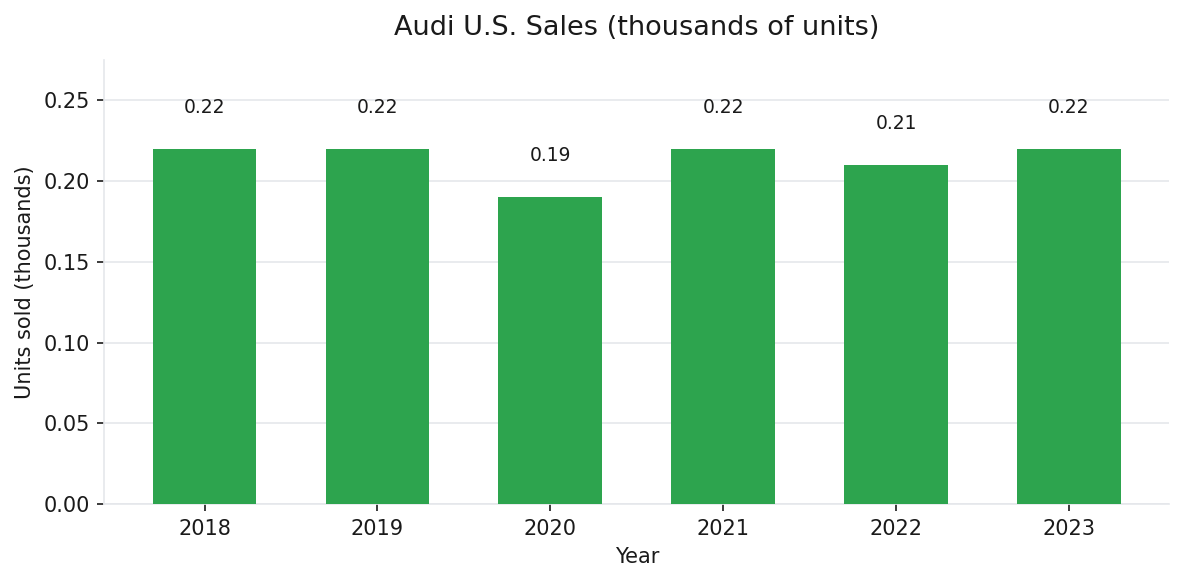
Audi U.S. annual vehicle sales 2018-2023
Audi U.S. annual sales
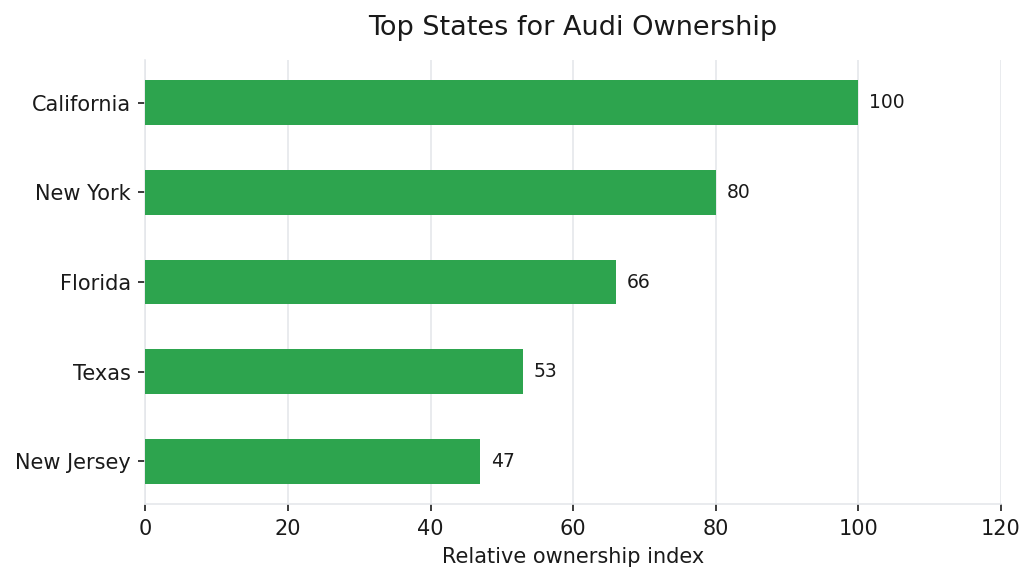
Top U.S. states for Audi vehicle ownership
Top states for Audi ownership

Used-car checklist

What to Verify on a Used Audi

Six checks specific to used Audis.

TDI: emissions fix or buyback?

On a 2010–2015 A3 TDI or a 2009–2016 3.0L TDI (Q7, A6, A7, A8, Q5), look for the emissions modification label and ask for the dealer record. See the diesel and air bag section.

Takata air bag inflators

Driver: 16V-078, 16V-079, 18V-082 (A3, A4 and A5 Cabriolet, Q5) and 19V-014 (TT, R8). Passenger: 16V-382, 17V-032, 18V-004, 18V-427 (2004–2009 A4, 2005–2011 A6). On a 2011–2013 A3 TDI with earlier air bag work, also 19V-862.

Brakes and steering

18V-369 (2018 Q5 and SQ5) carries a do-not-drive advisory. e-tron brake pedal: 24V-621 and 26V-240. 2019–2021 Q3: steering rack bolt 26V-590 (new in September 2026).

Fire-risk recalls on 2.0T and V6 models

2.0L turbo coolant pump 17V-002/18V-229 (2012–2017 A4, A5, A6, Q5); auxiliary heater 17V-622; Q5 and Q7 fuel pump flange 16V-660/17V-298; fuel rails 19V-035 (A6, A7, A8, Q7); 2022–2024 Q5 head cover screws 25V-294.

e-tron and plug-in hybrid batteries

2019–2022 e-tron: battery module overheating 23V-867. 2021–2024 Q5 plug-in hybrid and 2022 A7 plug-in hybrid: 25V-080. Ask what the dealer replaced, not just whether the campaign is closed.

Air bag sensing and water damage

Passenger air bag switched off by sensing faults: 21V-198 (2015–2020 A3) and 21V-874 (A4, A5). 2011–2017 Q5: sunroof drain 17V-001. 2018–2022 Q5: gateway module water damage 21V-947. Water stains in the headliner or rear footwells deserve a closer look.

World Manufacturer Identifier

Audi VIN prefixes (WMI)

Prefix registrations and example decodes come from NHTSA's vPIC database. The prefix tells you the maker and vehicle type; the 11th character and the full decode tell you the plant.

WAU
AUDI AG · Passenger car

A 2017 A4 and a 2019 A6 decode to Neckarsulm, a 2015 S3 to Győr (Hungary) and a 2022 e-tron GT to Heilbronn.

WA1
AUDI AG · SUV

A 2014 Q5 decodes to Ingolstadt, a 2018 Q5 to San José Chiapa (Mexico), a 2017 Q7 and a 2021 Q8 to Bratislava, a 2019 Q3 to Győr and a 2019 e-tron to Brussels.

WUA
Audi Sport GmbH · RS models and R8

A 2021 RS 7 decodes to Neckarsulm; R8s also carry this prefix.

TRU
Audi Hungaria · Passenger car

TTs built in Győr: a 2016 TT quattro decodes to Győr, Hungary.

Worked example

Worked example: reading a Audi VIN

Example VIN (demo only, not a real vehicle): WA1BNAFY2J2000000

WA1BNAFY2J2000000
WA1
1–3 · WMI
AUDI AG, SUV.
BNAFY
4–8 · Vehicle descriptor (VDS)
Audi codes for model, body, engine and restraints. This pattern decodes as a Q5 quattro Premium Plus with the 2.0L turbo gasoline engine.
2
9 · Check digit
Calculated from the other 16 characters using the federal formula. If one character is mistyped or altered, the check digit usually stops matching.
J
10 · Model year
J = 2018 (federal year-code table)
2
11 · Assembly plant
Decodes to San José Chiapa, Mexico.
000000
12–17 · Serial number
Production sequence. A zeroed demo serial is used here on purpose.
Buyer check: a 2018 Q5 is in do-not-drive brake caliper recall 18V-369 if its VIN is listed, so check before a test drive. Also confirm gateway module recall 21V-947 and brake master cylinder recall 19V-277; the VIN decides which ones cover this vehicle. A Mexican-built Q5 still starts with WA1, so the plant you decode should match the door-jamb label, not the prefix.

Buyer notes by model

Top Audi Models: What to Check

Open a model for the checks that matter most.

Audi Q5

2009–2012: Takata driver inflator 16V-078/18V-082. 2009–2017 gasoline: fuel pump flange 16V-660/17V-298. 2011–2017: sunroof drain and side air bag 17V-001. 2013–2017 2.0T: coolant pump 17V-002/18V-229, heater wiring 17V-622. 2014–2016 TDI: 3.0L emissions settlement. 2018: do-not-drive 18V-369; 2018–2022: gateway 21V-947. 2021–2023: engine bearings 22V-753; 2021–2024 plug-in hybrid: battery 25V-080; 2022–2024: head cover screws 25V-294. Since 2018, US Q5s decode to San José Chiapa, Mexico (still WA1).

Audi A4 and A5

2000–2002 A4: NADI inflator 20V-056/21V-470. 2004–2009 A4 and S4: Takata passenger inflators (16V-382, 17V-032, 18V-004, 18V-427); 2006–2009 A4 Cabriolet and 2010–2012 A5 Cabriolet: Takata driver inflators. 2013–2017 2.0T: coolant pump 17V-002/18V-229 and heater wiring 17V-622. 2017–2020 A4 and 2018–2020 A5: passenger air bag sensing 21V-874.

Audi A6 and A7

2001–2004 A6: headlight harness 04V-133 and fuel tank valve 08V-157. 2005–2011 A6 and S6: Takata passenger inflators. 2012–2014: fuel line recalls 16V-646/17V-781; 2012–2015 A6 2.0T: coolant pump 18V-229. 2014–2016 TDI: 3.0L emissions settlement. 2016–2018: fuel rails 19V-035. 2019–2025: rearview camera 25V-900; 2022 A7 plug-in hybrid: 25V-080.

Audi A3

2005–2013: Takata driver inflator 16V-079/18V-082; 2011–2013 TDI: 19V-862. 2010–2013 and 2015 TDI: 2.0L emissions settlement (buyback or fix). 2015–2020: passenger air bag sensing 21V-198 and front-wheel-drive fuel tank pump seal 24V-110. US A3s decode to Győr or Ingolstadt.

Audi Q7 and Q8

2007–2015 gasoline Q7: fuel pump flange 16V-660/17V-298. 2009–2016 Q7 TDI: 3.0L emissions settlement. 2016–2018: fuel rails 19V-035. 2019–2021 Q8 and 2020–2021 Q7: fuel pump 22V-516. 2019–2026: rearview camera 25V-900. Q7s and Q8s decode to Bratislava, Slovakia.

Audi e-tron, Q3 and TT

e-tron 2019–2022: battery modules 23V-867; 2019–2024: brake pedal 24V-621/26V-240. The e-tron SUV decodes to Brussels. Q3 2019–2021: steering rack bolt 26V-590. TT 2000–2001: NADI inflator; 2016–2017 TT and 2017 R8: Takata 19V-014.

FAQ

Common questions about Audi VINs

What VIN prefix do Audi vehicles use?

Audi vehicles manufactured in Germany carry VINs beginning with WAU, WA1, or WUA depending on the model type. Sedans and coupes such as the A4, A6, and A8 typically use WAU prefixes. Q-Series SUVs use WA1 prefixes. The Audi R8 supercar uses WUA as its VIN prefix. Audi Q5 models built at the company's San José Chiapa plant in Mexico also carry the WA1 prefix, and TT models built in Győr, Hungary use TRU. Because the W prefix identifies Audi rather than the country of assembly, check the 11th character (plant code) and the full VIN decode to see where an Audi was built.

What does a free Audi VIN check on VinNumber.net show?

The free decoder reads the VIN in NHTSA's vPIC database and returns the model, model year, body, engine, drive type and assembly plant. Audi VINs in vPIC start with prefixes such as WAU, WA1, WUA and TRU. The same lookup lists NHTSA safety recalls for that make, model and model year. Each of our 12 Audi model pages adds what NHTSA and the EPA have published: owner complaints, technical service bulletins, defect investigations, fuel economy and, where NHTSA has tested the car, NCAP crash ratings. It is not a vehicle history report: it doesn't show accidents, title brands, odometer readings or theft records.

Where is the VIN located on an Audi?

Audi places the VIN on a plate at the driver side base of the windshield, readable from outside. A matching sticker is inside the driver door jamb. On Audi Q-Series SUVs, the VIN is also stamped on the firewall near the front strut tower. A-Series sedans have an additional VIN stamp accessible from under the hood. Audi, like other Volkswagen Group vehicles, uses a consistent VIN structure across brands, so a vehicle that was formerly a Volkswagen or Porsche will have a structurally similar but brand-distinct VIN format.

Which Audi models have the most recall history?

In NHTSA's recall data since the 2001 model year, the A6 has the most Audi campaigns, followed by the Q5, Q7, A4 and A3, all long-running, high-volume lines. The A6, A4, A3 and Q5 were all affected by Takata airbag recall campaigns. The Audi Q7 has received recalls related to brake booster and side airbag components. TT models have historical campaigns covering the fuel tank and fuel lines (2008–2010, 2016–2019) and older driver air bag inflators (2000–2001). Audi vehicles equipped with turbocharged direct-injection engines across multiple generations share a number of oil and emissions-related service campaigns.

Is my used Audi TDI part of the diesel emissions settlement?

If it is a 2010–2013 or 2015 A3 TDI (2.0L) or a 3.0L V6 TDI (2009–2016 Q7, 2014–2016 A6, A7, A8, A8L and Q5), yes. 2.0L owners could choose a buyback or an approved emissions modification; 3.0L vehicles get an approved emissions modification under the December 2016 settlement. Look for the emissions modification label under the hood and ask for the dealer record. NHTSA's recall lookup won't show these repairs, because they are EPA and CARB settlement actions, not safety recalls.

Which Audi models have Takata air bag recalls?

NHTSA files these Audi campaigns under its Takata investigation: driver inflator recalls 16V-078, 16V-079 and 18V-082 (2005–2013 A3, 2006–2009 A4 Cabriolet, 2009–2012 Q5, 2010–2012 A5 and S5 Cabriolet) and 19V-014 (2016–2017 TT, 2017 R8), and passenger inflator recalls 16V-382, 17V-032, 18V-004 and 18V-427 (2004–2009 A4 and S4, 2005–2011 A6 and S6), phased by state. Recall 19V-862 covers 2011–2013 A3 diesels repaired earlier with a replacement inflator. Check the VIN in NHTSA's lookup.

Which Audi recalls carry a do-not-drive warning or a fire risk?

NHTSA lists a do-not-drive advisory on 18V-369 (2018 Q5 and SQ5 brake calipers). Fire-risk campaigns include the 2.0L turbo coolant pump recalls 17V-002 and 18V-229 (2012–2017 A4, A5, A6 and Q5), auxiliary heater wiring 17V-622, Q5 and Q7 fuel pump flange recalls 16V-660 and 17V-298, fuel rail recall 19V-035, e-tron battery recall 23V-867 and plug-in hybrid battery recall 25V-080. Confirm them on the VIN before you buy.

Does a WA1 VIN mean my Audi was built in Germany?

No. WA1 is AUDI AG's prefix for SUVs wherever they are built: NHTSA's vPIC decodes a 2018 Q5 to San José Chiapa, Mexico, a 2017 Q7 to Bratislava, Slovakia, a 2019 Q3 to Győr, Hungary and a 2019 e-tron to Brussels, Belgium. Cars use WAU, RS models and the R8 use WUA (Audi Sport GmbH) and Győr-built TTs use TRU. The 11th character and the full decode show the plant.