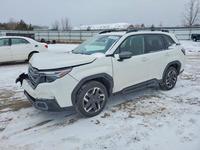
About the Subaru Forester
Frame rust is the hidden threat on used Subaru Foresters, particularly units originating from the Pacific Northwest and Northeast where the model dominates compact SUV sales. Since 1998, the Forester has built a reputation for longevity that keeps owners holding on through harsh winters, but VIN checks frequently reveal the structural toll of salt, ice, and high-mileage loyalty.
A VIN number lookup on this Subaru Forester includes real high-resolution auction photos sourced directly from Copart and IAAI, the largest salvage auction operators in the United States.
Subaru Forester Model Generations
What a Subaru Forester VIN Check Reveals
A VIN number check on any Subaru Forester pulls records from state DMV offices, NHTSA databases, insurance industry filings, and salvage auction records across all 50 states. The report covers the following data categories:
- Accident and collision history
- Full odometer timeline
- Open safety recalls from NHTSA
- Title brands (salvage, flood, lemon law, total loss)
- Theft and recovery records
- Lien and ownership history
- Structural and frame damage
- Airbag deployment records
- State inspection history
- Prior vehicle use (fleet, rental, taxi, auction)
Subaru Forester VIN Number Location
Where to find the VIN on a Forester
Before purchasing a used Forester, locate the VIN at the lower driver's side windshield and compare it to the door jamb sticker and B-pillar label. Forester is popular with outdoor and off-road buyers, and VIN histories commonly surface undisclosed roll damage or roof damage from vehicle tipping on unpaved terrain. The cargo area sticker near the rear hatch is also present on most model years.
The VIN also appears on the vehicle registration, insurance documents, and title. All locations should match. A mismatch between VIN plates is a potential indicator of a rebuilt or salvage vehicle.
Common Issues Found in VIN Reports for the Subaru Forester
VIN history reports on used Subaru Forester vehicles frequently show accident and collision claims, title discrepancies, and odometer irregularities. Any open NHTSA recall notices tied to the specific VIN will appear in the report, along with the recall completion status where that data is available.
Subaru vehicles carrying a VIN prefix of 4S3, 4S4, JF1, JF2 are traceable through all 50 state DMV systems and the National Motor Vehicle Title Information System (NMVTIS). Coverage for vehicles registered after 1990 is generally comprehensive.
NHTSA Safety Recalls
Subaru Forester — last 3 model years
What Forester owners report across recent generations
2019–2024 (5th generation, SK)
Cracked windshields lead NHTSA complaints for the 2019, as on other recent Subarus. CarComplaints ranks the thermo control valve assembly first for 2019, followed by a battery that keeps dying and a windshield that chips easily. Recalls on 2019 models cover a power steering connector that can short circuit and cut assist, and a PCV valve that can come apart and enter the engine, causing a loss of power, plus rear stabilizer bracket bolts on some 2019 models. [1] [2]
2014–2018 (4th generation, SJ)
Oil consumption is the notable complaint on the 2015. NHTSA owners describe the oil light coming on well before the next change, sometimes with hesitation, and CarComplaints criticizes Subaru for treating about a quart every 1,000 miles as normal. Air bag reports are also common, and a recall covers 2015–2018 models with heated seats whose passenger occupant detection connection may loosen. [3] [4]
2009–2013 (3rd generation, SH)
Seats are the largest NHTSA complaint category for the 2010, with owners describing the driver seat bracket separating from the frame at its tack welds and the seat dropping, in one case at freeway speed. CarComplaints ranks excessive oil consumption first for 2011, followed by unintended acceleration and a burning oil smell. Recalls cover front passenger air bag inflators on this generation. [5] [6]
What to check before buying
Run the VIN through the NHTSA recall lookup, including the passenger air bag inflator recalls on 2009–2013 models, the occupant detection recall on 2015–2018 models and the steering and PCV valve recalls on 2019 models. Ask for oil consumption test records and battery replacements. Check the windshield for cracks and the driver seat for looseness. On the drive, watch for hesitation and any steering assist warning.
- NHTSA recalls and owner complaints, 2019 Subaru Forester
- CarComplaints.com, 2019 Subaru Forester problems
- NHTSA recalls and owner complaints, 2015 Subaru Forester
- CarComplaints.com, 2015 Subaru Forester problems
- NHTSA recalls and owner complaints, 2010 Subaru Forester
- CarComplaints.com, 2011 Subaru Forester problems
Updated September 25, 2026 · Summarized in our own words by VinNumber.net from public owner reports; individual experiences vary.