
About Chevrolet VINs
How Chevrolet VINs are built
Chevrolet is General Motors' primary passenger and truck brand sold in the United States. VIN numbers on Chevrolet vehicles begin with 1G1 for passenger cars and 2G1 for Canadian-assembled models. Silverado trucks carry a 1GC prefix. A free VIN decode on any Chevrolet shows its factory specs, assembly plant and engine, plus any open NHTSA recalls.
The first three characters identify the maker and the country of assembly. In NHTSA's vPIC, US-built Chevrolets start with 1G: 1GC for trucks and vans such as the Silverado (Fort Wayne, Flint), Colorado and Express (Wentzville), 1GN for SUVs such as the Tahoe and Suburban (Arlington) and Traverse (Lansing), and 1G1 for cars such as the Malibu, Camaro, Corvette and Bolt. Canadian builds start with 2G (Oshawa, Ingersoll), Mexican builds with 3G (Silao, Ramos Arizpe) and Korean builds such as the Trax with KL. The 11th character and the full decode confirm the plant.
Chevrolet vehicles manufactured for the US market carry VIN prefixes of 1G1 (cars US), 1GC (trucks US), 1GN (SUVs US); 2G1, 2GC, 2GN (Canada); 3G1 (Mexico); KL8 (South Korea). The VIN number encodes the country of manufacture (USA), production plant, vehicle line, body style, engine type, model year, and a unique production sequence number.
Sources: Founding, GM: Chevrolet history (GM) · Sales: GM Q4 2025 US deliveries, GM full-year 2025 sales release
NHTSA campaign data
Which model years each recall covers
Drag the year line to your car’s model year. Bars it crosses are the campaigns to confirm on the VIN.
Coverage depends on build dates and equipment (engine, drivetrain, cab, options). A listed year doesn't mean every vehicle from that year is included; the VIN lookup decides. "Takata" marks campaigns NHTSA files under its Takata inflator investigation (EA15-001). "Do not drive" and "Park outside" mean NHTSA's recall record carries that advisory. Silverado means the 1500; Silverado HD covers the 2500 and 3500. Many campaigns also cover the GMC Sierra, Yukon, Terrain or Acadia, Buick or Cadillac models; check those makes separately. Silverado medium-duty (4500–6500) trucks are not included.
Chevrolet Recalls: How to Check a Specific VIN
- Enter the full 17-character VIN in the NHTSA recall lookup. It shows open safety recalls, including the do-not-drive and park-outside campaigns above.
- Then use GM's recall lookup and ask a Chevrolet dealer to check for open special coverage programs, which are not safety recalls.
- For a 2005–2014 car, look at the keys: the ignition switch and key ring recalls changed the switch, the key or the key ring.
- If a do-not-drive or park-outside recall is open, follow it until the repair is done. Recall repairs are free at Chevrolet dealers.
Full list: every campaign in this timeline
| Campaign | Issue | Models & years |
|---|---|---|
| 26V-289 | Do Not Drive Transfer case may lock the front or rear wheels | 2015–2020 Tahoe, 2015–2020 Suburban, 2026 Silverado. May 2026, about 66 vehicles: certain 2015–2020 Tahoe and Suburban (and Cadillac and GMC SUVs) and 2026 4WD/AWD Silverado 1500, Tahoe and Suburban. Dealers inspect and, if needed, replace the transfer case. NHTSA's record tells owners not to drive the vehicle until it is repaired. |
| 16V-256 | Do Not Drive Front upper control arm welds may be inadequate | 2016–2017 Silverado, 2016 Tahoe, 2016 Suburban. About 3,700 vehicles (April 2016). The arm can separate from the bushing and affect steering. Dealers replace both front upper control arms. NHTSA's record tells owners not to drive the vehicle until it is repaired. |
| 14V-246 | Do Not Drive Inner tie rod may not be tightened; steering can separate | 2014 Silverado, 2015 Tahoe. About 480 vehicles built in 2013–2014. Dealers check the tie rod torque and replace the steering gear if needed. NHTSA's record tells owners not to drive the vehicle until it is repaired. |
| 20V-701 · 21V-560 · 21V-650 · 24V-481 · 24V-812 | Park outside Bolt high-voltage battery may catch fire | 2017–2022 Bolt EV / EUV. Every 2017–2022 Bolt EV and 2022 Bolt EUV. 21V-560 and 21V-650 replace defective battery modules; 24V-481 and 24V-812 cover cars whose diagnostic software was installed incorrectly or failed to install. Until repaired, NHTSA's record also tells owners to limit charging to 90% and avoid depleting the battery. NHTSA's record tells owners to park outside, away from structures, until it is repaired. |
| 21V-189 | Park outside Express 6.6L battery cable may short against the fuse block | 2021 Express. 2021 Express and GMC Savana with the 6.6L gas engine. NHTSA's record tells owners to park outside, away from structures, until it is repaired. |
| 14V-047 · 14V-171 | Ignition switch may slip out of Run, disabling the air bags | 2005–2011 Cobalt / HHR. The 2014 ignition switch recall: 2005–2010 Cobalt and 2006–2011 HHR (with Pontiac and Saturn models). A heavy key ring or a bump can turn the key out of Run, shutting off the engine and the air bags. 14V-171 also replaces ignition cylinders that let the key come out when not in Off. |
| 14V-400 · 14V-355 | Key can be knocked out of Run; key ring and key slot fix | 2000–2014 Impala, 2000–2005 Malibu. 14V-400 (about 5.9 million GM vehicles): 2000–2005 Impala, 2000–2003 Malibu, 2004–2005 Malibu Classic and Monte Carlo. 14V-355: 2006–2014 Impala and 2006–2007 Monte Carlo. Dealers fit two key rings and a key slot insert or cover. |
| 14V-346 | Driver's knee can knock the flip key out of Run | 2010–2014 Camaro. All 2010–2014 Camaros built through May 2014 (about 465,000 vehicles). Dealers remove the key blade from the fob and supply separate keys. |
| 21V-050 · 21V-051 · 21V-052 · 21V-053 · 21V-054 | Takata passenger inflator may rupture: GMT900 trucks and SUVs | 2007–2013 Silverado, 2009–2014 Silverado HD, 2007–2014 Tahoe, 2007–2014 Suburban. February 2021, about 5.9 million GM trucks and SUVs across the five campaigns, including the Avalanche. NHTSA denied GM's petition to exclude them. No do-not-drive advisory, but the risk is the same kind of inflator rupture. Phased by region, starting with trucks ever registered in hot, humid states. Filed under NHTSA's Takata inflator investigation (EA15-001). |
| 15V-324 · 20V-011 | Takata passenger inflator may rupture: 2007–2008 Silverado HD | 2007–2008 Silverado HD. 2500HD and 3500HD built November 2006 to August 2008. 20V-011 replaces non-desiccated interim inflators fitted under earlier repairs. Filed under NHTSA's Takata inflator investigation (EA15-001). |
| 21V-782 · 22V-246 · 23V-334 | Driver air bag inflator may explode (ARC) | 2013–2017 Traverse. 23V-334 (May 2023, about 995,000 GM SUVs) covers 2014–2017 Traverse; 21V-782 and 22V-246 cover smaller 2013–2017 groups. Filed after NHTSA's investigation of ARC-made inflators (EA16-003). |
| 20V-736 · 21V-504 · 24V-756 · 25V-432 · 26V-166 · 26V-325 · 26V-611 | Roof-rail air bag inflator end cap may detach | 2015–2018 Silverado, 2015–2019 Silverado HD. A series of small campaigns from 2020 to September 2026. Dealers replace both roof-rail air bag modules. 26V-611 (2016–2017) letters are due in November 2026. |
| 23V-674 · 23V-870 · 25V-764 | Roof-rail air bag inflator may rupture | 2014 Cruze. 2014 Cruze and Buick Verano. Metal fragments can enter the cabin. Dealers replace the roof-rail modules. |
| 25V-274 | 6.2L V8 connecting rod or crankshaft defect may cause engine failure | 2021–2024 Silverado, 2021–2024 Tahoe, 2021–2024 Suburban. April 2025, about 597,000 vehicles with the 6.2L gas V8, including GMC and Cadillac models. Dealers inspect the engine and repair or replace it; engines that pass get higher-viscosity oil and related updates. |
| 19V-645 | Brake vacuum pump output may drop over time | 2014–2018 Silverado, 2015–2018 Tahoe, 2015–2018 Suburban. About 3.5 million GM trucks and SUVs (September 2019). Dealers reprogram the brake control module to use the ABS pump for assist. |
| 17V-414 · 18V-586 | Electric power steering assist may cut out and return suddenly | 2014–2015 Silverado, 2015 Tahoe, 2015 Suburban. 17V-414: 2014 Silverado 1500. 18V-586: 2015 Silverado 1500, Tahoe and Suburban. Software update. |
| 19V-761 | Failed wheel-speed sensor may trigger unwanted braking | 2014–2018 Silverado, 2015–2020 Tahoe, 2015–2020 Suburban. 5.3L, 4WD, 3.08 axle (about 653,000 vehicles). The vehicle can pull to one side at 41–60 mph. Brake module reprogramming. |
| 19V-889 · 20V-055 | Brake software error may disable stability control, ABS or brake assist | 2019 Silverado. 19V-889 (about 464,000 vehicles) can disable ESC and ABS without a warning light. 20V-055 fixes software from an earlier update that could disable electronic brake assist. Brake module reprogramming. |
| 19V-814 | Seat belt pretensioner gas may ignite the carpet | 2019–2020 Silverado, 2020 Silverado HD. About 556,000 trucks with carpet flooring. Only a risk when the pretensioners deploy in a crash. Fire risk. |
| 24V-797 | Diesel transmission valve may lock the rear wheels | 2020–2022 Silverado, 2020–2022 Silverado HD, 2021 Tahoe, 2021 Suburban. About 463,000 diesel GM trucks and SUVs (October 2024). New transmission software, plus a GM special coverage for related transmission repairs. |
| 19V-328 · 21V-496 | Duramax engine block heater cord may short circuit | 2017–2019 Silverado HD. 6.6L Duramax with the optional block heater. 21V-496 replaces heaters and cords that were only disabled under the first remedy. Fire risk. |
| 24V-060 | Power tailgate switch may short and unlatch while driving | 2020–2024 Silverado HD. 2500 and 3500 with the power-release tailgate. Water can short the touchpad switch. |
| 14V-152 | Transmission oil cooler line may leak onto hot parts | 2014 Silverado, 2015 Tahoe, 2015 Suburban. Six-speed automatic trucks and SUVs. Dealers inspect and reseat the line. Fire risk. |
| 14V-007 | Exhaust parts may overheat during extended idling | 2014 Silverado, 2015 Silverado HD. 4.3L and 5.3L 2014 Silverado 1500 and 2015 HD models. Engine control software update. Fire risk. |
| 22V-617 | Third-row seat belt buckle rivet may be malformed | 2021–2022 Tahoe, 2021–2022 Suburban. Dealers inspect both third-row buckles and replace them as needed. |
| 14V-252 | Body control module connector corrosion may cause electrical failures | 2004–2012 Malibu. About 2.4 million GM cars (May 2014), including the Malibu Maxx. Failures include brake lights that stay off or on, cruise control and traction control faults, and a car that can be shifted out of Park without pressing the brake. |
| 14V-153 · 10V-073 | Sudden loss of electric power steering assist | 2004–2009 Malibu, 2005–2010 Cobalt / HHR. 14V-153 (about 1.4 million GM cars): 2004–2006 and 2008–2009 Malibu, 2004–2006 Malibu Maxx, 2009–2010 HHR and 2010 Cobalt. 10V-073: 2005–2010 Cobalt, replacing the steering motor. |
| 14V-224 · 12V-460 | Transmission shift cable may break; gear may not match the shifter | 2004–2010 Malibu. 14V-224: 2004–2008 Malibu and 2004–2007 Malibu Maxx (about 1.1 million vehicles). 12V-460: 2008–2010 Malibu with the 4-speed automatic. The car can roll away even with the shifter in Park. |
| 20V-764 | Rear toe link may fracture in road-salt states | 2013 Malibu. Only cars sold or ever registered in 20 salt-belt states and DC. Dealers replace the rear toe links. |
| 26V-212 | Rear camera image may be distorted or blank | 2023–2025 Malibu. Owner letters mailed May 2026. Dealers inspect and replace the camera if needed. |
| 09V-116 · 15V-201 · 15V-701 | 3.8L V6 oil may drip onto the exhaust manifold and ignite | 2000–2004 Impala. Impala and Monte Carlo with the naturally aspirated 3.8L V6. 15V-701 (October 2015) applies an improved remedy because the earlier repairs did not fully remove the risk. Fire risk. |
| 16V-582 · 22V-165 | Windshield wiper ball joints may corrode | 2013–2015 Equinox. 16V-582: 2013 Equinox and GMC Terrain. 22V-165: 2014–2015. One or both wipers can stop working. |
| 23V-339 | Excess coating may block child seat LATCH anchors | 2020–2023 Equinox. Fails FMVSS 225. Until repaired, use the seat belt to install a child seat. |
| 12V-288 | Spilled oil may collect in the engine shield and ignite | 2011–2012 Cruze. About 413,000 cars built October 2009 to May 2012. Dealers modify the engine shield. Fire risk. |
| 13V-360 | Brake vacuum pump may stop, reducing brake assist | 2011–2012 Cruze. 1.4L turbo with the 6-speed automatic. Dealers replace a switch in the vacuum pipe. |
| 18V-304 | Fuel may leak after a rear crash | 2016–2018 Cruze. Cruze LS with a tire inflator kit instead of a spare (FMVSS 301). Dealers fit a lock ring that shields the fuel tank sensor. Fire risk. |
| 14V-118 | Side air bag and pretensioner wiring may fail; air bag light | 2009–2013 Traverse. Front seat side air bags and pretensioners may not deploy. Dealers solder the harness connections. |
| 14V-266 | Front lap belt pretensioner cable may separate | 2009–2014 Traverse. Built June 2008 to May 2014, with Buick Enclave and GMC Acadia. |
| 15V-415 | Power liftgate may fall unexpectedly | 2009–2012 Traverse. The gas struts can weaken and the liftgate can close quickly. Software update to the liftgate motor. |
| 26V-539 | Rear camera image may be distorted or blank | 2024–2026 Trax / Trailblazer. 2025 Trax and 2024–2026 Trailblazer, with Buick Envista and Encore GX. Owner letters mailed September 2026. |
Ignition and keys
The 2014 ignition switch and key recalls
In 2014 GM recalled millions of cars because the key could move out of Run while driving, shutting off the engine, power steering, power brakes and air bags. Most of the Chevrolets involved are now 12 to 26 years old, so many sit on used lots.
Cobalt and HHR
14V-047 replaces the ignition switch on 2005–2010 Cobalt and 2006–2011 HHR; 14V-171 replaces the ignition cylinder so the key can't come out unless it is in Off.
Impala, Malibu and Monte Carlo
14V-400 (2000–2005) and 14V-355 (2006–2014 Impala) add two key rings and a key slot insert or cover so the key is less likely to be knocked out of Run.
Camaro
14V-346: on 2010–2014 Camaros the driver's knee can hit the flip key. Dealers remove the blade from the fob and supply a separate key.
What to do
Until the repair is done, carry only the ignition key on the ring. Ask for the dealer invoice: a closed campaign on the VIN lookup is the real proof.
Sources: NHTSA recall records · GM recall lookup
About Chevrolet
Chevrolet's story is one of fierce competition and a deeply ingrained blue-collar identity. Its enduring rivalry with Ford has spanned decades, capturing the imagination and loyalty of American auto enthusiasts. From city streets to rural landscapes, Chevrolet has been a steadfast part of American life and culture, representing both innovation and the hard-working spirit of America.
Two Men, One Brand
The Chevrolet Motor Car Company was founded in 1911 by Swiss race car driver Louis Chevrolet and automotive pioneer William C. Durant. Durant, co-founder of General Motors, had been ousted from GM and was looking for a way back into the industry. Aligning with Chevrolet, he aimed to create an automobile that could compete with the dominant Ford Model T. Their collaboration resulted in the creation of a car that combined performance, style, and affordability. This formula would become central to Chevrolet's identity over the years.
One of Chevrolet's most enduring symbols is its iconic bowtie logo. The origins of the logo are shrouded in mystery, with several stories about its creation. Some say Durant saw the pattern in a French hotel wallpaper, while others claim it was inspired by a coal company's advertisement in a newspaper. Regardless of its origin, the bowtie has become synonymous with Chevrolet, representing its commitment to quality and innovation.
The Corvette and the Muscle Era
Chevrolet's early years were marked by its racing heritage, a passion that translated into some of the most iconic cars in American history. In 1953, Chevrolet unveiled the Corvette, a car that would become a symbol of American performance. Originally intended as a concept car, the Corvette's positive reception led to its production. It was sleek, sporty, and unlike anything else on the road. Over the years, the Corvette would evolve, but it always retained its reputation as an American icon, combining cutting-edge technology with timeless design.
The late 1960s saw the birth of another Chevrolet legend: the Camaro. Introduced in 1966 for the 1967 model year, the Camaro was Chevrolet's answer to Ford's Mustang. This sparked the legendary "pony car" wars, with each brand pushing the limits of performance and style. This rivalry produced some of the most revered muscle cars in automotive history and solidified Chevrolet's place in the hearts of car enthusiasts everywhere.
Pickup Wars
Chevrolet has long been a dominant force in the pickup truck market. The battle between the Chevrolet Silverado and the Ford F-150 is one of the most enduring rivalries in automotive history. Both have loyal followings and have been the backbone of work and play for millions of Americans. The Silverado is known for its durability, capability, and innovation, making it a favorite among those who need a reliable workhorse. Over the years, the Silverado has evolved to meet changing consumer demands while maintaining its rugged, no-nonsense reputation.
Another staple in Chevrolet's lineup is the Suburban, often hailed as America's family vehicle. Introduced in 1935, the Suburban is the longest-running nameplate in automotive history. Its spacious interior and towing capability have made it a favorite among families and outdoor enthusiasts. The Suburban represents the essence of Chevrolet's ability to adapt to the needs of American families, offering comfort and utility in equal measure.
The Impala also holds a special place in American culture. First introduced in 1958, the Impala became one of Chevrolet's most successful models. Known for its distinctive style and spacious interior, it quickly became a favorite among families and enthusiasts alike. The Impala's presence in music, film, and popular culture has cemented its status as more than just a car; it's a cultural icon.
The Bailout and the Bounce Back
The late 2000s were challenging times for Chevrolet. The global financial crisis hit the auto industry hard, leading to the near-collapse of many manufacturers. In 2009, General Motors, Chevrolet's parent company, filed for bankruptcy and required a significant government bailout to stay afloat. This period was marked by restructuring and refocusing on key brands and models.
Chevrolet emerged from this period stronger, revitalizing its lineup and focusing on innovation and quality. The introduction of models like the Chevrolet Volt, an electric plug-in hybrid, showcased the brand's commitment to sustainability and forward-thinking design. New generations of the Silverado and Corvette continued to push the envelope in terms of performance and technology, helping Chevrolet regain its footing in the highly competitive automotive market.
Why VIN History Matters for Chevrolet Buyers
For those in the market for a Chevrolet, understanding the vehicle's history is key to making an informed purchase. This is particularly true for models like the Silverado, which are often used for heavy-duty tasks and might have experienced significant wear and tear over the years. Similarly, aging Suburbans and Tahoes, popular in the used market for their spaciousness and versatility, may have hidden histories that could affect their longevity and performance.
By examining a vehicle's VIN history, buyers can uncover vital information about previous ownership, accident history, mileage discrepancies, and maintenance records. This knowledge not only provides peace of mind but also ensures that buyers are investing in a vehicle that meets their expectations and needs.
Chevrolet's storied past, marked by innovation, rivalry, and resilience, continues to shape its future. As it adapts to the ever-evolving automotive landscape, Chevrolet remains a beloved and iconic brand, deeply rooted in American culture and tradition.
Used-car checklist
What to Verify on a Used Chevrolet
Six checks specific to used Chevrolets.
Ignition and keys
2005–2011 Cobalt and HHR: 14V-047/14V-171. 2000–2014 Impala and 2000–2005 Malibu: 14V-400/14V-355. 2010–2014 Camaro: 14V-346. See the ignition section.
Air bags
2007–2014 Silverado, Tahoe and Suburban: Takata passenger inflators 21V-050 to 21V-054. 2013–2017 Traverse: driver inflator 23V-334. 2015–2019 Silverado: roof-rail air bags such as 24V-756 and 26V-611.
Bolt EV battery
Every 2017–2022 Bolt EV and 2022 Bolt EUV was recalled for battery fire risk (21V-560, 21V-650). Also confirm diagnostic software recalls 24V-481 and 24V-812.
Full-size trucks and SUVs
2021–2024 6.2L V8: engine 25V-274. 2014–2018: brake vacuum 19V-645. 2019 Silverado: brake software 19V-889/20V-055. 2020–2022 diesel: transmission 24V-797. Transfer case 26V-289 (do not drive).
Fire-risk recalls
2000–2004 Impala 3.8L: 15V-701. 2011–2012 Cruze: 12V-288. 2021 Express 6.6L: 21V-189 (park outside). 2017–2019 Silverado HD Duramax block heater: 21V-496. 2019–2020 Silverado: 19V-814.
Equinox 2.4L oil use
2010–2013 Equinox 2.4L: ask whether the piston rings were replaced under GM bulletin 13-06-01-003 or special coverage 14159A / N192291100. The extended coverage has expired, so check the oil level and service records.
World Manufacturer Identifier
Chevrolet VIN prefixes (WMI)
Prefix registrations and example decodes come from NHTSA's vPIC database. The prefix tells you the maker and country; the 11th character and the full decode tell you the plant.
A 2019 Silverado 1500 decodes to Fort Wayne, Indiana; a Silverado HD to Flint, Michigan; a Colorado and an Express van to Wentzville, Missouri.
Silverados built in Silao, Guanajuato decode as 3GC.
Malibu: Kansas City (Fairfax). Camaro: Lansing Grand River. Corvette: Bowling Green. Cruze and Cobalt: Lordstown. Bolt: Lake Orion.
Tahoe and Suburban decode to Arlington, Texas; Traverse to Lansing Delta Township, Michigan.
A 2013 Camaro and a 2017 Impala (2G1) decode to Oshawa, Ontario; an Equinox (2GN) to CAMI in Ingersoll, Ontario.
Equinox and Blazer models from Ramos Arizpe, Coahuila.
A 2024 Trax (KL7) and the Spark (KL8) decode to Changwon, South Korea.
Worked example
Worked example: reading a Chevrolet VIN
Example VIN (demo only, not a real vehicle): 1GCUYDED4KZ000000
K = 2019 (federal year-code table)Buyer notes by model
Top Chevrolet Models: What to Check
Open a model for the checks that matter most.
Chevrolet Silverado
2007–2013 (HD 2007–2014): Takata passenger 21V-050–21V-054, HD 15V-324/20V-011. 2014–2018: brake vacuum 19V-645, EPS 17V-414/18V-586, 2014 tie rod 14V-246 (do not drive). 2015–2019: roof-rail air bags. 2016–2017: control arms 16V-256 (do not drive). 2019: brake software 19V-889. 2021–2024 6.2L: 25V-274. HD: Duramax heater 21V-496, tailgate 24V-060.
Chevrolet Silverado VIN check and model history → · Colorado →
Chevrolet Tahoe and Suburban
Chevrolet Equinox
Chevrolet Malibu
Chevrolet Traverse
Impala, Camaro, Cruze, Cobalt and Bolt
Impala: key ring 14V-400/14V-355, 2000–2004 3.8L oil fire 15V-701. Camaro 2010–2014: flip key 14V-346. Cruze: 2011–2012 engine shield 12V-288, 2014 roof-rail air bags, 2016–2018 LS fuel leak 18V-304. Cobalt/HHR: ignition switch 14V-047. Bolt EV/EUV: battery 21V-650 (park outside).
Impala → · Camaro → · Corvette → · Trax → · Trailblazer →
FAQ
Common questions about Chevrolet VINs
What VIN prefix do Chevrolet vehicles use?
Chevrolet vehicles assembled in the United States typically carry VINs beginning with 1G1, 1GC or 1GN depending on the model line. Cars start with 1G1, pickup trucks with 1GC, and SUVs often with 1GN. Canadian assembly plants use 2G prefixes. Chevrolet models assembled in Mexico, South Korea, or other countries carry different first-character codes reflecting their country of manufacture.
What problems show up most often in Chevrolet VIN reports?
Chevrolet VIN history reports commonly flag airbag-related recall completions on older Cruze and Malibu models, along with a notable rate of collision claims on Silverado trucks. Equinox and Traverse SUVs from the 2010-2015 period show elevated engine and transmission claims. Corvettes that have passed through track use often carry inspection history anomalies. Silverados registered in northern states show a higher rate of undercarriage rust documentation.
How many Chevrolet vehicles are sold in the US each year?
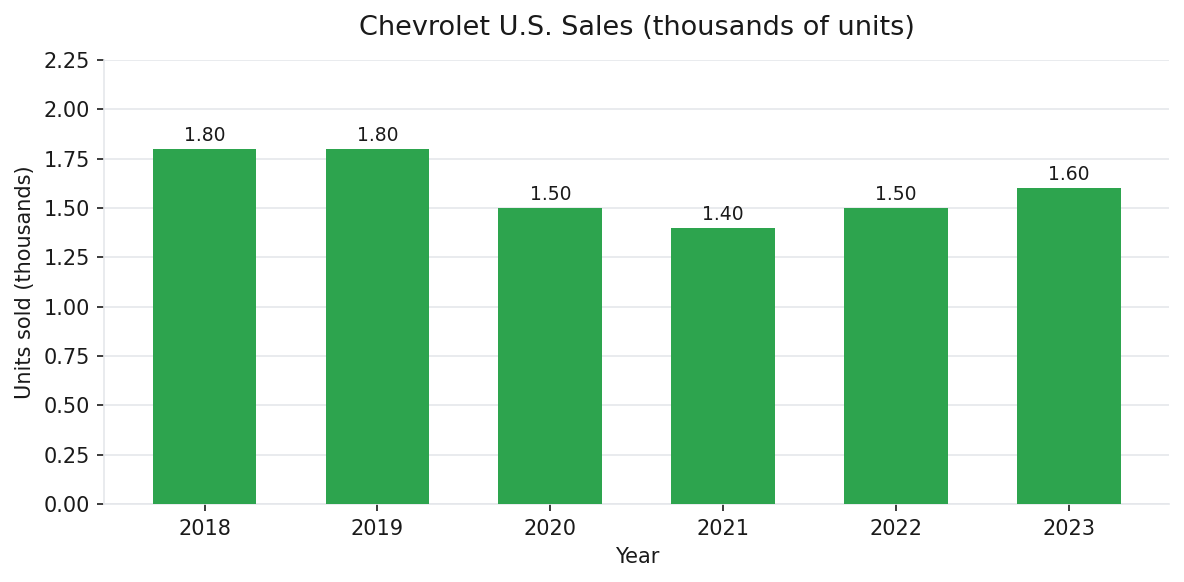
Chevrolet sold 1,829,235 vehicles in the United States in 2025, making it the third or fourth best-selling brand in most years depending on market conditions. The Silverado pickup is consistently the brand's top seller (588,709 in 2025, counting light-, heavy- and medium-duty and EV versions) and ranks second among US vehicle lines behind the Ford F-Series. The Equinox is Chevrolet's best-selling SUV, regularly ranking in the top five of its segment.
Where is the VIN located on a Chevrolet vehicle?
The VIN on Chevrolet vehicles appears on a metal plate at the base of the driver side windshield, visible from outside the car. Additional locations include the door jamb sticker on the driver side, the engine block, and the firewall in the engine compartment. On Silverado and Colorado trucks, the VIN is also stamped on the frame. Insurance documents, the title, and the registration certificate all carry the same VIN and should match the plate exactly.
Which Chevrolet models have the most documented recall history?
The Chevrolet Silverado carries the highest recall count in the Chevrolet lineup (about 140 NHTSA campaigns since the 2000 model year), followed by the Express van, Tahoe, Suburban and Malibu, due to their high production volumes and long model runs. The Cruze was subject to a significant airbag inflator recall covering multiple model years. Older Impalas and Monte Carlos have numerous historical campaigns tied to seatbelt and fuel system issues. Second-generation (2010–2017) Equinox campaigns center on windshield wiper module corrosion (16V-582, 22V-165) rather than the powertrain; its 2.4L engine oil consumption was handled through GM special coverage, not a recall.
Which Chevrolets are in the GM ignition switch recall?
The 2014 ignition switch recall 14V-047 covers the 2005–2010 Chevrolet Cobalt and 2006–2011 HHR (with Pontiac and Saturn models), and 14V-171 replaces their ignition cylinders. Related key recalls cover the 2000–2005 Impala, 2000–2003 Malibu, 2004–2005 Malibu Classic and Monte Carlo (14V-400), the 2006–2014 Impala (14V-355) and the 2010–2014 Camaro (14V-346). In all of them the key can move out of Run while driving, which can shut off the engine and keep the air bags from deploying. Until the repair is done, carry only the ignition key on the ring.
Should a used Chevy Bolt be parked outside?
Only if its battery recall is still open. Every 2017–2022 Bolt EV and 2022 Bolt EUV was recalled because the high-voltage battery could catch fire when charged to full or nearly full (20V-701, 21V-560 and 21V-650). Until the repair is done, NHTSA's records tell owners to park outside and away from structures, limit charging to 90% and avoid running the battery very low. Recalls 24V-481 and 24V-812 cover cars whose diagnostic software was installed incorrectly or failed to install, so confirm those are closed too.
Are older Silverado, Tahoe and Suburban trucks in the Takata air bag recall?
Yes. In 2021, after NHTSA denied GM's petition to exclude them, GM recalled about 5.9 million trucks and SUVs with Takata passenger inflators (21V-050 to 21V-054), including the 2007–2013 Silverado 1500, 2009–2014 Silverado 2500 and 3500, 2007–2014 Tahoe and Suburban, and the Avalanche. The 2007–2008 Silverado HD has separate campaigns (15V-324 and 20V-011). These recalls do not carry a do-not-drive advisory, but the inflator can rupture in a crash, so confirm the campaign for the VIN is closed.
What is the Chevrolet 6.2L V8 engine recall?
Recall 25V-274 (April 2025, about 597,000 vehicles) covers 2021–2024 Silverado 1500, Tahoe and Suburban models with the 6.2L L87 gas V8, along with GMC and Cadillac models. Connecting rod or crankshaft manufacturing defects can cause engine failure. Dealers inspect the engine and repair or replace it as needed; engines that pass inspection get higher-viscosity oil and related updates. When buying one of these trucks, ask for the inspection result and any engine replacement record.